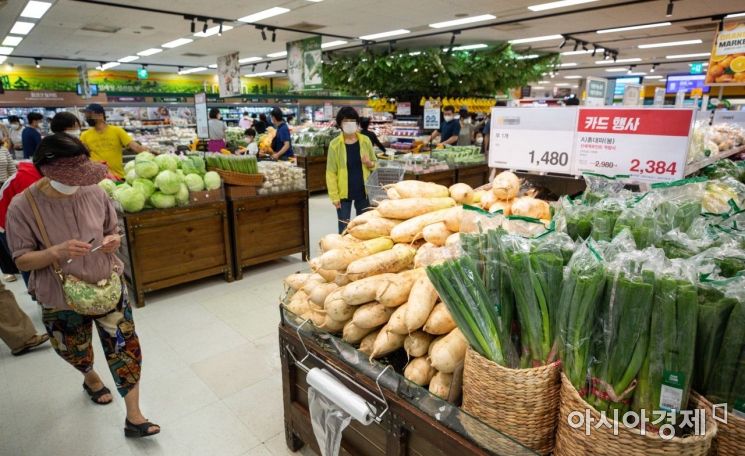
 Citizens shopping at a large supermarket in Seoul on the 6th amid growing concerns over rising grocery prices due to instability in the supply and demand of agricultural and livestock products. Photo by Jinhyung Kang aymsdream@
[Asia Economy Reporter Seungjin Lee] The prices of major food ingredients are rising one after another, increasing the burden on grocery prices. Due to the ongoing impact of highly pathogenic avian influenza (AI), egg prices have not stabilized for half a year, and prices of key food ingredients such as rice and garlic remain at record highs.
According to the Korea Agro-Fisheries & Food Trade Corporation (aT) on the 27th, the retail price of 20kg of rice was 61,375 won, which is 18.6% higher than the previous year. Rice prices have been rising in the double digits for six consecutive months since December last year. This is due to reduced sunlight hours and increased rainfall caused by last year's longest rainy season and typhoons, resulting in poor crop yields and decreased rice production.
This has pushed up the prices of foods primarily made from rice. The price of commercial Makgeolli sold in supermarkets rose 14.9% compared to a year ago. This is the largest increase in 22 years and 4 months since January 1999 (17.0%). The price of Makgeolli served in restaurants also increased by 2.1%, the highest rise since February last year (2.4%).
The increase in rice cake prices is also growing. It recorded a 1.9% increase year-on-year in February, followed by 2.8% in March, 4.0% in April, and 4.7% last month. Instant foods, including ready-to-eat rice, also continued to rise, increasing by 3.2% last month.
Prices of essential Korean food ingredients such as garlic and red pepper powder remain at record high levels. The retail price of garlic per 1kg was 11,401 won, 62% more expensive than the previous year. Although the price slightly dropped by 2% compared to a month ago, it still remains high.
The retail price of 1kg of red pepper powder was 37,785 won, 44.8% higher than the previous year. Since the stock of red pepper powder is low and the government’s reserve release has ended, prices are expected to rise further.
The impact of AI continues to cause 'golden eggs.' The retail price of a special egg carton (30 eggs) was 7,547 won, slightly up 1.1% from the previous month despite the end of AI spread. Compared to the previous year, the price is 47.3% higher.
Egg prices are expected to remain unstable in the second half of the year. Due to AI, 16.7 million laying hens, accounting for 23% of the total, were culled by April this year. Since it takes six months for chicks to grow into laying hens, it will take at least until October this year to recover to pre-culling levels. The problem is the mortality caused by summer heatwaves and the possibility of AI resurgence from November.
In response, the Ministry of Economy and Finance has approved the 'Amendment to the Tariff Rate Quota Regulation' to reduce the tariff rate applied to egg imports to 0% until the end of this year. Tariff rate quotas refer to temporarily applying a lower tariff rate than the basic tariff rate to a certain quantity to stabilize domestic prices.
Since egg prices have been high since early this year, the Ministry of Economy and Finance will extend the egg tariff rate quota (0%) scheduled to end in late June until the end of the year. Accordingly, eight egg-related items totaling 36,000 tons can be imported duty-free until the end of this year.
© The Asia Business Daily(www.asiae.co.kr). All rights reserved.

















