Achieved No.1 Global Market Share in Secondary Battery Industry After 10 Years
Entered Electric Vehicle Battery Business in 2005
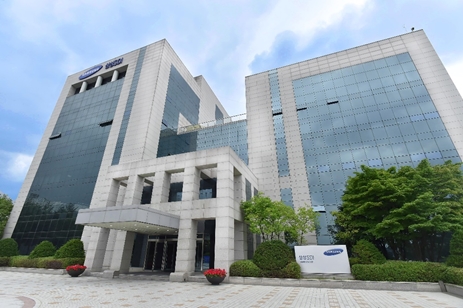
[Asia Economy Reporter Hwang Yoon-joo] July 1 marks the 51st anniversary of Samsung SDI's founding. The term that has been attached to Samsung SDI since its establishment is 'innovation.' It has produced numerous number-one products, from color cathode ray tubes, mobile LCDs, PDPs, small batteries, OLED materials, to ESS batteries. Samsung SDI, which has led the Korean electronics industry, is now making another leap forward as an eco-friendly energy company.
Samsung SDI, which has written the history of Korea's electronics industry... focuses on batteries
Samsung SDI was founded in 1970 under the name 'Samsung-NEC Corporation.' Its main products were electronic components such as vacuum tubes and cathode ray tubes. In the 1980s, it expanded its business by officially starting the color cathode ray tube and monitor business. The 1990s were a period when Samsung SDI continuously conducted research and development, writing the history of the display industry and emerging as a global company. In November 1999, the company changed its name to 'Samsung SDI' as it shifted its business structure from focusing on cathode ray tubes to future-oriented advanced industries.
Samsung SDI sought change again in 2009. To focus on the battery business, it transferred AMOLED-related business and personnel to the newly launched Samsung Mobile Display (Samsung Display), wound down the PDP business in 2014, and merged with the materials division of Cheil Industries at the time, transforming into a global battery and materials company.
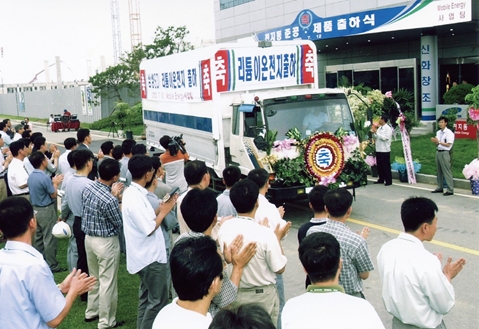
The battery business, which has now become Samsung SDI's mainstay, was actively commercialized starting in 1994. In 1999, it held a groundbreaking ceremony for a secondary battery factory in Cheonan and began mass-producing batteries in 2000. Although a latecomer in the battery business, Samsung SDI quickly stood out in the market by introducing high-capacity products one after another. Compared to industry products that mainly had 1600mAh capacity, Samsung SDI launched its first product, a cylindrical battery with 2000mAh capacity, which was 25% stronger. Subsequently, it gained attention by being the first to develop batteries with capacity increased by 200mAh increments.
Along with developing high-capacity and high-output products, Samsung SDI has continuously refined its standard system since entering the battery business, ensuring safety and quality throughout the entire process from development and design to manufacturing and inspection. Based on these efforts, Samsung SDI achieved the world's number one market share in the small secondary battery business by the end of 2010, just 10 years after starting mass production?a remarkable achievement within a decade.
A declaration toward the future: Electric vehicle batteries
Samsung SDI entered the electric vehicle battery business in earnest in 2005, simultaneously achieving profitability in the small battery business. The start was 'SB LiMotive,' launched in 2008 in partnership with Germany's Bosch. SB LiMotive surprised the world by winning a BMW project just nine months after its launch. Since then, while independently managing the electric vehicle battery business, Samsung SDI expanded its business by signing supply agreements not only with BMW but also with various global automakers such as Volkswagen.
Samsung SDI then established battery production bases in Korea, China, and Europe. Domestically, the Ulsan plant, which had been the foundation for global leadership during the display business era, was designated as the hub for medium and large batteries, and production began in the first half of 2011.
In 2015, Samsung SDI established a battery joint venture in Xi'an, China, and started mass production. This move was made in anticipation of growth in the Chinese market as the Chinese government pursued plans in the 2010s to dominate the global mobility market with electric vehicles.
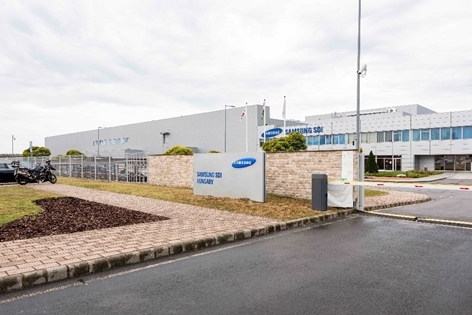
In 2017, the company completed a battery factory in Hungary. This was based on the judgment that a European production base was necessary as new projects from European customers continued to be secured. With many European automakers' production bases concentrated there, Samsung SDI rebuilt the existing PDP production plant in Hungary into a battery production plant. As a result, Samsung SDI established a global electric vehicle battery triangle system connecting Korea, China, and Hungary.
Samsung SDI is accelerating preparations for mass production of the next-generation battery, the 'Gen.5' battery, which will begin full-scale production in the second half of this year. The 'Gen.5' battery incorporates Samsung SDI's latest material technologies, including high-nickel NCA with 88% nickel content and silicon anodes. It is expected to significantly contribute to the expansion of the electric vehicle market by enabling a driving range of 600 km on a single charge.
© The Asia Business Daily(www.asiae.co.kr). All rights reserved.



















