Ulsan GRDP Up... Lowest Female Employment Rate
Households with Couples Working in the Same Industry Down by 23,000 from Previous Year
[Asia Economy Reporter Jang Sehee] Jeju Island has been found to have the highest proportion of dual-income households nationwide.
According to the Statistics Korea's "2020 Second Half Regional Employment Survey on Dual-Income Household Employment Status" released on the 27th, among 158,000 households with spouses in the Jeju region, 96,000 households, or 60.4%, were dual-income households, the highest proportion in the country. Jeonnam (57.7%) and Jeonbuk (54.3%) also had more than half of households as dual-income.
Sejong (50.6%), Gwangju (48.7%), and Daejeon (46.7%) also exceeded the national average dual-income household rate of 45.4%.
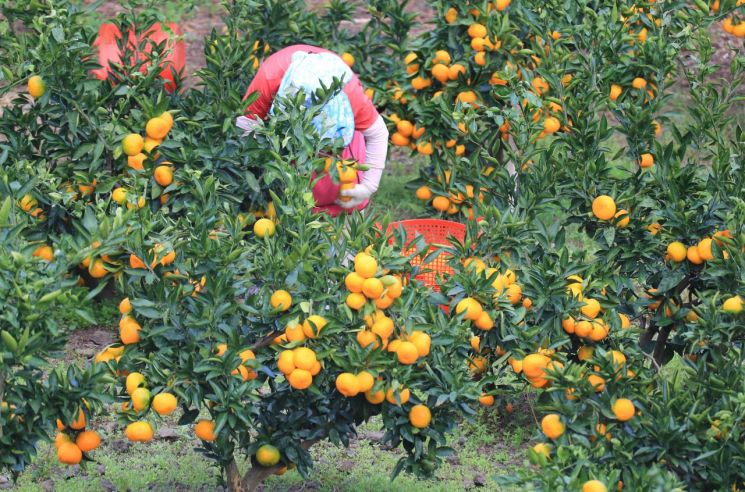
According to Statistics Korea, regions with a high proportion of agriculture, forestry, and fisheries, as well as wholesale and retail trade, tend to have higher dual-income rates. In fact, Jeju, Jeonnam, and Jeonbuk are regions where agriculture, forestry, and fisheries account for more than 20%.
On the other hand, the region with the lowest proportion of dual-income households was Ulsan, where among 288,000 households with spouses, only 109,000 households, or 37.9%, were dual-income. This is related to the low employment rate of women.
The female employment rate in Ulsan was the lowest among all 17 cities and provinces. Last year, the male employment rate in Ulsan rose by 0.1 percentage points from the previous year to 71.0%, but the female rate dropped by 2.1 percentage points to 44.7%.
In particular, Ulsan is interpreted as having low demand for dual-income among women due to its high regional gross domestic product (GRDP) and many large corporate complexes.
By education level, the proportion of dual-income households among married households was highest for those with a college degree or higher, rising by 0.3 percentage points from the previous year to 49.1%.
Among 5,822,000 married households with a college degree or higher, 2,857,000 were dual-income. In contrast, the proportion for high school graduate households was 44.7%, and for middle school graduate or below households was 36.3%, both decreasing by 1.5 and 1.7 percentage points respectively compared to the previous year.
Among 4,984,000 cohabiting dual-income households, those where the spouses work in the same industry (1,854,000 households) decreased by 23,000 from the previous year. The proportion of dual-income households working in the same industry was 37.2%. The same industry proportion was high in agriculture, forestry, and fisheries (80.5%), wholesale and retail trade, and accommodation and food service activities (54.6%), and low in electricity, transportation, communication, and finance (12.9%), and construction (13.2%).
Meanwhile, among cohabiting dual-income households, couples working in the same occupation numbered 1,909,000 households, an increase of 11,000 from the previous year. The proportion rose by 0.6 percentage points to 38.3%.
© The Asia Business Daily(www.asiae.co.kr). All rights reserved.
![Clutching a Stolen Dior Bag, Saying "I Hate Being Poor but Real"... The Grotesque Con of a "Human Knockoff" [Slate]](https://cwcontent.asiae.co.kr/asiaresize/183/2026021902243444107_1771435474.jpg)
















