Lithium Battery Exports Initially Mostly to China
Germany Tops Exports from 2017 to Last Year
US Exports Surge This Year... Electric Vehicles & ESS Increase
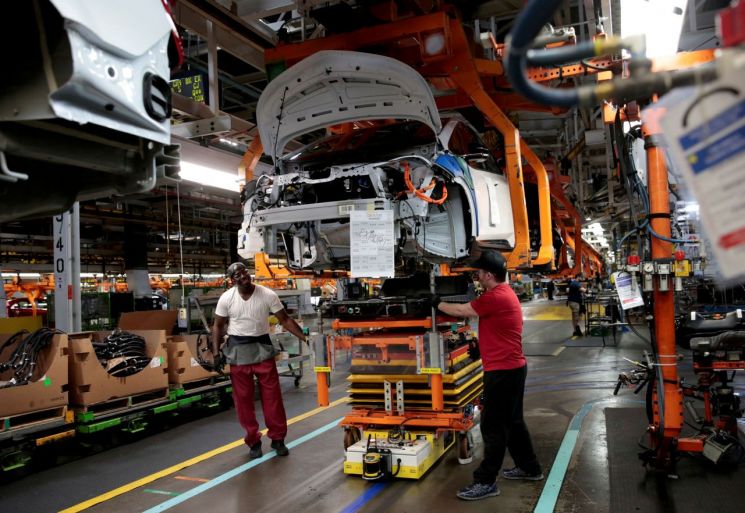 An employee at the American automobile manufacturer GM's factory is assembling a battery pack for an electric vehicle.
 [Asia Economy Reporter Choi Dae-yeol] The country that imports the most secondary batteries produced in South Korea has changed to the United States this year. A few years ago, the volume exported to China was overwhelmingly large, and for the past four years, Germany was the largest export destination. This is attributed to the increased demand for electric vehicles and energy storage systems (ESS) in the U.S.
According to data from Korea Trade Statistics operated by the Korea International Trade Association on the 27th, the value of lithium batteries (based on HS code 850760) exported to the U.S. from domestic production up to last month this year was recorded at $832 million. The volume of exports to the U.S. has increased by nearly 400% compared to the same period last year, surpassing the total export value of last year before half of this year has passed.
The share of the U.S. in South Korea's battery exports accounts for more than one-third of the total battery exports this year ($2.259 billion). From 2012, when related statistics began to be officially compiled, until 2016, China was the largest export destination. From 2017 to last year, Germany was the top export country. Although the U.S. has consistently ranked among the top battery export destinations, this is the first year it has become the largest export country.
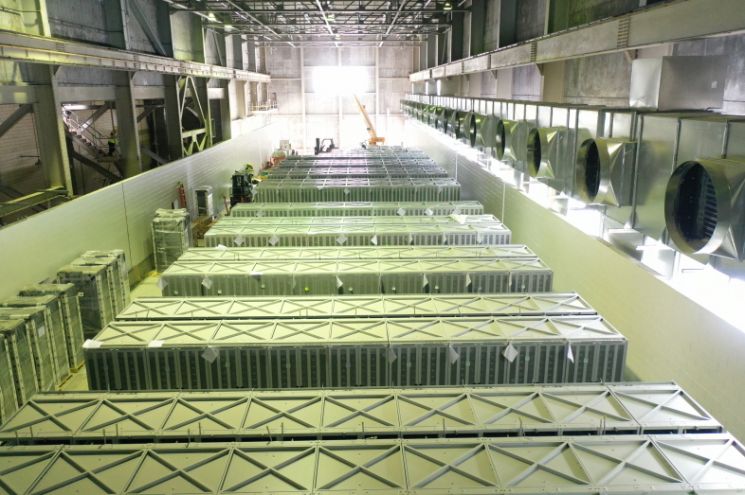 Energy Storage System (ESS) installed at a power plant operated by Vistra, a U.S. power company, in the northeastern Monterey region of California. This ESS uses batteries from LG Energy Solution and is considered the largest single-site facility of its kind. Photo by LG Energy Solution
The increase in battery exports to the U.S. is attributed to the Biden administration's Green New Deal policies leading to the expansion of electric vehicle adoption, as well as increased ESS demand due to power supply disruptions in general households caused by cold waves and wildfires. Domestic production in the U.S. has been insufficient, so imports from China, South Korea, and Japan have been substantial historically, with the recent growth rate accelerating.
There are only a handful of companies worldwide that produce secondary batteries on a large scale. In the U.S., except for LG Energy Solution and Japan's Panasonic, there are almost no large-scale production facilities, so a significant portion of demand relies on imports. Even last year, when electric vehicle adoption was slow, the volume used domestically was more from imports than domestic production. In the past two to three years, the share of batteries imported into the U.S. from Poland, Hungary, and Malaysia has increased, which is presumed to be due to the increased volume exported to the U.S. by Korean battery companies operating locally.
With the increase in electric vehicle adoption in the U.S. this year, local production is also rising, so exports to the U.S. are likely to continue growing for the time being. LG, General Motors in the U.S., and SK Innovation are building large-scale factories, but mass production is expected to start from the end of this year or next year. According to market research firm Market Knowledge, the demand for lithium batteries in the U.S. is expected to nearly double from $6.7 billion this year to $12 billion by 2025.
© The Asia Business Daily(www.asiae.co.kr). All rights reserved.
![Clutching a Stolen Dior Bag, Saying "I Hate Being Poor but Real"... The Grotesque Con of a "Human Knockoff" [Slate]](https://cwcontent.asiae.co.kr/asiaresize/183/2026021902243444107_1771435474.jpg)

















