Bank of Korea Officializes Interest Rate Hike Within the Year
Need to Manage 1,765 Trillion Won Household Debt...Caution Required Against Excessive Leverage Investment
[Asia Economy Reporter Kim Eunbyeol] As the Bank of Korea has officially signaled an interest rate hike within the year, and speculation about a rate increase as early as August has emerged, advice is being given to prepare for the aftermath of the largest-ever surge in household debt. Although the Bank of Korea has stated that it will orderly normalize interest rates to minimize the shock from increased household debt, many borrowers have already invested in real estate, stocks, and cryptocurrencies through aggressive borrowing and leveraged investments, making loan interest burdens inevitably heavy. As the COVID-19 situation continues, the burden on households and businesses that increased borrowing to sustain their livelihoods due to the pandemic may also grow.
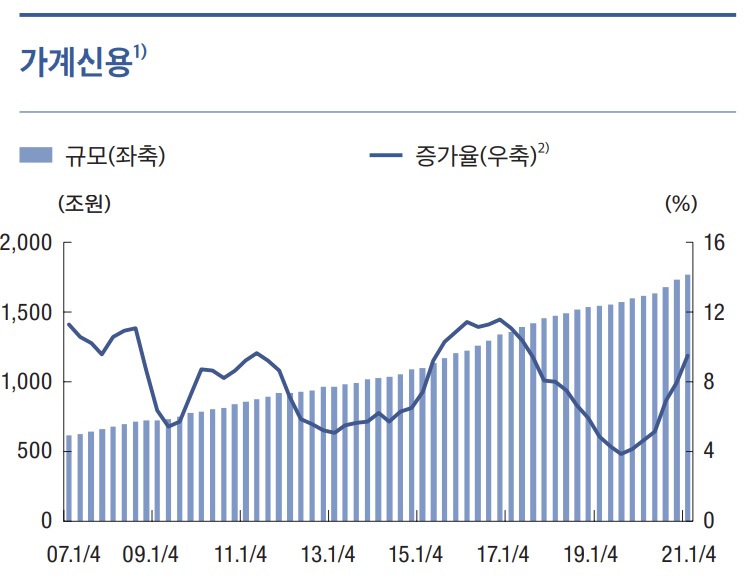
According to the Bank of Korea on the 26th, household credit stood at 1,765 trillion won at the end of the first quarter, up 9.5% from 1,611.4 trillion won at the end of the first quarter last year. The household credit growth rate has continuously increased from 4.6% in the first quarter of last year to 5.2% in the second quarter, 7.0% in the third quarter, and 7.9% in the fourth quarter. This means household debt is growing at an increasingly rapid pace.
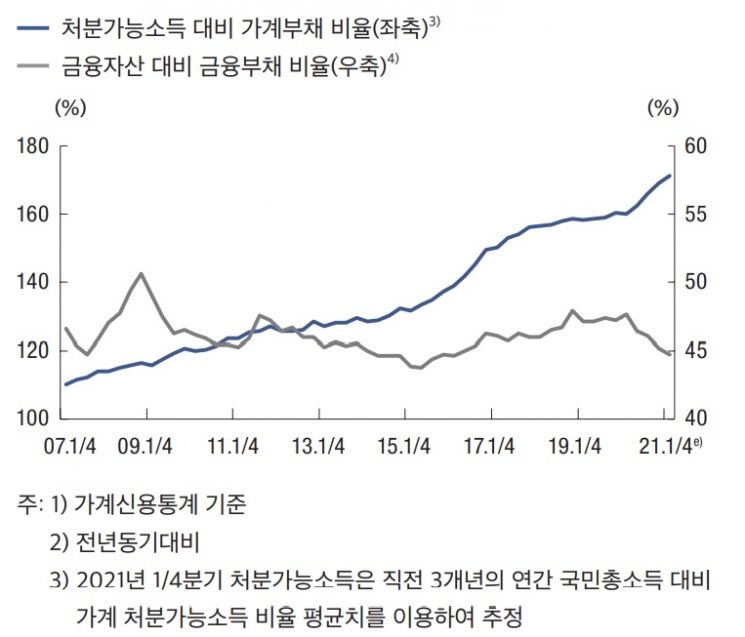
Accordingly, the household debt-to-disposable income ratio, which indicates the household's debt repayment ability, rose to 171.5%, up 11.4 percentage points from a year ago. According to Statistics Korea's first-quarter household trend survey, the average monthly income per household increased by only 0.4% compared to a year ago. Income remains stagnant, but debt burden has become heavier.
In particular, the debt of the 20s and 30s age groups is serious. According to Statistics Korea, the average household debt nationwide last year was 82.56 million won. For those in their 20s, it was 34.79 million won; 30s, 100.82 million won; 40s, 113.27 million won; and 50s, 99.15 million won. Although the debt scale may be smaller compared to middle-aged and older groups, considering income, the debt burden is significant. Among multiple debtors who borrowed from three or more financial institutions at the end of last year, the loan balance of those in their 20s and 30s was 130 trillion won, a 16.1% increase from a year earlier.
Meanwhile, if the base interest rate rises, loan interest rates will also increase, raising the interest burden on borrowers with debt. About 70% of domestic household debt is variable-rate loans. Therefore, as the base rate rises and financial bond rates increase accordingly, interest burdens inevitably grow, which could lead to reduced consumption that had been recovering from the COVID-19 shock. This is why the Bank of Korea mentions 'orderly interest rate normalization.' A rapid rate hike could cause significant shocks to households and others. Experts expect the Bank of Korea to raise rates by 25 basis points (1bp=0.01 percentage points) within this year and then raise rates about once per quarter to mitigate market shocks.
Bank of Korea Governor Lee Ju-yeol officially confirmed an interest rate hike within the year during the '2021 First Half Inflation Targeting Operation Review Briefing' on the 24th, mentioning the possibility of inflation. Previously, the Bank of Korea hinted at a potential rate hike in the second half of the year, citing rapid asset price increases and soaring debt following over a year of monetary easing after COVID-19. Since inflation has risen more than expected and may fluctuate around the inflation target of about 2%, the rate hike within the year is widely anticipated.
The governor stated, "From a medium-term perspective, there are considerable latent factors that could cause inflation," adding, "Fiscal stimulus measures and large-scale liquidity supply implemented by governments and central banks worldwide, combined with rapid economic recovery, could further increase inflationary pressures." He also assessed, "As our economy's recovery becomes clearer, inflationary pressures from the demand side are gradually expanding."
He also made it clear that rates should be raised within the year considering financial imbalances and inflation. He said, "Normalizing interest rates in line with economic recovery is a natural process," and warned, "Neglecting to address financial imbalances will inevitably have very significant negative impacts on the economy and inflation in the medium term."
However, Deputy Prime Minister and Minister of Economy and Finance Hong Nam-ki stated on the 25th, "If interest rates rise, the interest burden on households and businesses is expected to increase."
Deputy Prime Minister Hong appeared at the National Assembly's Planning and Finance Committee plenary session that morning and responded to Democratic Party lawmaker Jeong Il-young's question about whether the Bank of Korea's rate hike conflicts with economic stimulus through disaster relief funds by saying, "Monetary authorities independently discuss interest rates, so it is not appropriate for the government to comment," starting his remarks this way.
He added, "However, it is desirable for fiscal and monetary policies to be harmoniously implemented in managing the economy," and said, "Various considerations are necessary." If the Bank of Korea raises rates within the year, the interest burden on already increased household debt will grow. Hong said, "It is necessary to observe the situation regarding debt burdens on households, businesses, and the government," and added, "The government will strive to harmonize various fiscal and financial policies."
Hong also said, "There are limits to government interference in monetary policy decisions on interest rates. Not just limits, but the Bank of Korea operates independently," and added, "We fully respect the Bank of Korea's independence, and since Governor Lee Ju-yeol and I are scheduled to attend the upcoming G20 meeting together early next month, there will be opportunities to discuss this around that time."
© The Asia Business Daily(www.asiae.co.kr). All rights reserved.
![Clutching a Stolen Dior Bag, Saying "I Hate Being Poor but Real"... The Grotesque Con of a "Human Knockoff" [Slate]](https://cwcontent.asiae.co.kr/asiaresize/183/2026021902243444107_1771435474.jpg)












