Biden Reaches Agreement with Bipartisan Lawmakers
Mentions of Corporate Tax Increase Removed
Despite Reduced Investment, Opportunity to Modernize US Infrastructure and Enhance Competitiveness with China
Congressional Approval Uncertain Amid Human Infrastructure Investment Concerns
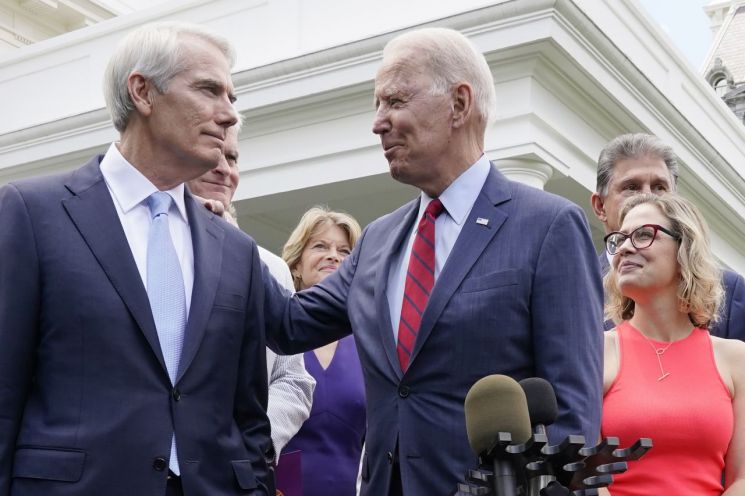 U.S. President Joe Biden is seen smiling brightly and placing his hand on the shoulder of Republican Congressman Rob Portman while talking at the White House on the 24th (local time). President Biden announced that he had reached an agreement on the infrastructure investment bill with bipartisan senators from both the Democratic and Republican parties.
 [Image source=AP Yonhap News]
[Asia Economy New York=Correspondent Baek Jong-min] U.S. President Joe Biden has finally reached an agreement with bipartisan members of Congress on an infrastructure investment plan. Although the initial investment scale of $2.25 trillion was drastically reduced to $1 trillion during the negotiation process, and the new investment amount was limited to $579 billion, it is being evaluated as a significant turning point for rebuilding America’s foundation and competing with China. An important variable in the agreement process was the removal of the plan to raise the corporate tax rate.
On the morning of the 24th (local time), President Biden met with 10 bipartisan senators at the White House and told reporters, "We have reached an agreement."
He said, "It is important that we all agreed that none of us will get everything we want," and added, "I think they gave more than they initially intended." This means that a bipartisan agreement was achieved through compromise.
President Biden initially lowered the investment plan from $2.25 trillion to $1.7 trillion for this agreement and eventually reached a consensus at the $1 trillion level.
According to the fact sheet released by the White House, the infrastructure investment agreement includes $579 billion (656 trillion won) in new projects, totaling $973 billion (1,102 trillion won) over five years and $1.209 trillion (1,369 trillion won) over eight years. New projects will invest $312 billion in transportation and $266 billion in other infrastructure.
In the transportation sector, $109 billion is allocated to roads and bridges, $66 billion to railroads, $49 billion to public transit, $25 billion to airports, $7.5 billion to electric vehicle infrastructure, and $7.5 billion to electric buses. This is essentially a plan to completely overhaul the U.S. transportation system. The federal government will invest $20 billion in infrastructure financing to leverage $180 billion in private investment funds.
Other infrastructure investments include $73 billion for power, $65 billion for high-speed internet networks, and $55 billion for water supply systems.
The funds needed for the investment will be secured through additional tax revenue by investing in the Internal Revenue Service, unused COVID-19 unemployment insurance relief funds, proceeds from 5G spectrum auctions, and sales of strategic petroleum reserves.
President Biden proposed raising the corporate tax rate from 21% to 28% to secure funding, but this was not included in the agreement. The Republican-proposed gasoline tax increase also disappeared.
Regarding this, The Washington Post analyzed that the unclear funding plan could lead to an expansion of the fiscal deficit. It is also uncertain whether the budget bill will pass Congress as agreed. Republican dissatisfaction with large-scale government spending remains, and progressive factions, which pressured President Biden with the Green New Deal policy, are expected to oppose it.
The New York Times (NYT) forecasted that for the infrastructure investment bill to pass the Senate without issues, it must secure support from at least 60 senators, including 10 Republicans, and that it is still too early to be confident.
President Biden, seemingly aware of this situation, said in a separate speech, "This agreement is an important victory for my economic agenda to secure the competitiveness of America and democracy against China," and requested cooperation from Congress.
Another variable is the pressure from President Biden and House Speaker Nancy Pelosi to pass the infrastructure plan together with the $1.7 trillion human infrastructure investment plan called the ‘American Families Plan.’
President Biden emphasized that he will not sign unless both bills are passed together. White House Deputy Press Secretary Karine Jean-Pierre said, "The agreed budget will serve as a stepping stone for passing the American Families Plan, and President Biden wants the bills to be passed simultaneously."
© The Asia Business Daily(www.asiae.co.kr). All rights reserved.

















