Jeonse Supply-Demand Index at 110.4... Up 0.7P from Last Month
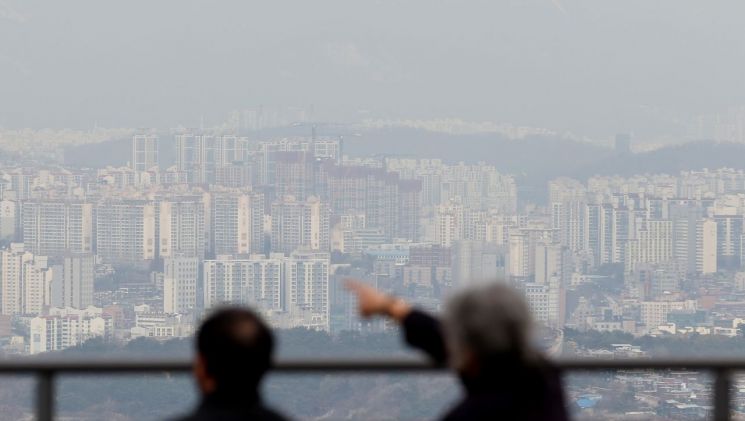
[Asia Economy Reporter Jo Gang-wook] An indicator showing the level of shortage in Seoul's jeonse supply has reached its highest point in three months. With the rise in Seoul apartment jeonse prices continuing for over 100 weeks, concerns about a jeonse crisis are growing ahead of the moving season during school vacations.
According to the weekly apartment price trend report by the Korea Real Estate Board on the 25th, Seoul's apartment jeonse supply-demand index for this week (based on the survey on the 14th) was recorded at 110.4, up 0.7 points from last month (109.7). The jeonse supply-demand index is an indicator showing the degree of jeonse supply shortage, extracted by analyzing surveys from member real estate agencies and the number of online listings. It is expressed as a number between 1 and 200, with higher values indicating greater demand relative to supply, meaning a shortage.
The Seoul apartment jeonse supply-demand index fluctuated around 110 in the first half of last year, then steadily rose after the full implementation of the 'Lease 2 Laws'?the Jeonse and Monthly Rent Cap System and the Right to Request Contract Renewal?in August last year, reaching 133.3 in November. This year, the index remained above 120 until February, reflecting severe jeonse difficulties. Following the announcement of the 2·4 Housing Supply Plan, it dropped to around 110 in March and further fell to 103.3 in the last week of April. However, since June, when the property tax base date and capital gains tax surcharges began, listings from multi-homeowners disappeared, causing a tightening of listings in popular complexes. Recently, due to reconstruction relocation demand in areas such as Banpo and Noryangjin, the index started rising again, returning above 110 this week (110.4) for the first time in three months since the third week of March (112.5).
Dividing Seoul into five regions, the Northeast area, including Nowon-gu where recent price increases have been steepest, recorded 114.1, up 0.2 points from the previous week (113.9), the highest among the regions. Following was the Southeast area, including Seocho-gu, where jeonse shortage concerns have grown due to reconstruction relocation demand in Banpo-dong, rising 1.2 points to 114.0. The Northwest area, including Mapo and Seodaemun-gu, rose 0.5 points to 110.5, and the Southwest area, including Yangcheon, Yeongdeungpo, and Dongjak-gu, increased 1.3 points to 106.1. The Central area, including Jongno and Jung-gu, remained unchanged at 102.7 from the previous week.
Not only Seoul but also Gyeonggi and Incheon saw increases, heightening concerns about the jeonse shortage. Gyeonggi rose from 112.6 to 112.9, and Incheon from 110.5 to 113.2. Accordingly, the jeonse supply-demand index for the metropolitan area increased from 111.4 last week to 112.1 this week.
Meanwhile, the apartment purchase sentiment index in Seoul slightly declined for the second consecutive week, dropping from 107.3 last week to 106.9 this week. However, among Seoul's five regions, the Southeast area, which includes the Gangnam 3 districts, rose from 110.9 to 111.5, indicating stronger buying sentiment. The Southwest (106.7→105.2) and Northeast (106.9→106.5) areas saw decreases, while the Northwest (103.3→103.3) and Central (106.8→106.8) areas remained at the same level as the previous week. In Incheon, the apartment purchase sentiment index fell from 114.0 to 111.8, but in Gyeonggi, it rose from 117.3 to 117.7, showing stronger buying sentiment. Overall, the metropolitan area index slightly decreased from 113.5 to 113.4.
© The Asia Business Daily(www.asiae.co.kr). All rights reserved.

















