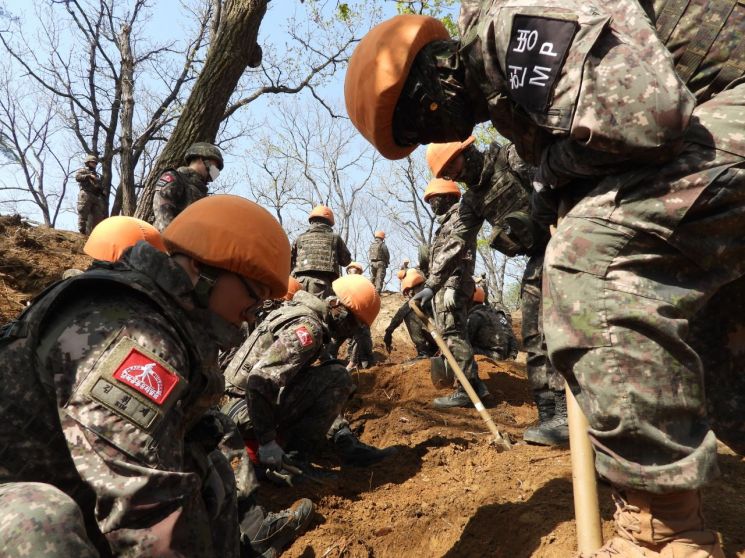
[Asia Economy Yang Nak-gyu, Military Specialist Reporter] The "Joint North-South Excavation of War Dead from the Arrowhead Hill during the Korean War," which had been conducted unilaterally due to North Korea's refusal to participate, ended on the 24th. With the expiration of the planned two-and-a-half-year excavation period, an estimated 120,000 remains presumed to still be buried can no longer be excavated. Arrowhead Hill, located within the Demilitarized Zone (DMZ) in Cheorwon, Gangwon Province, is believed to contain many remains of soldiers missing from the Korean War.
The Ministry of National Defense announced on the 25th, "The excavation work of Korean War remains conducted unilaterally by the South at Arrowhead Hill for two and a half years, following the September 19, 2018 inter-Korean military agreement, officially ended on the 24th." At the time of the military agreement, North and South Korea had agreed to conduct joint excavation work in the Arrowhead Hill area, but due to the deterioration of inter-Korean relations, the North did not respond, resulting in unilateral operations by the South. Over the two and a half years, 3,092 remains were excavated from the southern area of Arrowhead Hill. The military estimates that most of the approximately 120,000 remains that have yet to return to their families remain buried. Additionally, 101,816 personal effects were excavated in this area, and the identities of nine South Korean war dead were confirmed.
The Ministry of National Defense plans to begin excavation work at Baengma Hill nearby in the second half of the year. However, it is expected that as many remains will not be found there as at Arrowhead Hill. On the 24th, the Blue House held a Standing Committee meeting of the National Security Council (NSC), chaired by National Security Office Director Suh Hoon, to seek expanded cooperation with related countries regarding the excavation of remains in the Demilitarized Zone (DMZ).
© The Asia Business Daily(www.asiae.co.kr). All rights reserved.

















