Ruling and opposition parties clash over recipients and methods of 'disaster relief funds' in 2nd supplementary budget
Ruling party insists on 'universal payment', government proposes 'bottom 70% income'... "Possibility of increasing the ratio remains open"
[Asia Economy Reporters Oh Ju-yeon and Jeon Jin-young] The ruling and opposition parties are showing different stances on the second supplementary budget (추경), making final coordination difficult. Regarding the disaster relief fund payment plan to be included in the supplementary budget, the ruling party wants to target the "entire population," but the government strongly insists on limiting it to the "bottom 70% income group." Attention is focused on whether the ruling party will make a concession by raising the income threshold to find a compromise with the government.
On the 24th, Yoon Ho-jung, floor leader of the Democratic Party of Korea, urged the government to respond swiftly to the supplementary budget bill during the morning policy coordination meeting, saying, "I ask the fiscal authorities to have more confidence and take a proactive role." This is interpreted as a de facto pressure on the government regarding the nationwide disaster relief fund, where the ruling party and government show a temperature gap. He added, "We will finalize the small business support law, which passed the subcommittee last week, in the June National Assembly and begin full-scale negotiations with the government on the supplementary budget to overcome COVID-19."
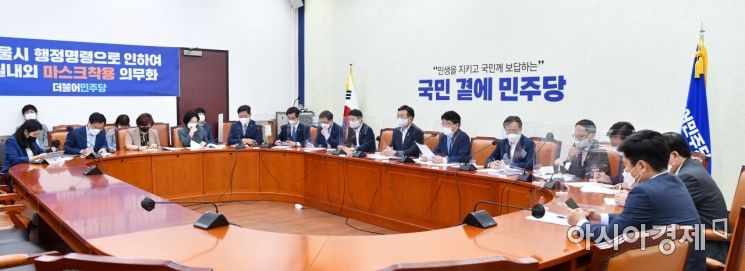 Yoon Ho-jung, floor leader of the Democratic Party of Korea, is attending the policy coordination meeting held at the National Assembly on the 24th and delivering opening remarks. Photo by Yoon Dong-ju doso7@
The Democratic Party plans to set the size of the second supplementary budget at 33 to 35 trillion won and execute support for small business damages, nationwide disaster relief funds, and credit card cashback within this budget. It also includes COVID-19 prevention and vaccine costs, emergency employment measures, youth employment support, and financial support for vulnerable groups in blind spots, aiming to pass the supplementary budget bill by July. However, the government insists on limiting the nationwide disaster relief fund to the bottom 70% income group, creating a confrontation. On the previous day, Deputy Prime Minister and Minister of Economy and Finance Hong Nam-ki appeared at the National Assembly’s Planning and Finance Committee full session and said, "I think the supplementary budget size will be in the low 30 trillion won range," showing a difference from the ruling party’s estimate. He also opposed by saying, "We are not considering (nationwide disaster relief fund payments)."
As the government takes a passive stance on the nationwide disaster relief fund, the Democratic Party expressed frustration. Park Wan-joo, chair of the Democratic Party’s Policy Committee, said at the meeting, "The supplementary budget is urgently needed not only for disaster relief funds and loss compensation but also to recover the educational gap caused by COVID-19." The Better Future, a Democratic Party policy opinion and political action group, also held a press conference that day, demanding "bold and swift payment of nationwide disaster relief funds."
The Democratic Party maintains the principle of targeting the disaster relief fund to the entire population, but it is also open to the possibility of raising the government’s ‘bottom 70%’ income threshold.
After the policy coordination meeting, Representative Yoo Dong-soo told reporters, "We believe it is better to target the entire population, but there are concerns about high administrative costs, and Deputy Prime Minister Hong has opposed it until recently," adding, "Regarding the disaster relief fund payment ratio, 70% was discussed at the last meeting, and although 80% has not been formally proposed yet, the possibility of raising the ratio is open."
On the same day, Kim Young-jin, ruling party floor whip of the National Assembly’s Planning and Finance Committee, appeared on KBS Radio’s ‘Choi Kyung-young’s Strong Current Affairs’ and said, "From the ruling party’s perspective, paying the nationwide disaster relief fund fully has greater economic effect and public utility," but also left room for compromise, saying, "I believe the differences between the government and the ruling party can be gradually narrowed through various discussions." He explained, "The government has a methodological difference, questioning whether including nationwide disaster relief funds and credit card cashback would have the same effect. This needs adjustment." He added, "Since the supplementary budget bill has not yet been submitted to the government and the National Assembly, we need to wait until early July."
The opposition party criticized the nationwide payment method as populism. Ryu Seong-gil, opposition floor whip of the People Power Party’s Planning and Finance Committee, appeared on the same radio program and said, "It is right to provide strong support to vulnerable groups," and criticized, "Nationwide support is actually a populist and political decision."
© The Asia Business Daily(www.asiae.co.kr). All rights reserved.
![Clutching a Stolen Dior Bag, Saying "I Hate Being Poor but Real"... The Grotesque Con of a "Human Knockoff" [Slate]](https://cwcontent.asiae.co.kr/asiaresize/183/2026021902243444107_1771435474.jpg)
















