China's Pork Prices Fall for 5 Consecutive Months... Halved Since Early Year
Significant Impact on Pork Consumer Prices, May Not Reflect Actual Inflation in China
[Asia Economy Beijing=Special Correspondent Jo Young-shin] Pork prices in China have plummeted, putting Chinese authorities on high alert. With pork prices halving compared to the beginning of the year, Chinese livestock farmers and pig farming companies are in turmoil. China is the world's largest pig breeding and consumption country. Some experts even point out that the collapse in pork prices could distort China's Consumer Price Index (CPI) statistics.
According to Chinese economic media Caixin, the national pork price in the third week of June was recorded at 15.13 yuan per kilogram, down 6.8% from the previous week, reported on the 24th. The average pork price across 30 provinces in China was 26.23 yuan per kilogram, down 5.5% from the previous week and 44.4% compared to the same period last year, marking a decline for five consecutive months, Caixin reported.
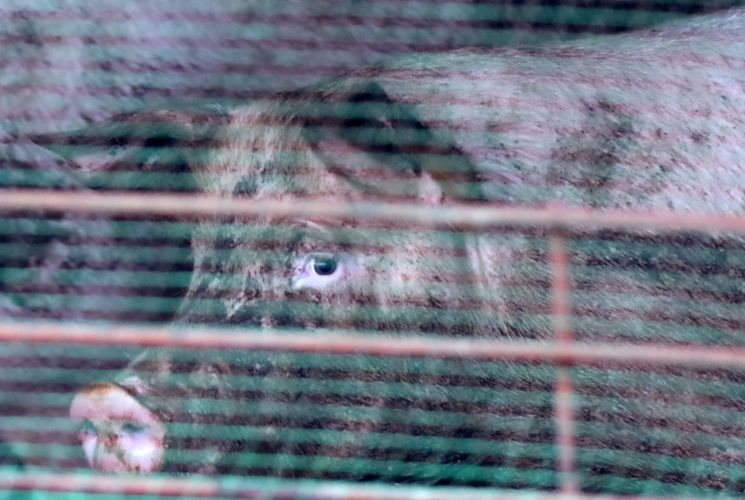
China's pork prices have shown abnormal signs since the beginning of the year. According to China Pig Industry Network, the price was 36.01 yuan per kilogram (live pig basis) on January 20, then dropped to 29.66 yuan on February 24, 28.51 yuan on March 17, 24.49 yuan on April 7, 18.47 yuan on May 26, and 13.50 yuan on June 20, falling every week each month and halving in five months.
The National Development and Reform Commission of China hastily issued a level 3 early warning to the market, increased reserves, and recommended livestock farmers maintain an appropriate level of breeding production capacity, but these measures have been insufficient to stop the price collapse.
Caixin analyzed that the cause of the pork price decline is due to increased pig breeding following the outbreak of African Swine Fever (ASF) in 2018-2019, which led to the price drop. It also explained that the livestock and pig farming industries, concerned about ASF, took the lead in breeding, which contributed to the price decline. Additionally, a decrease in pork consumption due to an increase in substitutes also had an impact.
Caixin cited data from the Ministry of Agriculture and Rural Affairs of China, reporting that as of the end of last year, the national pig inventory was over 92% of that in 2017, and the number of sows has increased for 20 consecutive months, reaching 98.4% of the 2017 level. China is known to have bred about 450 million pigs, half of the world's total, before the ASF outbreak.
Zhu Zhengyong, a researcher at the Institute of Animal Husbandry and Veterinary Medicine, Chinese Academy of Agricultural Sciences, said, "Since October last year, China's pork prices have shown signs of decline," and predicted, "It will take some time for pork prices to return to an upward trend from both supply and demand perspectives."
There are also concerns that pork prices, which account for a large portion of the consumer price calculation, are causing an optical illusion. In fact, last month China's Producer Price Index (PPI) rose by 9.0% month-on-month, but the consumer price only increased by 1.3%. Due to a sharp rise in international raw material prices, China's PPI recorded its highest level in 13 years since 2008. As a result, the gap between the PPI growth rate and CPI increase rate reached a record high of 7.7 percentage points. This is why some argue that if pork is excluded from the CPI calculation, the actual CPI growth rate could be much higher than the announced 1.3%.
An industry official in Beijing said, "Pork prices have a significant impact on China's consumer prices," adding, "Whether intentional or due to a mismatch between supply and demand, the decline in pork prices may not accurately reflect China's consumer prices." This suggests that despite official announcements, China may be experiencing inflationary pressures.
© The Asia Business Daily(www.asiae.co.kr). All rights reserved.

















