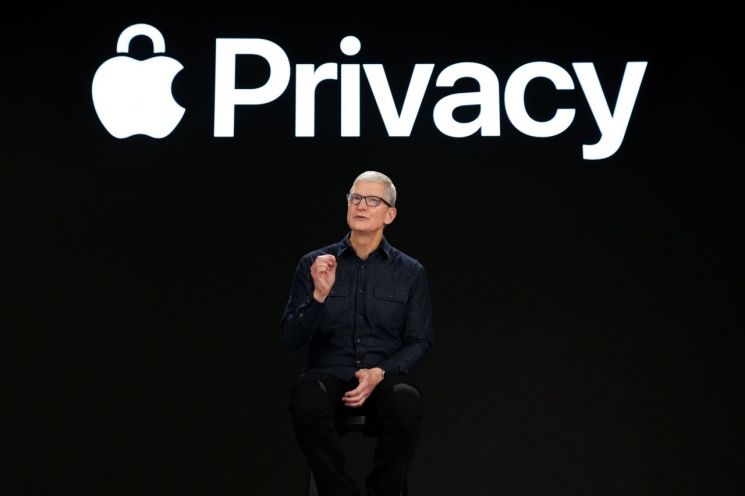
[Asia Economy Reporter Kwon Jae-hee] Apple has claimed that if users download apps without going through its own application (app) market, the App Store, there is a risk of users' privacy being exposed.
This statement came as the U.S. House of Representatives is pushing a series of bills aimed at curbing the market dominance of big tech companies, including nullifying large-scale mergers and acquisitions (M&A) and corporate breakups.
According to the Wall Street Journal (WSJ) on the 23rd (local time), Apple pointed out in a report released that day that allowing iPhone users to download apps directly to their iPhones without going through the App Store threatens privacy protection and makes it difficult for parents to control their children's iPhones. It also added that user data could potentially be exposed to ransomware attacks.
Apple's stance came on the same day as a hearing was scheduled in the U.S. House Judiciary Committee to discuss a series of bills regulating the monopolistic behavior of big tech companies.
Among the proposed bills, the "American Innovation and Choice Online Act" includes provisions that could prohibit Apple's practice of blocking so-called "sideloading," which allows downloading apps bypassing the App Store. The aim is to expand users' choice regarding which apps they can download, and a similar "Digital Markets Act" is undergoing legislative procedures in Europe.
In response, Apple argued in the report that allowing sideloading would lure users to download apps from outside the App Store, making them targets for hackers and scammers.
Apple stated, "Due to the vast scale of the iPhone user base and the sensitive data stored on iPhones such as photos, location, health, and financial information, allowing sideloading would unleash a flood of investments aimed at hacking the Apple platform."
Apple has imposed strict security standards and content policies on apps registered in the App Store while charging a 30% commission on app sales. This accounts for the majority of Apple’s service revenue, which was recorded at $16.9 billion (approximately 19.2 trillion KRW) in the first quarter.
Apple is not alone. On the 22nd, Brian Huseman, Vice President of Amazon, urged delaying the legislative process and assessing the impact, stating that the proposed bill provisions would have a significant negative effect on hundreds of thousands of small and medium-sized businesses selling on Amazon in the U.S. and tens of millions of consumers buying products on Amazon. Google also requested a delay in legislation.
Facebook called the new bill the "poison pill" of the IT industry.
On the other hand, the "App Fairness Coalition," which includes Epic Games, the developer of the popular game "Fortnite" currently in litigation with Apple over App Store fees, and music streaming company Spotify, welcomed the bill.
The App Fairness Coalition evaluated the measure to allow sideloading as "an important step amid growing movements to hold platforms accountable for anti-competitive behavior."
© The Asia Business Daily(www.asiae.co.kr). All rights reserved.


















