KOSPI and KOSDAQ Soar, but Alone Left Behind 8 Years Ahead
Trading Value and Volume Halved
Only One New Listing This Year
Direct KOSDAQ Entry Amid IPO Boom
[Asia Economy Reporter Song Hwajeong] A cold wind is blowing over KONEX as it approaches its 8th anniversary next month. Both trading volume and trading value have halved since the beginning of this year. This contrasts sharply with the booming KOSPI and KOSDAQ markets, which have reached all-time highs, climbing the 'Samcheonpi' and 'Cheonsdak' peaks.
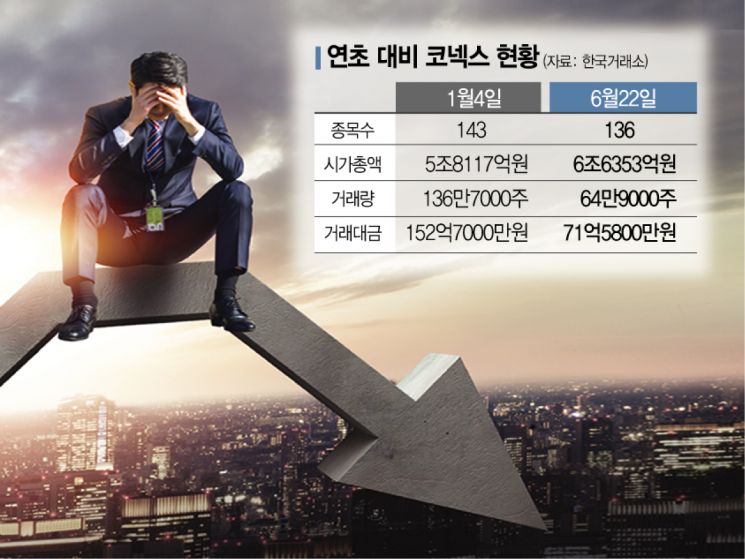
According to the Korea Exchange on the 23rd, KONEX's trading value on the previous day was 7.158 billion KRW, more than half down from 15.27 billion KRW at the start of the year. Trading volume showed a similar trend. The previous day's trading volume was 649,000 shares, shrinking to about half of the 1.367 million shares at the beginning of the year.
The number of listed companies decreased to 136 from 143 at the start of the year. This year, only one company, Iseong CNI, was newly listed on the 4th, and with Time Technology starting trading from the 24th, the total new listings in the first half of the year are expected to be just two. The number of new KONEX listings peaked at 50 companies in 2016, then declined to 29 in 2017, 21 in 2018, 17 in 2019, and 12 last year. If fewer than eight companies are newly listed in the second half, the total number of new KONEX listings this year will fall into single digits. The number of companies transferring to KOSDAQ has also significantly decreased. This year, only three companies?Raontech, C-Lab, and PNH Tech?have transferred to KOSDAQ (excluding SPAC mergers), compared to nine companies last year.
Considering the IPO frenzy in the first half of this year was hotter than ever, KONEX has been left out. In fact, the IPO boom has contributed to the cold wind at KONEX. Companies newly listed through IPOs have attracted market attention by achieving 'Ttah-sang' (opening price at twice the IPO price followed by hitting the upper limit), and with the lowering of the KOSDAQ entry barriers through technology special listings, companies are choosing to go directly to KOSDAQ rather than KONEX. In May, the number of KOSDAQ-listed companies surpassed 1,500, ranking third globally after the US NASDAQ and Canada's TSX-V. Factors contributing to the increase in KOSDAQ companies include the KONEX rapid transfer listing system, technology special listing system, Tesla requirements, and the sponsor growth recommendation special listing system. An industry insider said, "As KOSDAQ listing requirements have been relaxed, more companies are choosing to go directly to KOSDAQ rather than through KONEX," adding, "Although interest in over-the-counter stocks has increased due to the recent IPO boom, KONEX is rather being sidelined." In fact, the market capitalization of K-OTC, a regulated over-the-counter market, exceeds 22 trillion KRW, more than three times that of KONEX.
There are calls for institutional improvements to revitalize KONEX. Individual investors need a minimum deposit of 30 million KRW to invest in KONEX companies, and the number of circulating shares is not large. These factors are cited as reasons for the contraction in KONEX trading. Additionally, the designated advisor system is a burden. The designated advisor system requires securities firms to act as advisors to specific companies, providing advice, guidance, and assistance with compliance to capital market laws, as well as handling disclosures and filings. Having a designated advisor is mandatory for listing on KONEX. Listing fees and advisory costs have been pointed out as burdens for KONEX companies. An industry insider said, "I understand that financial authorities are reviewing improvements to the minimum deposit requirement to revitalize KONEX," adding, "Institutional improvements are urgent to prevent KONEX from shrinking."
© The Asia Business Daily(www.asiae.co.kr). All rights reserved.

















