Excavation of the 'Dongdaemun Stadium Site' from 2008 to 2009 Unearthed
A Sword with a Completely Different Form from Joseon Swords before the 19th Century
Permanent Exhibition at Dongdaemun History & Culture Park
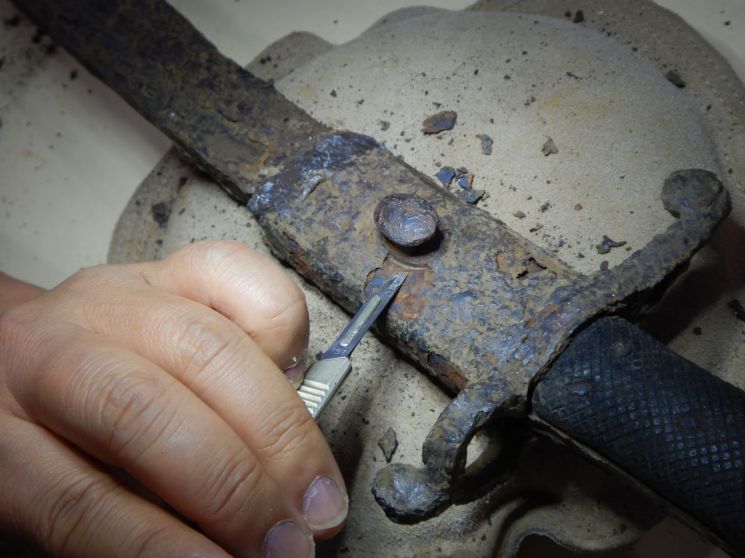
[Asia Economy Reporter Lim Cheol-young] The Seoul Museum of History announced on the 23rd that it has preserved and treated a bayonet used with a modern rifle from the late 19th century, excavated from the Hadogam site (下都監), a branch office of the Joseon Dynasty's Hunlyeondogam (訓鍊都監), and displayed it at the Dongdaemun History & Culture Park.
According to the museum, during the excavation of the Dongdaemun Sports Complex conducted from 2008 to 2009 for the construction of Dongdaemun Design Plaza (DDP), an artifact presumed to be a 'sword' related to Hadogam was unearthed. After preservation treatment, it was confirmed to be a bayonet used with a modern rifle introduced to Korea in the late 19th century during the late Joseon period.
Until now, this bayonet was only assumed to be a Japanese-made sword (刀) related to Hadogam, a branch of Hunlyeondogam, before preservation treatment. However, based on the overall shape of the sword and the MRD precision measurement results conducted during the recent preservation process, it was confirmed to be a bayonet used with a rifle developed in Britain in the mid-19th century during the late Joseon period.
Until now, aside from the bayonets used by the Qing army recovered from the ‘Goseungho’ shipwreck off the coast of Incheon, there have been no cases of bayonets actually used with modern rifles introduced to Korea in the late 19th century being excavated.
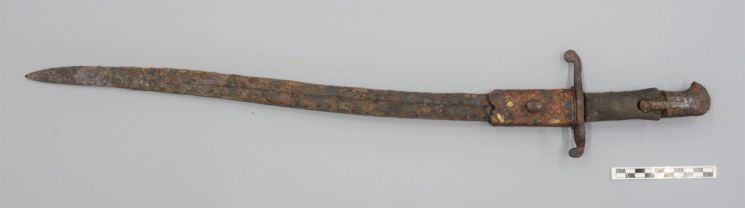
The confirmed bayonet measures 71.6 cm in total length, with a blade length of 57.5 cm and a handle length of 13.5 cm, and the handle was made using animal leather. Before preservation treatment, except for the handle area, the detailed shape could not be accurately identified due to metal corrosion compounds, and especially the exact form of the only remaining metal ornament of the scabbard was unknown. However, since it was buried in a pond environment with high moisture and limited air exposure, the animal leather handle, which is materially more vulnerable than metal, was well preserved.
The preservation treatment was carried out in five stages: cleaning, removal of corrosion compounds, exposure of the plated surface, stabilization, and restoration. As a result of the preservation treatment, most of the metal corrosion products covering the artifact were removed, restoring the bayonet's morphological features, and the metal ornament, the only remaining part of the scabbard, revealed engraved patterns, detailed shapes, and a gold-plated surface.
The bayonet excavated from the Hadogam site is expected to be evaluated as an important artifact because it is a Western-style bayonet that likely entered Korea through China or Japan in the late 19th century and was used by the Joseon army.
© The Asia Business Daily(www.asiae.co.kr). All rights reserved.


















