"Since I'm going in anyway, I'll make a bigger mess"
Second assault on the victim who reported him... Court sentences to prison
Aggravated punishment under current law, but retaliatory crime against reporter... Urgent need to strengthen victim protection
 There are victims who are afraid of retaliatory crimes and therefore cannot make proper reports. Additionally, some victims suffer actual secondary harm immediately after reporting, leading to ongoing calls for strengthened personal protection for these individuals.
 [Image source=Yonhap News]
[Asia Economy Reporter Kim Soyoung] # Perpetrator A, who was caught by the police on charges of sexually harassing a female employee at a bar, went back to the bar and caused a disturbance immediately after being questioned. The reason for the rampage was that someone reported him. A threw chairs in the store and assaulted the bar owner, leading to a trial. The court sentenced A to imprisonment. The bench stated, "Retaliatory crimes seriously hinder the discovery of substantive truth in criminal cases and undermine the state's criminal justice functions. The defendant committed the crime during the recidivism period," and sentenced him to one year in prison.
Retaliatory crimes, such as threatening or assaulting the reporter because they filed a complaint, continue unabated. As a result, voices calling for stronger protection of reporters' personal safety to prevent secondary harm to victims are growing louder. Experts point out that although relevant laws already exist, there is a lack of personnel to manage and supervise them.
According to the Ministry of Justice, a total of 2,126 retaliatory crimes occurred over five years from 2014 to 2018. There were 403 cases in 2014, 474 in 2015, 479 in 2016, 389 in 2017, 381 in 2018, and 232 cases up to July 2019. Among types of retaliatory crimes, retaliatory threats were the most frequent with 1,142 cases over the past five years, followed by retaliatory assault with 513 cases and retaliatory injury with 392 cases.
However, measures to ensure victims' personal safety decreased by about 38% over five years, from 3,102 cases in 2014 to 2,349 in 2015, 1,957 in 2016, 1,685 in 2017, and 1,172 in 2018. As of July 2019, there were 637 cases, remaining at the previous year's level.
Given this situation, it is difficult for victims to report properly. On the 1st, a man in his 50s who assaulted a victim with a soju bottle during a dispute while drinking went back to the victim and assaulted him again with a beer bottle, saying, "Since I'm going to jail anyway, I'll cause bigger trouble." The perpetrator was eventually tried and sentenced to prison, but the retaliatory crime had already occurred.
Such retaliatory crimes are subject to aggravated punishment under the law. Those who kill a person for the purpose of retaliation related to criminal case investigations, complaints, accusations, statements, or testimonies are punishable by death, life imprisonment, or imprisonment for ten years or more. Under criminal law, murder carries a statutory penalty of death, life imprisonment, or imprisonment for five years or more. When aggravated by retaliatory crime, the punishment is more severe, with death, life imprisonment, or imprisonment for ten years or more.
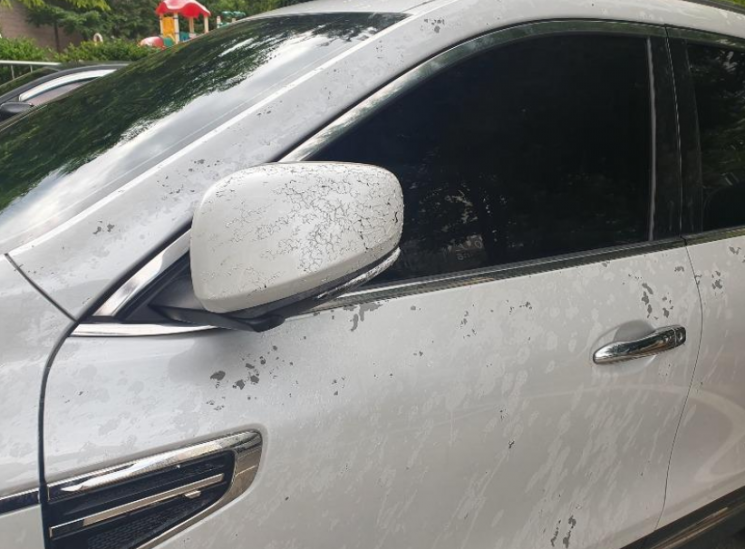 A netizen posted photos claiming they were subjected to a 'sulfuric acid retaliation attack' after reporting a vehicle illegally parked in a disabled parking space. Photo by Online Community Capture
Also, on the 16th, a post on an online community sparked public outrage after reporting a vehicle illegally parked in a disabled parking space led to retaliatory terrorism with toxic substances.
The victim, who identified himself as a husband with a disabled wife who has mobility difficulties, said, "I pick up my wife, who undergoes rehabilitation therapy daily, to the hospital. There was a vehicle without a disabled parking sticker parked in the disabled parking space inside the apartment, and I thought, 'Are there still people with such civic awareness these days?' and passed by."
He continued, "However, as the illegal parking became frequent and caused increasing inconvenience to traffic, I decided to report it and took photos of the violating vehicle, reporting it through the Safe Report app."
He added, "When I went out after receiving a neighbor's call, I was shocked. Toxic substances had been sprayed on my vehicle, causing the paint to melt, and the car parked next to mine was also in a terrible state due to the toxic substances."
He appealed, "Since the incident, my wife has been anxious and sleepless, fearing further retaliation. Please catch the criminal who committed this retaliatory crime for reporting the illegally parked car in the disabled parking space as soon as possible and help prevent further damage."
Netizens raised their voices for the protection of reporters, saying, "This is why people are afraid of retaliation and hesitate to report even when wronged," and "Only victims suffer. I hope the law becomes a country that protects them."
Summarizing citizens' opinions, it can be seen as a demand to strengthen personal protection measures. Currently, victims fearing retaliatory crimes can request personal protection from the police or obtain restraining orders from the court. If necessary, they can receive relocation expenses through prosecution review. However, judgments vary depending on the crime, and due to personnel and budget limitations, not all victims receive protection.
Experts also pointed out this reality. Professor Oh Yoonseong of the Department of Police Administration at Soonchunhyang University emphasized, "Although systems and laws for aggravated punishment of retaliatory crimes are in place, it is practically difficult to protect all reporters in advance due to issues such as police manpower."
© The Asia Business Daily(www.asiae.co.kr). All rights reserved.


















