Survey Results from 100,000 Citizens for 2022 Revised Curriculum Feedback
51% Support External Experts Conducting Solo Classes in High School Credit System
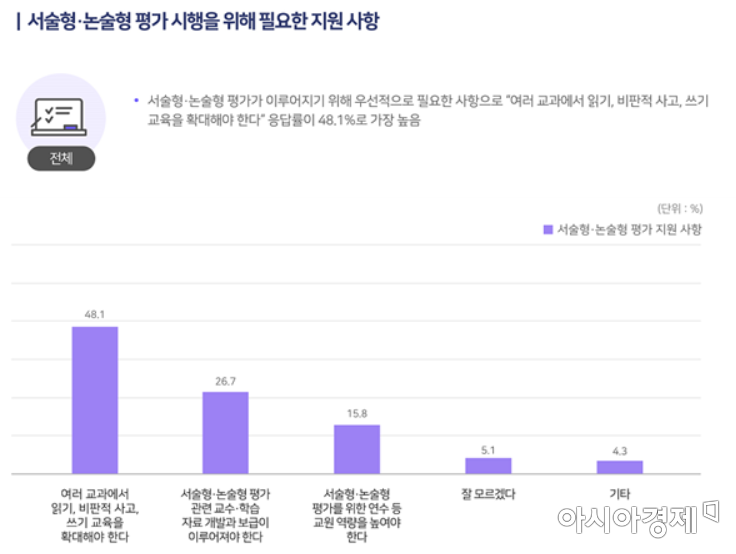
[Asia Economy Reporter Han Jinju] Five out of ten citizens believe that in order for descriptive and essay-type evaluations to be conducted in middle and high schools, education in reading, critical thinking, and writing should be expanded.
On the 22nd, the Presidential Committee on National Education announced the results of the "2022 Revised Curriculum Public Participation Survey," conducted online from May 17 for one month, targeting 101,214 citizens.
In the 2022 Revised Curriculum Public Participation Survey, the most common response (48.1%) for activating descriptive and essay-type evaluations was to expand education in reading, critical thinking, and writing across multiple subjects. This was followed by ▲development and distribution of teaching and learning materials related to descriptive evaluations (26.7%) ▲enhancement of teacher competencies through training, etc. (15.8%).
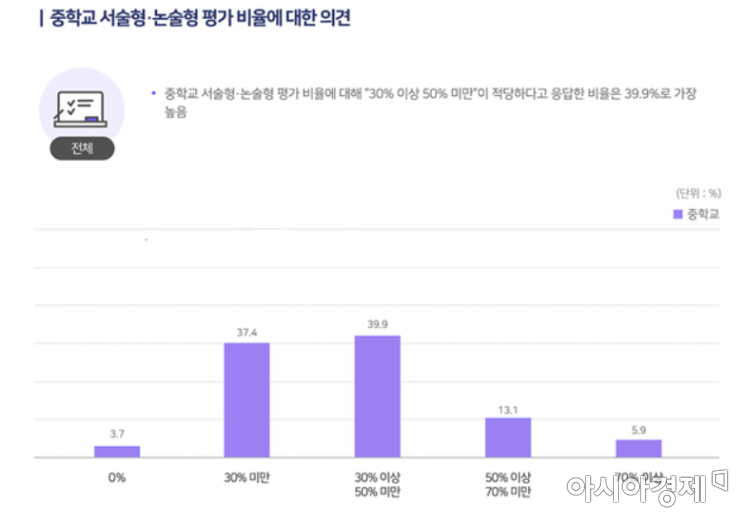
Regarding the proportion of descriptive and essay-type evaluations, the most common answer for both middle and high schools was between 30% and less than 50%. For middle schools, it was 39.9%, and for high schools, 39.7%. However, 37.4% of respondents also expressed the opinion that the proportion of descriptive evaluations in middle schools should be less than 30%.
The area to focus on most for promoting the high school credit system was "providing a variety of elective subjects," with 43.6% of respondents selecting this. Regarding the scope of credit recognition for education outside of school, such as universities or research institutions, the dominant opinion was "gradual and active expansion" (62.0%).
More than half of the public supported the idea that if a desired subject is offered but there is no teacher in charge, an external expert could conduct the class independently. Support was 51.5%, while opposition was 37.2%.
Support measures to close the learning gap included ▲development of a learning level diagnostic evaluation system (27.8%) ▲continuous operation of learning support systems run by local governments and education offices (24.9%) ▲support for enhancing teacher expertise to guide students with basic learning difficulties (23.0%), among others.
Regarding the aims and values of education, citizens chose "pursuit of happiness for individuals and society collectively" (20.9%) as the top priority. This was followed by ▲self-directed learning (15.9%) ▲growth as responsible citizens (15.6%) ▲interest and motivation in learning (12.7%). Words suggested to be included in the image of future talents were consideration (22.4%), responsibility (19.7%), and creativity (15.2%) in that order.
The education area that needs strengthening was most commonly answered as "character education" (36.3%). This was followed by ▲humanities literacy education (20.3%) ▲career and vocational education (9.3%) ▲artificial intelligence and software education (9.0%) ▲ecological transition education (5.6%), among others. Regarding the amount of learning content by subject, the majority opinion was that it is either generally too much (39.8%) or appropriate (36.7%).
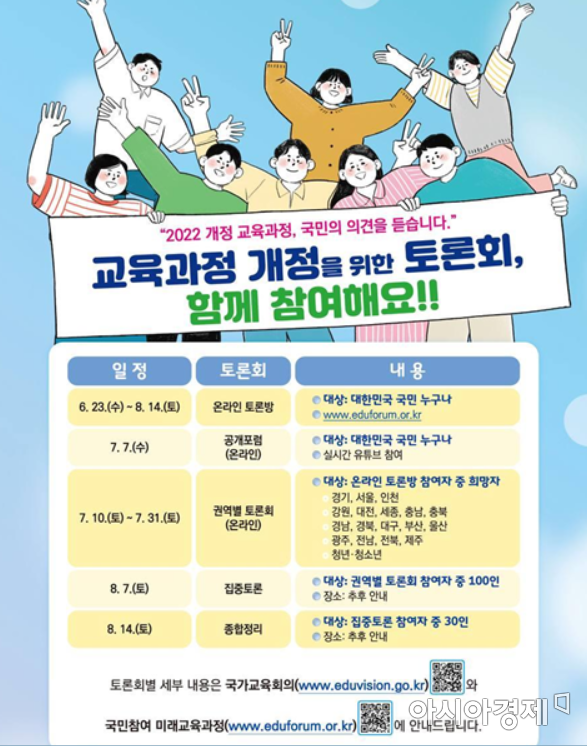
Based on the survey results, the National Education Committee will conduct online and offline discussions and deliberations. From the 23rd, discussions will be held in an online forum on seven topics including curriculum application, the amount of learning content, plans for essay and descriptive evaluations, and support measures for the high school credit system.
On the 7th of next month, a public forum for the general public will be held based on the survey results. Subsequently, regional discussions and issue debates centered on the public participation group will also be conducted. The results of the deliberations and discussions will be compiled and recommended to the Ministry of Education, and public opinions will be reflected in the curriculum revision.
© The Asia Business Daily(www.asiae.co.kr). All rights reserved.



















