Sungwook Cho Emphasizes 'Digital Fair Economy'... Continuous Platform Regulation and Sanctions
Industry: "Digital Will Fade Without Innovation... Existing Regulatory Methods Do Not Apply"
Ongoing Pressure to Open Cafeteria, Logistics, and SI to Large Corporations... Important Issues Like Hyundai Heavy and Daewoo Shipbuilding Postponed Repeatedly
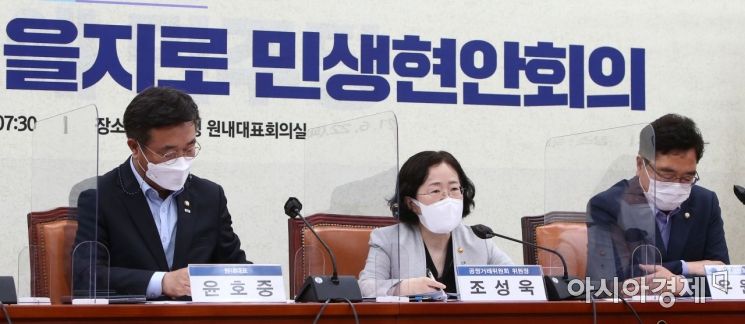 Chairman Jo Sung-wook of the Korea Fair Trade Commission attended the 'Dang-Jeong-Cheong Euljiro Livelihood Issues Meeting' held at the National Assembly on the 22nd and delivered a greeting./Photo by Yoon Dong-joo doso7@
[Sejong=Asia Economy Reporter Kwon Haeyoung] The Fair Trade Commission (FTC) has begun reviewing regulations on platform companies that hold vast amounts of data to prevent monopolies by these companies amid the growing importance of big data. However, concerns are emerging that the FTC's data regulation policies could dampen the industry's desire for innovation in a rapidly changing digital environment where new services are emerging through convergence with distribution, finance, and other sectors. Recently, the FTC has also strengthened sanctions against large corporations in sectors such as school meals, logistics, and system integration (SI), leading to criticism that various regulations are only tying the hands of companies rather than fostering a fair competitive environment.
◆FTC Strengthening Platform Regulations= The FTC's commissioning of a research project on 'Competition and Consumer Issues in the Data Sector and Establishing Fair Trade Order' has raised concerns that it could lead to regulations that hinder innovative services by platform companies such as Naver. While some regulation of platform companies is necessary, there are worries that excessive regulations, like last year's sanctions against Naver, could infringe on trade secrets and stifle the will to innovate.
Last year, the FTC imposed fines on Naver for allegedly manipulating search algorithms in the shopping and video sectors to prioritize its own services and for not providing real estate information to competitors. However, Naver argued that the algorithms are part of the routine activities of search engines and only a fraction of numerous algorithms, and that the real estate information was obtained through a patented system developed in-house, thus not allowing free-riding by competitors. Considering the Naver case, there is a high possibility that future FTC data regulations could infringe on trade secrets or restrict innovative services depending on the scope of information disclosure required from platforms.
The FTC appears to be expanding regulations beyond Naver to platforms like Baedal Minjok and Coupang. The Online Platform Act (On-Platform Act) and amendments to the Electronic Commerce Act, which strengthen platform responsibilities toward merchants and consumers, are clear examples.
Industry insiders point out that as FTC Chairman Cho Sung-wook emphasizes a 'digital fair economy,' the FTC is approaching the digital sector with an overly regulatory mindset. An industry official said, "The vacancies left by Auction and Gmarket, once the top two shopping platforms, were taken over by Coupang, and Daum, once the largest domestic portal, was absorbed by Kakao, which started as a mobile messenger about ten years ago. The digital sector, where new players easily emerge and those without innovation are eliminated, is completely different from other industries, so the FTC should not apply the same regulations as existing competition laws."
◆Regulations, Regulations, Regulations on Large Corporations Too... "Is the FTC the Ministry of SMEs and Startups?" The FTC's scrutiny is not limited to platforms but also targets conglomerates. It is pressuring them daily to reduce transactions with affiliates and open up work opportunities in logistics, school meals, and system integration (SI) sectors.
Four companies, including Samsung Electronics, are facing FTC sanctions for unfairly supporting their affiliated catering company, Samsung Welstory. The demand is to open work opportunities to small and medium-sized catering companies, but the business community criticizes the government for interfering even in employee meal issues. The FTC plans to announce voluntary guidelines for opening logistics work opportunities early next month. It is reported that an event involving large corporations such as Samsung Electronics, Hyundai Motor, and LG Electronics is being prepared. This is seen as a second round of large-scale mobilization events following the opening of school meal services.
However, the FTC has yet to reach a conclusion on more critical issues such as the corporate merger between Hyundai Heavy Industries and Daewoo Shipbuilding & Marine Engineering. While some analyze that the FTC is waiting for the European Union's decision, others suggest it is mindful of civic groups' backlash against what they call 'conglomerate preferential sales.'
Some argue that the FTC is focusing solely on supporting small business owners and SMEs by strengthening regulations on platforms and large corporations. Professor Sung Tae-yoon of Yonsei University's Department of Economics said, "The FTC is not an agency for supporting SMEs. Instead of regulating large corporations and platforms to support SMEs and small business owners, the policy focus should be on creating an environment where fair competition is possible."
◆China's 'Didi Chuxing' That Drove Out Uber Is Hard to See in Korea= While our competition authorities are preoccupied with regulating large corporations operating in global markets and platforms offering innovative services, overseas countries are rolling up their sleeves to nurture domestic industries, resulting in a flood of innovative services.
For example, Amazon, a U.S. big tech company, has long offered innovative services such as allowing Korean consumers to obtain credit cards in the U.S. based on their domestic purchase history through big data analysis. The Chinese Uber equivalent, Didi Chuxing, is similar. Founded in 2012 by a sales employee from Alibaba, the company grew with investment from Tencent. It later merged with Kuaidi Dache, an Alibaba subsidiary, and acquired Uber China in 2016. It plans to list on the U.S. stock market within the year. This is interpreted as a result of active industrial nurturing by the Chinese government.
A government official said, "In China, domestic companies are uniting to integrate shared vehicle services, securing competitiveness against foreign companies and expanding globally again," adding, "If the FTC views platforms, distribution, and logistics only from its own perspective, it could block the emergence of innovative businesses and services and cede our market to foreign companies."
© The Asia Business Daily(www.asiae.co.kr). All rights reserved.

















