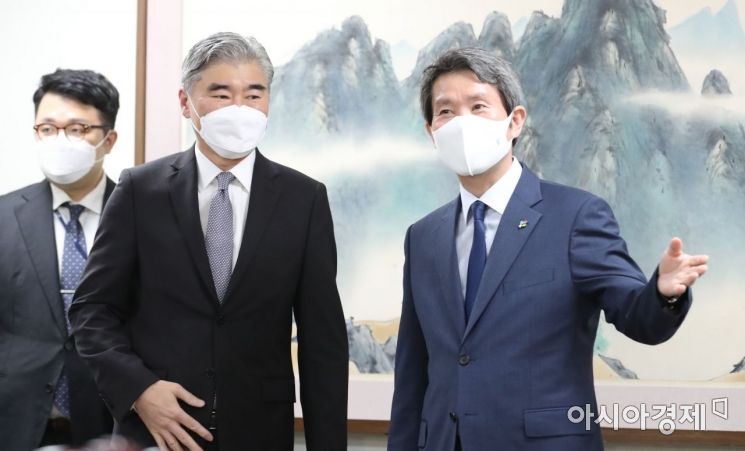
 Minister of Unification Lee In-young is seen greeting Sung Kim, the U.S. Special Representative for North Korea, at the Government Seoul Office in Jongno-gu, Seoul, on the 22nd, and then guiding him to his seat. Photo by Hyunmin Kim kimhyun81@
[Asia Economy Reporter Lee Ji-eun] South Korea and the United States are sending a strong signal urging North Korea to engage in dialogue. North Korean Workers' Party General Secretary Kim Jong-un recently emphasized "dialogue" in his message to the U.S., raising the possibility that if North Korea responds positively to the South Korea-U.S. dialogue proposal, the situation on the Korean Peninsula could rapidly thaw. However, the fact that the incentives North Korea desires have not been concretely presented and whether the joint South Korea-U.S. military exercises will proceed in August remain variables.
Special Representative for North Korea Policy Sung Kim, who is visiting South Korea to discuss North Korea-related issues including the South Korea-U.S. senior nuclear talks, paid a courtesy call on President Moon Jae-in on the afternoon of the 22nd to convey the details of the working-level discussions that began the previous day. Earlier that morning, during a meeting with Minister of Unification Lee In-young, when Minister Lee proposed ideas such as reunions of separated families and visits to Mount Kumgang, Kim expressed a willingness to cooperate. The two countries also agreed to terminate the working group, which North Korea had expressed dissatisfaction with.
During a meeting with Minister Lee in the Ministry of Unification's reception room that day, Kim said, "We want to closely cooperate whenever the South Korean government proposes various ideas in the future," and added, "As President Joe Biden mentioned at the South Korea-U.S. summit, the U.S. strongly supports South Korea's meaningful dialogue and cooperation policies." This was in response to Minister Lee's mention of cooperation measures such as family reunions and resuming visits to Mount Kumgang. Kim stated, "We are now at a very important moment and timing to shift to a dialogue phase," and expressed hope that "North Korea will respond quite positively to our dialogue proposal." Minister Lee also emphasized, "These cooperative processes are practical approaches to encourage North Korea to respond at the dialogue table."
South Korea and the U.S. will also terminate the working group, which North Korea regarded as a "thorn in its side." The Ministry of Foreign Affairs announced that during the South Korea-U.S. senior nuclear talks held the previous day, they agreed to end the working group. The working group was a working-level consultative body established by South Korea and the U.S. to discuss denuclearization and inter-Korean cooperation. Last June, Kim Yo-jong, Deputy Director of the Workers' Party, criticized the working group, saying, "We blindly accepted the 'South Korea-U.S. working group' imposed by the overlords and reported every issue to the White House," blaming the working group for the demolition of the inter-Korean joint liaison office and attributing it to the South Korean side. The termination of the working group could provide North Korea with a justification to engage in dialogue.
© The Asia Business Daily(www.asiae.co.kr). All rights reserved.

















