Hana Financial Research Institute Report
Domestic Banks Grew but Crisis Remains
[Asia Economy Reporter Kiho Sung] Although the profitability of domestic banks has improved since COVID-19, an analysis has emerged that potential risks due to the rapid increase in household debt have grown. Due to the continued boom in stock and real estate investments, the increase in household debt over the past year ranks third in the world.
On the 22nd, Yoonbo Shim, Senior Researcher at Hana Financial Management Research Institute, stated in the report "Changes in the Performance of the Global Top 200 Banks after COVID-19" that "The ratio of household debt to Gross Domestic Product (GDP) of domestic banks exceeded 100% in the third quarter of last year," adding, "The growth rate also ranked third worldwide in the past year, raising concerns."
In fact, the outstanding household loans of domestic banks already exceeded 1,000 trillion won in February this year. According to the Bank of Korea and the Financial Services Commission, as of the end of February, the outstanding household loans in the banking sector amounted to 1,003.1 trillion won, an increase of 6.7 trillion won from the previous month (996.4 trillion won), entering the 1,000 trillion won range. Although it decreased by 1.6 trillion won to 1,024.1 trillion won last month compared to the previous month (1,025.7 trillion won), this is analyzed as a temporary effect due to the refund of subscription deposits for SK IETechnology (SKIET) public offering shares. In particular, since the Total Debt Service Ratio (DSR) regulations will be strengthened from next month, it is widely expected that household loans will increase significantly again as last-minute demand surges this month.
Accordingly, in the market, concerns are emerging that the rapidly increasing household debt risk will become a major obstacle for the banking sector, especially as the Bank of Korea's base interest rate is likely to rise in the second half of this year.
Researcher Shim advised, "The form of profitability deterioration varies by (global) region, so there will be a time lag in performance recovery in the future," and added, "It is necessary to prepare for potential risks caused by COVID-19 support policies and the rapid increase in household debt."
Meanwhile, the asset size of the global top 200 banks grew by about 15% last year, supported by liquidity supply in each country and expanded financial support focused on affected companies. However, due to growth centered on low-profitability assets and interest rate declines, operating profit growth was modest, and net profit declined by about 18% due to a significant increase in COVID-19-related loan loss provisions.
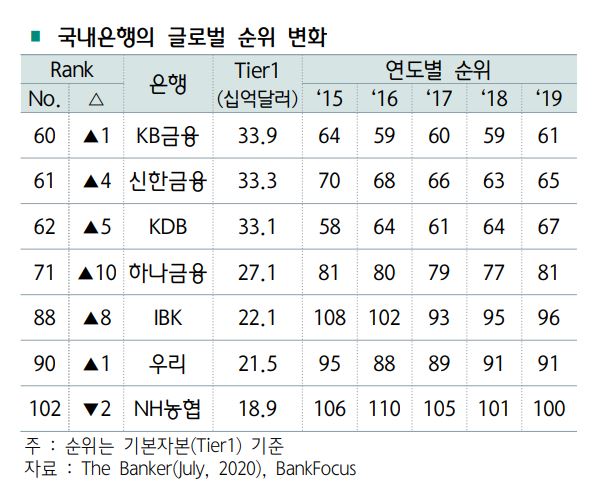
Domestic banks also showed noticeable growth. Although the number of domestic banks listed among the global top 100 banks decreased by one compared to the previous year, the rankings of all six banks rose. KB Kookmin Bank rose one step to 60th, Shinhan Bank 61st (▲4), KDB Industrial Bank 62nd (▲5), Hana Bank 71st (▲10), IBK Industrial Bank 88th (▲8), Woori Bank 90th (▲1), and NH Nonghyup Bank ranked 102nd (▼2).
© The Asia Business Daily(www.asiae.co.kr). All rights reserved.
![Clutching a Stolen Dior Bag, Saying "I Hate Being Poor but Real"... The Grotesque Con of a "Human Knockoff" [Slate]](https://cwcontent.asiae.co.kr/asiaresize/183/2026021902243444107_1771435474.jpg)
















