Proposal for Amendment to the Information and Communications Network Act
[Asia Economy Reporter Cha Min-young] From fake news related to COVID-19 to provocative hate and discriminatory remarks in popular webtoons and YouTube videos, the internet world is being disturbed. Despite the enormous impact, user damage is increasing due to regulatory gaps, leading to calls in the National Assembly for self-regulation such as 'User Committees' within online platforms.
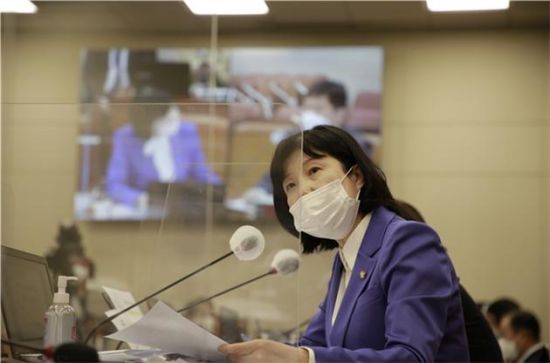
On the 22nd, National Assembly Science, Technology, Information and Broadcasting and Communications Committee member Yang Jeong-suk announced that she has proposed an amendment to the Information and Communications Network Act to prevent user damage caused by illegal, harmful, and false information as the status of major information and communication services such as portals, social networking services, and online video services rises and their social influence grows.
Recently, the number of communication-related reviews by the Korea Communications Standards Commission has exceeded 200,000 cases, with approximately 252,000 cases in 2018, 216,000 cases in 2019, and 226,000 cases in 2020. Over the past five years, the number of cases of discriminatory and derogatory content corrected online by the Commission has approached 7,714.
Major countries overseas have also taken action. Germany enacted the 'Network Enforcement Act' (NetzDG) in 2017, strengthening the content management responsibility of digital platform operators. If hate, discrimination, or child pornography content is posted online, it must be deleted within 24 hours, and violations can result in fines up to 50 million euros (approximately 66.25 billion KRW). In France, the Internet Hate Speech Prohibition Act, which mandates deletion of 'clearly illegal' content within 24 hours and requires a user reporting system, passed the lower house last May. Operators who fail to delete within 24 hours face fines up to 1.25 million euros (approximately 1.65 billion KRW).
Yang Jeong-suk said, "The current user protection measures under Korean law are insufficient to effectively prevent and block user damage caused by the distribution of illegal, harmful, and false information through major information and communication services such as portals," adding, "Despite the enormous social influence of information and communication services, there is no internal self-regulation system established by operators to build a sound information distribution environment."
In the broadcasting sector, according to Article 87 of the Broadcasting Act, a viewers' committee composed of experts in related fields operates to represent viewers and convey their opinions to broadcasters. Similarly, it is pointed out that a similar self-regulation mechanism is needed for information and communication services, as internal self-regulation systems operate in broadcasting.
The amendment bill, led by Representative Yang Jeong-suk, stipulates that providers of portals, social networking services, and online video services that meet criteria set by presidential decree, such as average daily users, sales, and types of business, must establish user committees. This aims to prevent user damage caused by illegal, false, and harmful information and protect user rights and interests.
Representative Yang urged the passage of the amendment, saying, "It is necessary to introduce a new self-regulation system that can propose or demand correction of the distribution of information that is highly likely to harm user interests through experts representing users."
Meanwhile, the amendment bill was co-sponsored by National Assembly members Kang Min-jung, Ahn Ho-young, Yoon Jae-gap, Yoon Jung-byeong, Lee Seong-man, Lee Yong-bin, Lee Jang-seop, In Jae-geun, and Jo Oh-seop.
© The Asia Business Daily(www.asiae.co.kr). All rights reserved.
![Clutching a Stolen Dior Bag, Saying "I Hate Being Poor but Real"... The Grotesque Con of a "Human Knockoff" [Slate]](https://cwcontent.asiae.co.kr/asiaresize/183/2026021902243444107_1771435474.jpg)
















