Examining Taxable Households by Seoul Autonomous Districts
About 1.1 Billion KRW Concentrated in Songpa, Gangdong, etc.
2% Taxation Method Controversy Provides Pretext to Ruling Party Hardliners
[Asia Economy Reporters Kim Hyunjung (Sejong), Mun Jewon] If the ruling Democratic Party's party line to set the comprehensive real estate tax (종합부동산세) taxation standard as the 'top 2% of official property prices' is realized, the Gangnam areas such as Songpa, Gangdong, and Seocho districts will receive the most tax exemption benefits. This is because the housing priced around 1.1 billion KRW, which is predicted as the baseline, is most densely concentrated there. Along with the controversy over the '2% taxation method,' this strengthens the hardliners within the ruling party on real estate policy, leading to criticism that both 'practicality and legitimacy' may be lost.
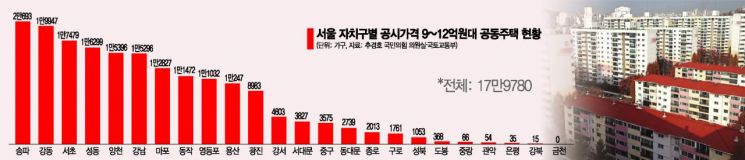
According to the 'Status of Official Property Price Ranges by Each District in Seoul' submitted by the Ministry of Land, Infrastructure and Transport to People Power Party lawmaker Choo Kyung-ho on the 21st, as of 2021, among apartment complexes in Seoul, the local governments with the highest proportion of households priced between 900 million KRW and 1.2 billion KRW (179,780 households) are Songpa (20,693 households, 11.5%), Gangdong (19,947 households, 11.1%), and Seocho (17,479 households, 9.7%), mainly located in the Gangnam area. Earlier, the ruling party reached a consensus at last week's policy meeting to set the comprehensive real estate tax target as the 'top 2% of official property prices.' This means ranking the total official property price sums of nationwide houses aggregated per individual and imposing the comprehensive real estate tax only on the top 2%. Based on the official property prices announced by the Ministry of Land this year, the 2% baseline is expected to be around 1.1 billion KRW.
◆ About 180,000 Households in Seoul with Official Property Prices Between 900 Million and 1.2 Billion KRW = According to the status of official property prices by district in Seoul, approximately 179,780 households, about 7% of the total 2,583,508 households across Seoul, fall within the 900 million to 1.2 billion KRW range. In previous years, all households within this range were subject to the comprehensive real estate tax, but from this year, some within the 900 million to 1.1 billion KRW range fall outside the baseline and are exempt from paying the tax.
If the ruling party's plan is finalized, districts such as Dobong and Geumcheon, which have no apartment complexes exceeding 900 million KRW, are expected to have no comprehensive real estate tax payers (excluding single-family houses), and districts with very few apartment complexes in the 900 million to 1.2 billion KRW range, such as Gangbuk (15 households), Eunpyeong (35 households), Gwanak (54 households), and Jungnang (66 households), are expected to have no or fewer tax-paying households.
However, depending on future government-party consultations on how to adjust the pace of official property price increases, the number and proportion of households within the relevant range may change significantly.
◆ Ruling Party: "Complies with the Principle of Tax Legality" = The market points out that the ruling party's plan to reform the comprehensive real estate tax does not comply with the principle of tax legality. There is no precedent for setting the basis for taxation targets as a 'proportion (%)', and in this case, it is difficult to predict tax payment status due to fluctuations in real estate prices.
Seo Jin-hyung, President of the Korea Real Estate Society (Professor at Gyeongin Women's University), said, "Considering the uncertainty of taxation and the administrative costs of recalculating the top 2% annually, the '2% taxation plan' imposes excessive social costs," emphasizing, "It not only increases tax confusion among citizens but also drags real estate policy into the political realm through tax systems targeting 'specific forces'." Lawyer Kim Yerim of Jeonghyang Law Firm explained, "Since the taxation target is unclear, it may violate the principle of tax legality, and there is a high possibility of constitutional challenges in the future regarding such dispositions," adding, "Controversy is expected in terms of tax fairness, and collective lawsuits similar to those seen in previous rental business operators and official property price realization processes may reoccur." Professor Lim Jaeman of Sejong University's Department of Real Estate said, "If the comprehensive real estate tax is imposed on the top 2%, housing prices will inevitably rise further," expressing concern that "Ultimately, supporters may leave, and the market may collapse."
A ruling party official responded, "The basis for specifying the taxation target is stipulated in the law, and the specific taxation standard amount is delegated to the enforcement decree, so it complies with the principle of tax legality," rebutting, "Rather, whether housing prices rise or fall, there is no significant fluctuation in the taxation target, increasing predictability for taxpayers."
© The Asia Business Daily(www.asiae.co.kr). All rights reserved.
![Clutching a Stolen Dior Bag, Saying "I Hate Being Poor but Real"... The Grotesque Con of a "Human Knockoff" [Slate]](https://cwcontent.asiae.co.kr/asiaresize/183/2026021902243444107_1771435474.jpg)
















