Abolition of the System → Reconsideration from the Starting Point
Market Confusion Intensifies Due to Zigzag Moves
Focus Only on Vote Calculation Ahead of Election
Experts "Must Consider Housing Stability for Ordinary People"
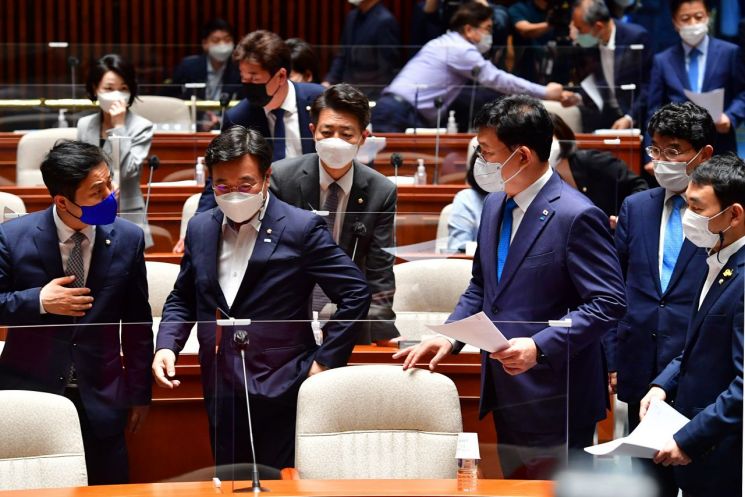 Democratic Party of Korea Supreme Council Member Kim Yong-min (from the right), Policy Committee Chair Park Wan-joo, Representative Song Young-gil, Chief Secretary Kim Young-ho, Floor Leader Yoon Ho-jung, and Supreme Council Member Kim Young-bae are preparing for a policy lawmakers' meeting on real estate tax policies on the 18th at the National Assembly in Yeouido, Seoul.
 [Image source=Yonhap News]
[Asia Economy Reporter Moon Jiwon] The ruling party and government’s zigzag approach surrounding the registered rental business operator system is increasing market confusion. Although the Democratic Party of Korea has decided to reconsider the system’s abolition from scratch, concerns are emerging that conflicts could reignite at any time since benefit reductions are inevitable in the future. Experts point out that the ruling party and government need to thoroughly review the effectiveness of system reform based on housing stability for ordinary citizens, rather than on vote calculations, to reduce confusion.
According to political circles on the 21st, the Democratic Party decided at a policy parliamentary meeting on the 18th to scrap the previously pursued policy to abolish rental business operators and reconsider it from the beginning. Earlier, on the 27th of last month, the Democratic Party announced through the ‘Rental Registration Business System Improvement Plan’ that construction rentals would be maintained but new registrations for purchased rentals would be abolished. The party reversed its position to ‘reconsider from scratch’ less than a month after announcing the system’s abolition.
The ruling party and government changing their stance on the rental business operator system is not a recent phenomenon. In the early days of the administration in 2017, the government actively encouraged the system by granting various tax benefits to rental business operators on the condition that they comply with public obligations such as rental obligation periods and rent caps. However, as housing prices in the metropolitan area surged afterward, rental business operators were labeled as the ‘main culprits of rising housing prices,’ and through the July 10th measures last year, 4-year short-term rentals and 8-year apartment purchase rentals were abolished.
The Democratic Party’s step back from completely abolishing the system is interpreted as due to unexpectedly strong opposition from rental business operators. One rental business operator said, “I am tired of the back-and-forth approach with no standards, no subjectivity, and no driving force,” adding, “Although the Democratic Party announced a reconsideration policy, I am anxious because I don’t know when they might reverse it again.”
The Democratic Party is reportedly considering maintaining tax benefits for livelihood-type rental business operators who do not own many houses to reduce market backlash. Disadvantages such as tax benefit abolitions would be applied restrictively only to rental business operators owning dozens of houses or more. There is also discussion about allowing new registrations for non-apartment rental business operators by housing type.
Within the industry, criticism is raised that the ruling party and government repeatedly reverse policies as they focus solely on vote calculations ahead of elections. Professor Shim Gyo-eon of Konkuk University’s Department of Real Estate said, “The vast majority of rental business operators are livelihood-type, and it was a wrong approach to condemn all of them as the main culprits of rising housing prices as if conducting a witch hunt,” adding, “The rental business operator system should be encouraged, but adjustments should be made to reduce only the parts where benefits are excessive.”
© The Asia Business Daily(www.asiae.co.kr). All rights reserved.

















