[Asia Economy, Military Specialist Yang Nak-gyu] The British Royal Navy Air Service was the first military force to deploy armored vehicles in combat. In 1914, the British military commissioned Rolls-Royce to produce armored vehicles for reconnaissance missions. The armored vehicles played a significant role on the battlefield. Not only did they conduct reconnaissance, but they also rescued pilots whenever aircraft from the naval air service crashed. Over time, armored vehicles took on multipurpose roles. Domestic defense companies received technology transfers from overseas to produce first-generation armored vehicles, and later manufactured second-generation armored vehicles using domestic technology. To see the latest third-generation armored vehicles, I visited Hanwha Defense’s Changwon plant located in Changwon, Gyeongnam, on the 2nd.
Upon entering the 210,000㎡ (61,000 pyeong) facility, various air defense equipment and armored vehicles caught my eye. Across the building stood a 30m wheeled anti-aircraft gun, supplied to the army, proudly positioned under a large South Korean flag. Next door, the Biho Combined 30mm anti-aircraft gun was also visible. The phrase “One team HanwhaDefense” displayed throughout the factory hinted at the extensive human exchange and communication dedicated to producing numerous ground weapons.
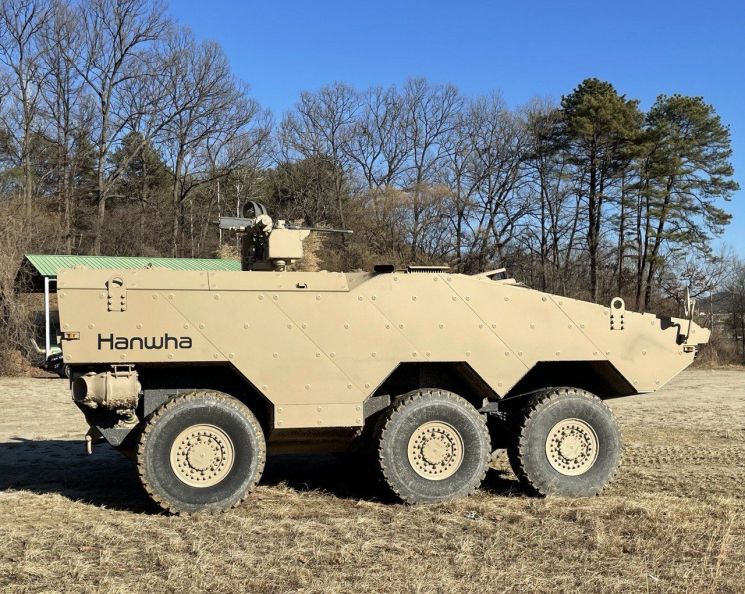
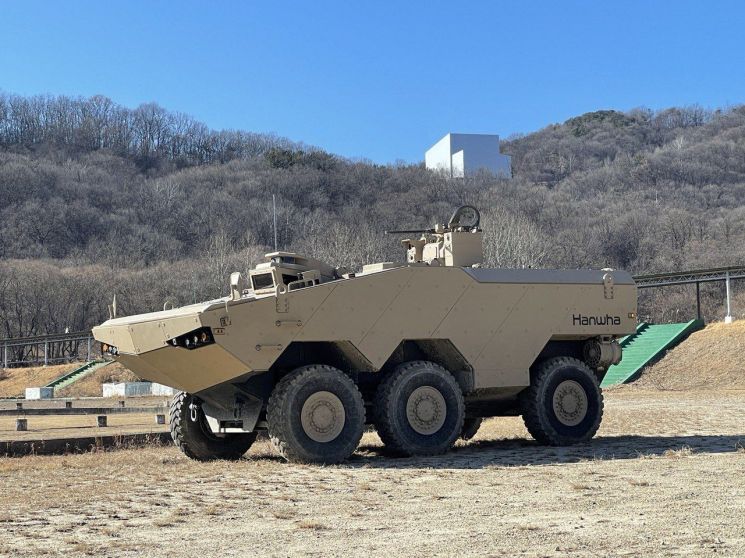
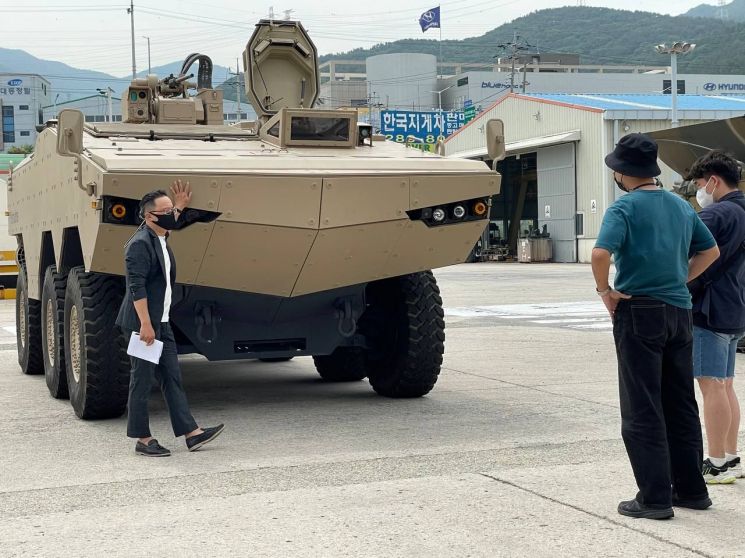
Entering the driving ground with a 150m circular track, the export-model wheeled armored vehicle “TIGON” greeted me. Its headlights, shaped like hawk eyes, gave it a sleek appearance at first glance. The bottom of the TIGON is V-shaped. The reason for the V-shaped hull bottom is to disperse the shock to both sides when an improvised explosive device (IED) or mine detonates directly beneath the vehicle. The U.S. Mine-Resistant Ambush Protected (MRAP) vehicles used in the Iraq and Afghanistan wars also employ this design. The six tires mounted on the TIGON were enormous, reaching waist height. The grooves on the tire surface were wide enough to fit half a finger. So Won-yong, the lead researcher, said, “The TIGON can withstand an 8kg anti-tank mine and is equipped with run-flat tires, allowing it to travel over 40km at speeds of 45km/h even after being shot.”
Turning to the rear and opening the back door, I saw eight seats for soldiers. Behind the seats were shock absorbers installed to protect against mine blasts. The floor was finished with reinforced materials to prevent penetration by mine fragments. On both sides at the rear of the vehicle, devices resembling small fans were visible at first glance. These were water jets, a feature found only on naval vessels. The TIGON can move at speeds of 8km/h on water such as rivers and lakes.
In 2018, the TIGON scored a record-high 78.8 points in a competition held in the United Arab Emirates (UAE), where armored vehicles from 10 countries competed. It outperformed the U.S. military’s Stryker armored vehicle, which scored in the 50s, drawing global attention. To board the TIGON, I fastened the seatbelt in the rear seat. As the rear door closed, the interior darkened, and tension filled the air. The TIGON started quietly, quieter than expected.
Compared to the K-21 armored vehicle passing by, the noise was comparable to that of a sedan. However, once driving began and speed increased, it surged forward like an enraged leopard. After about 100m, I looked at the monitor installed in the cockpit and saw the outside scenery rushing by like an arrow.
The motion sickness lasted only briefly as the TIGON began to take corners and continued driving for about five more minutes. Although the drive was short, it was enough to feel the vehicle’s speed. The TIGON demonstrated overwhelming power even on slopes with a 30-degree incline, steeper than most hillsides. My body tilted so much that I was about to fall into the adjacent seat, but the TIGON, having climbed about 10m, stopped in place and then surged forward another 5m. It was a moment to feel the tremendous power of the engine.
Technical Manager Yang Hee-woong said, “The TIGON is a vehicle capable of operating in deserts, jungles, and swamp areas. Its optimal center of gravity design ensures stability at high speeds and excellent posture control during sharp turns.”
When the rear door opened and I got out of the seat, sweat ran down my spine, probably from the tension. Looking at the TIGON again from outside after the driving experience, it looked solid and sturdy. It seemed ready to sweep not only Southeast Asia but also the Middle Eastern markets.
© The Asia Business Daily(www.asiae.co.kr). All rights reserved.
![Clutching a Stolen Dior Bag, Saying "I Hate Being Poor but Real"... The Grotesque Con of a "Human Knockoff" [Slate]](https://cwcontent.asiae.co.kr/asiaresize/183/2026021902243444107_1771435474.jpg)


















