KAIST Develops Hydrogel-Based Flexible Brain-Machine Interface
Professor Park Seongjun's Team Collaborates with MIT to Create Long-Term Implantable Device
Expected to Enable Research on Long-Term Progressive Brain Diseases like Alzheimer's and Parkinson's
[Asia Economy Reporter Kim Bong-su] A brainwave measurement device that causes no adverse reactions even after long-term use has been developed. This is expected to advance research on brain neurological diseases requiring ultra-long-term observation, such as Alzheimer's disease and Parkinson's disease.
The Korea Advanced Institute of Science and Technology (KAIST) announced on the 21st that Professor Park Sung-joon’s research team from the Department of Bio and Brain Engineering, in collaboration with Professor Polina Anikeeva from the Massachusetts Institute of Technology, succeeded in developing a hydrogel-based flexible brain-machine interface.
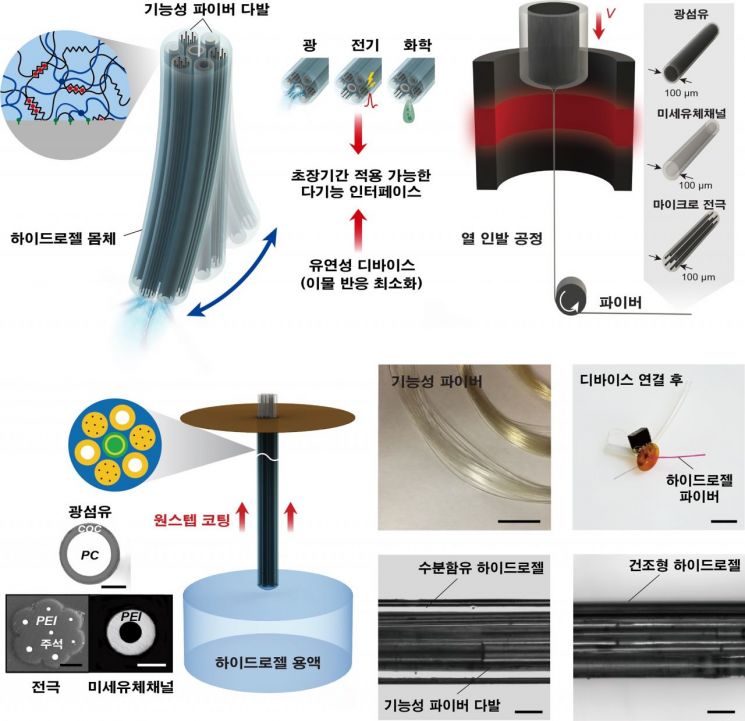
The research team created a 'brain-mimicking neural interface' by embedding multifunctional fiber bundles into hydrogel (a semi-solid substance combining water and jelly). It includes optical fibers for optogenetics technology that can stimulate specific neuron types with light, electrode bundles to read signals from the brain, and microfluidic channels to deliver drugs into the brain.
This interface has a polymer-like hardness when the hydrogel body is dried, making it easy to insert into the body. Once inside, it rapidly absorbs bodily moisture, becoming soft and similar to the surrounding tissue rich in moisture, thereby minimizing foreign body reactions.
The research team directly applied this device to animal models and succeeded in measuring brain signals for up to six months after insertion. They also conducted ultra-long-term optogenetics and behavioral experiments on freely moving rats. Unlike existing brainwave interfaces, the expression of astrocytes and immune cells caused by foreign body reactions was significantly reduced.
Professor Park Sung-joon said, "This study is significant as it is the first to use hydrogel as a constituent material for multifunctional neural interfaces, greatly extending their lifespan," adding, "We expect this to further advance research on brain neurological diseases requiring ultra-long-term observation, such as Alzheimer's disease and Parkinson's disease."
© The Asia Business Daily(www.asiae.co.kr). All rights reserved.

















