Final Report Meeting on Feasibility Study for Phase 1 (Mokpo∼Wando) Construction Project
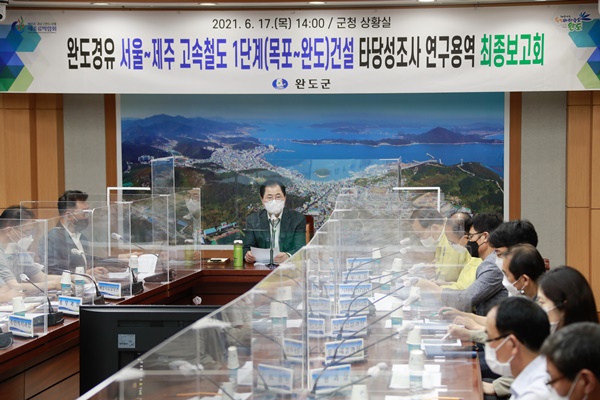 A final report meeting was held for the feasibility study on the construction of the Seoul-Jeju high-speed railway Phase 1 (Mokpo-Wando) passing through Wando. (Photo by Wando-gun)
[Wando=Asia Economy Honam Reporting Headquarters Reporter Choi Kyung-pil] On the 21st, Jeollanam-do Wando-gun announced that it held the final report meeting for the feasibility study research service on the construction of the Seoul-Jeju high-speed railway Phase 1 (Mokpo-Wando), which passes through Wando, on the 17th.
This research service was launched in June 2019 by the Public Transportation Forum, Seoul National University of Science and Technology Industry-Academic Cooperation Foundation, Yushin Co., Ltd., and Koyespecial Co., Ltd. to review the feasibility of the project, including route alternatives for passing through Wando-gun on the Seoul-Jeju high-speed railway line plan, demand forecasting, and economic analysis.
As a result of the service, a plan was established to promote Phase 1 with L=85.1 km (16.3 km shared use, 68.8 km new construction) from Muan Airport to Haenam and Wando, with a project cost of 2.829 trillion KRW, and Phase 2 with L=109.5 km from Wando to Jeju, with a project cost of 21.667 trillion KRW. A consultative body was formed with Jeollanam-do, Jeju-do, and neighboring local governments, and it was decided to continuously propose to central government agencies and political circles to reflect this in the 20th presidential election pledges as well as in the national railway network plan.
Meanwhile, in November last year, Wando-gun held a forum hosted by National Assembly members Yoon Jae-gap, Kim Seung-nam, Lee Gae-ho, and Cho Oh-seop to announce the necessity and justification of constructing the Seoul-Jeju high-speed railway passing through Wando both domestically and internationally.
Last month, a forum was held at the Wando Culture and Arts Center, hosted by the Wando-gun Prosperity Association and the Wando-gun Youth Union, where local residents deeply discussed the necessity, expected effects, and promotion direction of the high-speed railway construction.
Shin Woo-cheol, the mayor of Wando-gun, emphasized, “If the high-speed railway is constructed, accessibility will be dramatically improved, allowing local residents to lead better lives. Considering the expected effects of key projects such as the marine healing industry, marine bio-industry, construction of a marine tourism hub city, and establishment of the National Subtropical Arboretum, as well as regional balanced development and social value aspects, the Seoul-Jeju high-speed railway must pass through Wando.”
Kang Seung-pil, professor at Seoul National University of Science and Technology and the person responsible for the task, stated, “Currently, the national core transportation network plan should be improved to a continental advancement type covering the entire Korean Peninsula including Jeju.”
Regarding the necessity of constructing the Seoul-Jeju high-speed railway passing through Wando as a subordinate transportation plan, he presented reasons such as the establishment of a high-speed transportation network on the western axis of the Korean Peninsula, reduction of reliability in air and passenger transport due to accident risks and weather factors, regional balanced development, and improved accessibility to the metropolitan area.
In particular, Professor Kang said at the final report meeting, “By passing through Haenam-eup and Wando-eup, the Seoul-Jeju high-speed railway will generate demand, maximizing project effects and is expected to revitalize the regional tourism industry.”
© The Asia Business Daily(www.asiae.co.kr). All rights reserved.

















