Building Exterior Work Often Short-Term and Small-Scale, Pointed Out as 'Safety Management Blind Spot'
Fall Accidents Persist Despite Ministry of Labor's Emergency Inspection Last April
One-Time Site Supervision and Inspections Fail to Provide Fundamental Solutions
Experts Call for Strengthened Primary Contractor Responsibility and Workers' Familiarity with Industrial Safety and Health Act
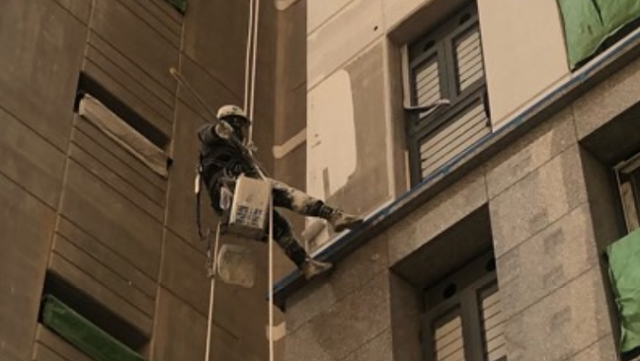 A worker is using a 'dalbigye' to paint the exterior wall of a building. Photo by Ministry of Employment and Labor
[Asia Economy Reporter Kim Choyoung] Recently, a man in his 60s working on exterior wall painting at an apartment in Gangdong-gu, Seoul, fell to his death. Despite the government taking measures such as urgent on-site inspections following a series of fatal falls during exterior wall repair and painting work on buildings like apartments, critics argue that these actions have not provided a fundamental solution. Experts emphasize strengthening the responsibility of the primary contractor and ensuring that on-site workers are well-versed in the Industrial Safety and Health Act.
According to statistics from the Korea Occupational Safety and Health Agency, from 2016 until April of this year, there have been 66 deaths related to 'dalbigae' (a suspended scaffold tied with ropes to fixed parts of a building) accidents in the construction industry over the past five years. Among these, 46 deaths (70%) occurred during exterior wall work on multi-family housing.
The types of fatal accidents during exterior wall work are categorized into three: △ preparation phase (falling from the roof edge during scaffold installation or preparation), △ boarding phase (falling while sitting on the dalbigae scaffold), and △ working phase (falling due to rope loosening or breakage during scaffold work).
The leading cause of accidents is rope loosening (51%), followed by rope breakage (22%), falls during boarding the scaffold (9%), breakage of fixed supports (6%), scaffold falls (6%), moving outside the scaffold (3%), and insufficient rope length securing (1%). Other causes include the absence of safety belts and fall prevention devices, as well as scaffold aging.
 Building exterior wall work has been pointed out as a blind spot in safety management. [Image source=Yonhap News]
Until now, exterior wall work using dalbigae has often been short-term and small-scale, leading to concerns about safety management blind spots. There have been criticisms that safety rules were not properly followed due to the absence of supervisors or lack of safety education.
At the site of the fatal fall of a man in his 60s during painting work on an apartment exterior wall in Gangdong-gu, Seoul, on the 7th, it was revealed that workers were not provided with safety belts or helmets. Additionally, safety railings, which should be installed on all sides of the scaffold, were also missing.
Current regulations on industrial safety and health standards stipulate that the construction entity must assign a supervisor on-site to inspect for material defects such as rope conditions in advance, decide on safe work methods, and continuously monitor hazardous situations during construction.
The managing entity must also verify whether safety education on accident cases and prevention measures has been conducted before work begins and supervise whether the construction company and workers comply with the Industrial Safety and Health Act and related regulations to work safely.
However, there are criticisms that the government’s measures for exterior wall work, considered a safety management blind spot, are limited to one-off site inspections and monitoring, failing to eradicate accidents.
In April, following a series of falls during exterior wall painting work on apartments, the government launched urgent site inspections and supervision, but dalbigae accidents have continued since then.
Experts suggest that strengthening the responsibility of the primary contractor and ensuring that on-site workers understand the Industrial Safety and Health Act can eradicate these accidents.
Park Hyeyoung, a labor health solidarity labor attorney, said in an interview with CBS Radio, "Because employment is structured in many subcontracting layers, even if safety issues are raised on-site, accidents often occur before action is taken, or the person who raised the issue is dismissed?one of the two usually happens. We need to start by strengthening the responsibility of the primary contractor." She also advised, "On-site workers are likely unaware of the Industrial Safety and Health Act, especially in small-scale workplaces, so the Ministry of Labor should actively step in to inform them."
© The Asia Business Daily(www.asiae.co.kr). All rights reserved.


















