Gwangju Cafe Owner and Other '586' Activists Criticize Current Government's 'Sojusung' Policy
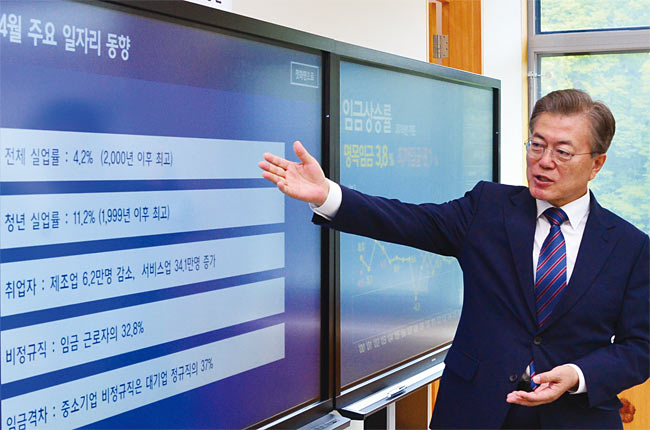 President Moon Jae-in is demonstrating the 'Job Situation Board' at the Yeomin-gwan office in the Blue House on May 24, 2017. [Image source=Yonhap News]
[Asia Economy Reporter Han Seung-gon] "Gangnam leftists have destroyed the self-employed and the livelihood ecosystem of ordinary people," "Everyone who talked about income-led growth are all fraudsters."
The voices of former '586 activist' figures criticizing the Moon Jae-in administration are growing louder. The main criticism is that jobs are decreasing and life is becoming too difficult. Criticism of the current government's job policies has also come from opposition parties as well as research reports from the Democratic Party of Korea. President Moon stated that he pursued growth through raising the minimum wage and income-led growth (Soju-seong).
Activists from the 1980s democratization movement have raised their voices, saying that life has become even tougher due to the current government's job policies. This generation is currently a major support base for the Democratic Party, making their criticism of the Moon administration particularly noteworthy.
Mr. Bae Hoon-cheon, a graduate of Chonnam National University who participated in the struggle to overthrow the Chun Doo-hwan regime, openly criticized the Moon administration's Soju-seong policy. Also, Ham Woon-kyung, a symbolic figure of the 586 generation's anti-American struggle who led the occupation of the U.S. Cultural Center, criticized the government's steep minimum wage increase after running a sashimi restaurant himself.
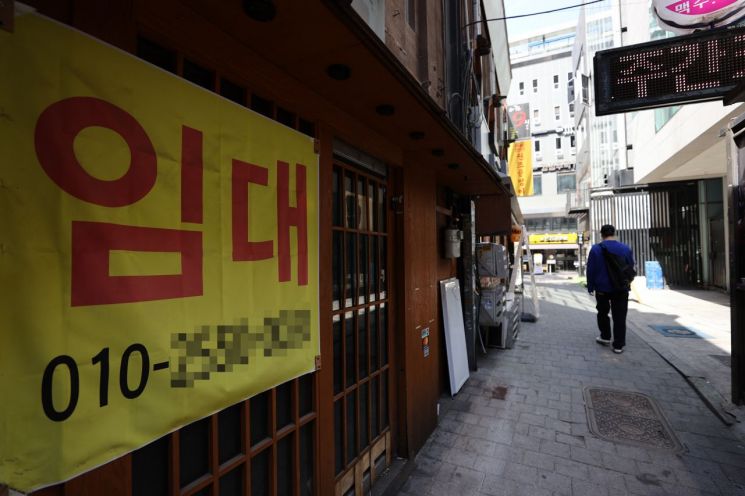 The '586' generation, consisting of figures from the activist circles, is voicing criticism toward the Moon Jae-in administration. They criticized that the income-led growth policy pursued by the current government has made running small businesses even more difficult.
 [Image source=Yonhap News]
Mr. Bae, who runs a coffee shop in Gwangju Metropolitan City, attended a public debate held on the 12th at the Gwangju April 19th Revolution Memorial Hall's Unification Hall under the theme "Moon Jae-in Administration's Economic Policies and the Reality of Honam." He said, "I gathered courage because I thought it would be beneficial for the future of the Republic of Korea, where our children will live, to hear the perspective of a local resident in Gwangju, the support base of this government."
He then criticized the minimum wage, saying, "Even now, I get furious thinking about it. I hardly ever hire part-timers. Even if I do, I only hire part-timers with experience working less than 15 hours. Jobs that used to be ignored because the working hours were too short to make money now get filled within a day after posting an ad. So many calls come in that it interferes with business."
He added, "The Moon administration was far from economic growth from the start. They made all the youth bury themselves in study rooms to focus on civil service exams. Young people should be able to enter small and medium enterprises to earn money, socialize, and meet friends, but since they are all stuck in study rooms clutching only workbooks, how can neighborhood businesses survive?"
He also criticized, "Gangnam leftists pushed anti-market policies such as income-led growth, minimum wage hikes, and the 52-hour workweek, destroying the self-employed and the livelihood ecosystem of ordinary people."
Meanwhile, in an interview with Chosun Ilbo, Mr. Ham said, "For employees' wages to rise, store sales must increase first; wages don't go up before sales increase," rebutting Soju-seong. He continued, "Good intentions don't always lead to good results," and raised his voice, saying, "The Democratic Party thinks of itself as progressive but is oblivious to its own destruction."
In particular, he expressed dissatisfaction, saying, "Having run a business, I can say that everyone who talked about income-led growth are all fraudsters. Does income increase just because the government tells you to pay higher wages? It actually reduces employment."
 [Image source=Yonhap News]
While voices from the 586 activist group, a support base of the Democratic Party, criticize the Moon administration's job policies, critical views have also emerged from the Democratic Research Institute, the party's think tank.
In a report titled "Analysis of Characteristics of Unemployed Youth and Proposals for Customized Youth Employment Policies," the institute evaluated, "Although the budget has doubled since the early days of the administration, youth employment remains sluggish." Regarding this background, it stated, "The sluggish youth employment is due to government policies focusing only on quantitative expansion with insufficient effectiveness," and added, "An improved understanding of 'youth' as the core target of unemployment measures is necessary."
In this context, the 'economic pain index,' which sums the consumer price inflation rate and unemployment rate, was found to have reached its highest level in 10 years as of last month (May).
According to calculations by Rep. Chu Kyung-ho of the People Power Party, a member of the National Assembly's Planning and Finance Committee, based on Statistics Korea data, the economic pain index last month was 6.6. This is the highest figure for May since May 2011 (7.1). It has risen sharply compared to 4.7 in May 2019 and 4.2 in May 2020.
The economic pain index was first devised by American economist Arthur Okun and is an indicator that sums the inflation rate and unemployment rate at a specific point in time to gauge the level of economic hardship felt by the public. Last month, the consumer price inflation rate was 2.6%, and the unemployment rate was 4.0%, resulting in an economic pain index of 6.6.
Rep. Chu criticized, "The Moon administration's job policy failures, combined with the job drought caused by the COVID-19 shock and the sharp rise in living costs, are increasingly hurting ordinary people." He emphasized, "The government and ruling party must quickly ease regulations to help create corporate jobs and also focus on price management."
Meanwhile, amid criticism of Soju-seong and job policies, President Moon emphasized at an international conference that growth is being pursued through Soju-seong. In a virtual speech at the 109th International Labour Organization (ILO) General Assembly on the 17th, President Moon stressed, "We boldly raised the minimum wage and pursued inclusive growth, including income-led growth."
© The Asia Business Daily(www.asiae.co.kr). All rights reserved.


















