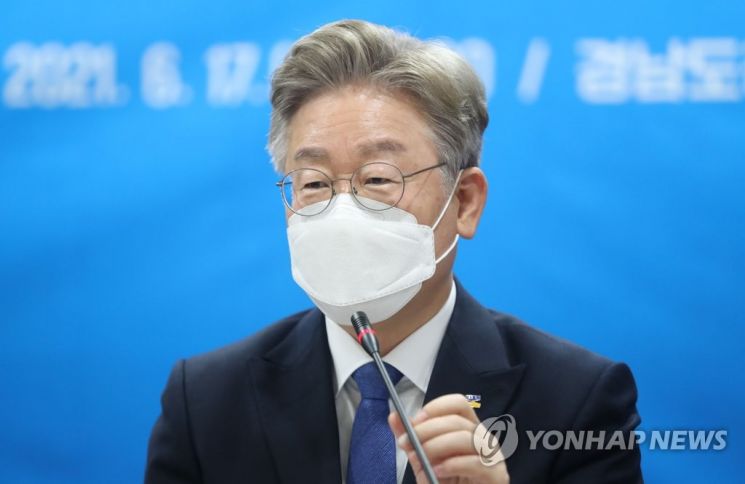
 Gyeonggi Province Governor Lee Jae-myung is delivering a greeting at the "Policy Agreement Ceremony for Joint Cooperation between Gyeongsangnam-do, Gyeonggi-do, Gyeongsangnam-do Institute, and Gyeonggi Research Institute," held on the morning of the 17th at Gyeongsangnam-do Provincial Office in Uichang-gu, Changwon-si, Gyeongnam.
 [Image source=Yonhap News]
[Asia Economy Reporter Kim Choyoung] Lee Jae-myung, Governor of Gyeonggi Province, opposed the government's proposal to limit disaster relief payments to the bottom 70% income bracket, stating that "high-income earners who pay more taxes are also citizens."
On the 20th, Lee said on his Facebook, "If it is a national policy to revitalize the economy and support affected citizens with taxes paid by the people, it is just and fair that everyone enjoys the benefits."
Earlier, the Ministry of Economy and Finance reportedly proposed a support plan during party-government consultations to provide disaster relief payments to households in the bottom 70% income bracket and offer credit card cashback to all citizens.
Lee pointed out, "There are opinions to exclude not only the top 30% income earners but also public officials and large corporation workers," adding, "Since the payments are made with taxes paid more by high-income earners, excluding those who pay more taxes is an unreasonable double discrimination."
He emphasized, "If limited to 70%, those who earn just 10 won more, corresponding to 70.01%, will be excluded, causing income regressivity," and "No citizen would easily accept exclusion from support just because they earn 10 won more than their neighbor."
He also added, "Those excluded in times of crisis suffer not because of the amount but due to feelings of alienation and discrimination, which damages the community," and "Public officials and large corporation workers are also citizens who pay taxes in this country, and they suffer from COVID-19 and incur costs such as masks just the same."
Finally, Lee advised, "Our Democratic Party and the Moon Jae-in administration, which aim for universal welfare, must be extremely cautious about unreasonable discrimination among citizens," and "The Democratic Party should remember why it advocated universal school meals that benefit even conglomerate grandchildren instead of discriminatory meals."
Meanwhile, the party, government, and Blue House are scheduled to hold a high-level party-government consultation meeting this afternoon to discuss the scale, method, and timing of disaster relief payments.
© The Asia Business Daily(www.asiae.co.kr). All rights reserved.

















