New Social Distancing System Revision to Take Effect on the 1st of Next Month
'Ban on Private Gatherings of 5 or More' Officially Incorporated
Level 1: No Limit on Private Gatherings
Level 2: Up to 8 People → Level 3: Up to 4 People
Level 4: Only 2 People Allowed After 6 PM
Fully Vaccinated Individuals Exempt from All Capacity Limits
If Current Trend Continues,
Level 2 in the Capital Area, Level 1 in Non-Capital Areas Expected
However, a 2-Week Transition Period Allowing Up to 6 People in the Capital Area
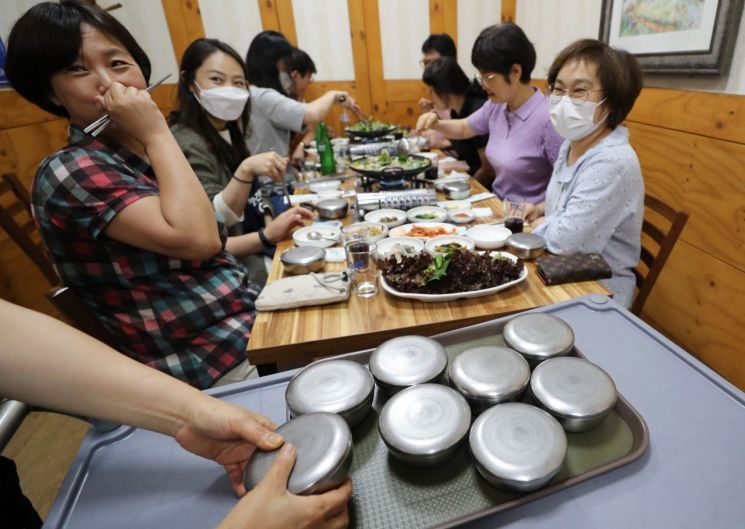 On the afternoon of the 18th, when private gatherings of up to 8 people became possible in Gwangju, a restaurant near Buk-gu Office in Gwangju served steamed rice bowls to a table of 8 customers.
 [Photo by Yonhap News]
[Asia Economy Reporter Lee Chun-hee] Starting from the 1st of next month, a new social distancing system reform plan will be implemented. The 'ban on private gatherings of five or more people,' which has been maintained as a separate quarantine measure for about half a year, will be officially incorporated into the system.
According to the new reform plan, if the current level of COVID-19 spread is maintained, from next month, gatherings of up to 8 people will be allowed in the metropolitan area, and there will be no limit on the number of people in non-metropolitan areas. However, in the metropolitan area, a two-week transition period until the 14th of next month will allow private gatherings of up to 6 people, after which the number of people allowed to gather will be gradually increased.
The Central Disaster and Safety Countermeasures Headquarters of the Ministry of Health and Welfare announced on the 20th that the new social distancing stage reform plan containing these details will be implemented from the 1st of next month. In June last year, the government announced a social distancing system based on a three-stage system. In November, a more detailed five-stage system was designed.
However, as subdivisions such as levels 1.5 and 2.5 were inserted between stages 1 to 3, there were criticisms that the behavioral response messages for the 0.5 stage were unclear. Also, although the key indicator for adjusting social distancing stages is the number of confirmed cases, even when these numbers were met, health authorities hesitated to raise the distancing stage citing that auxiliary indicators such as severe patient beds and residential treatment centers were still sufficient, leading to complaints that the criteria had become meaningless.
In response, the government explained that since over 14 million people received at least the first dose of the COVID-19 vaccine in the first half of the year and general public vaccinations began in the second half, it was necessary to prepare standards and quarantine rules reflecting the reduced risk, which led to the formulation of this reform plan.
Application of confirmed case criteria by region... 'Per 100,000 population' is the standard
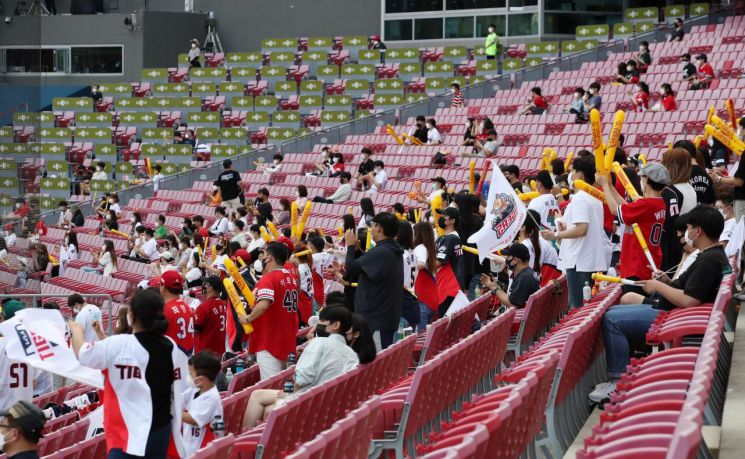 On the 16th, spectators at Gwangju-Kia Champions Field are watching and cheering during the KBO professional baseball game between the SSG Landers and the KIA Tigers. [Image source=Yonhap News]
The new reform plan simplifies the existing five stages into four and strengthens the autonomy of local governments. Stage 1 is 'Suppression,' Stage 2 is 'Regional Spread/Capacity Limit,' Stage 3 is 'Area Spread/Gathering Ban,' and Stage 4 is 'Widespread Outbreak/Stay-at-Home Order.'
These stages are determined based on the weekly average number of confirmed cases per 100,000 population. If the number of confirmed cases is less than 1 per 100,000, Stage 1 applies; if 1 or more, Stage 2 applies. Stage 3 is applied when confirmed cases are 2 or more per 100,000 and regional intensive care units are over 70% occupied; Stage 4 is applied when cases are 3 or more per 100,000 and nationwide intensive care units are over 70% occupied. Additionally, auxiliary indicators such as the reproduction number (R value), the proportion of cases under investigation for infection routes, the proportion managed within the quarantine network, and test positivity rates are utilized.
According to the confirmed case indicator, the nationwide criteria are: Stage 1 for fewer than 500 cases, Stage 2 for 500 or more, Stage 3 for 1,000 or more, and Stage 4 for 2,000 or more. For the metropolitan area, the criteria are half of these: fewer than 250 → 250 or more → 500 or more → 2,000 or more. Health authorities explained that strictly applying the per 100,000 population standard would set the Stage 2 elevation threshold at 518.5 nationwide and 259.3 in the metropolitan area, but such criteria could cause communication difficulties, so they rounded the numbers to units of 50 or 10.
Adjustments by region rather than nationwide elevation can be autonomously decided by each local government, and regional adjustments are made in consultation with the Central Disaster and Safety Countermeasures Headquarters, with each city and province taking the lead.
Stage 1 'No restrictions' → Stage 2 'Up to 8 people' → Stage 3 'Up to 4 people'
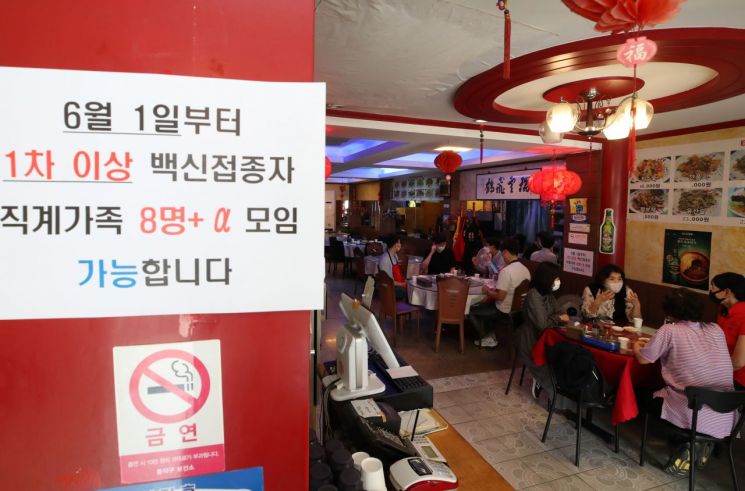 On the 1st, an incentive measure was implemented that exempts immediate family members who have received at least one dose of the COVID-19 vaccine from the limit on the number of people allowed at family gatherings. On the 1st, a Chinese restaurant in Dongjak-gu, Seoul, displayed a notice stating that immediate family gatherings including vaccinated members can have "8 people + α."
 [Image source=Yonhap News]
The restriction on the number of people allowed in private gatherings, which is of greatest interest to citizens, has been officially incorporated into the distancing system through this reform plan. In Stage 1, gatherings are allowed without limits on the number of people, provided quarantine rules are followed. In Stage 2, gatherings of up to 8 people are allowed, and in Stage 3, gatherings of up to 4 people are permitted as currently. In Stage 4, the 'Widespread Outbreak/Stay-at-Home Order' stage, gatherings of up to 4 people are allowed before 6 p.m., but only up to 2 people afterward.
Notably, the 8-person limit in Stage 2 exempts direct family gatherings from the restriction. First birthday parties (doljanchi) are also allowed with up to 16 people. However, these exceptions do not apply if the stage is elevated to Stage 3.
As previously announced by the government, as part of incentives for COVID-19 vaccine recipients, those who have completed the second dose (or the first dose for Janssen) and 14 days have passed are exempt from private gathering restrictions. Also, exceptions apply regardless of the stage for cohabiting family members, caregiving or end-of-life situations, and cases where a minimum number of people is required to form sports teams.
These private gatherings include all meetings and events aimed at socializing, such as alumni meetings, club gatherings, workplace dinners (including lunch), New Year's parties, first birthday parties, 60th and 70th birthday celebrations, and regular online cafe meetings. Weddings and funerals are not considered private gatherings and are subject to separate standards. In Stage 2, gatherings of 100 or more people are prohibited; in Stage 3, 50 or more; and in Stage 4, only relatives may gather.
Separate standards for events and assemblies... Assemblies and protests limited to 499 people in Stage 1, 99 in Stage 2
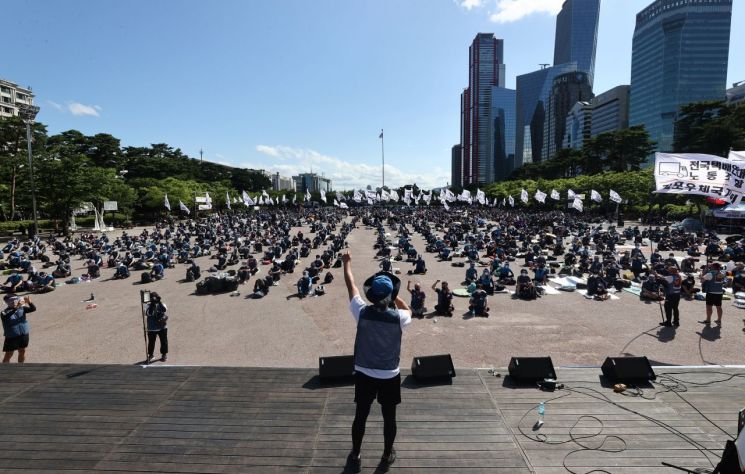 On the morning of the 16th, members of the National Courier Workers' Union held a rally at Yeouido Park in Seoul, urging measures to prevent death from overwork and the implementation of social agreements. [Image source=Yonhap News]
Separate standards also apply to events and assemblies. Large-scale events such as local festivals, briefings, and commemorations can gather more than 500 people in Stage 1 if prior notification is given to local governments. However, in Stage 2, gatherings of 100 or more are prohibited; in Stage 3, 50 or more; and in Stage 4, such large-scale events are banned.
Assemblies and protests are subject to stricter regulations than general events and assemblies due to the higher risk of droplet transmission from chanting and singing. In Stage 1, up to 499 people can gather; in Stage 2, up to 99; in Stage 3, up to 49; and in Stage 4, only one-person protests are allowed.
Exhibitions, fairs, international conferences, academic events, and large concerts have different standards. Exhibitions and fairs allow one person per 4㎡ in Stage 1, and one person per 6㎡ in Stages 2 to 4. International conferences and academic events require one seat spacing or 1m distancing in Stage 1, and two seats spacing or 2m distancing in Stages 2 to 4. Large concerts operate with assigned seating and venue rules, allowing up to 5,000 attendees in Stages 2 to 4.
Some events are exempt from these restrictions. Essential corporate management activities and official duties based on laws, such as regular shareholder meetings, National Assembly sessions, broadcasting production and transmission, graduation and entrance ceremonies, can be held if quarantine rules are followed. Exams can also be conducted if a distance of at least 1.5m between examinees is maintained.
However, those who have completed COVID-19 vaccination are exempt from all restrictions on private gatherings, events, and assemblies. The government plans to continuously expand these incentives considering vaccination progress and epidemic situations. Possible measures under review include lifting seat spacing, allowing standing concerts, and permitting food consumption inside movie theaters exclusively for vaccinated individuals.
New distancing system to be implemented from the 1st of next month... Metropolitan area has a 2-week 'transition period'
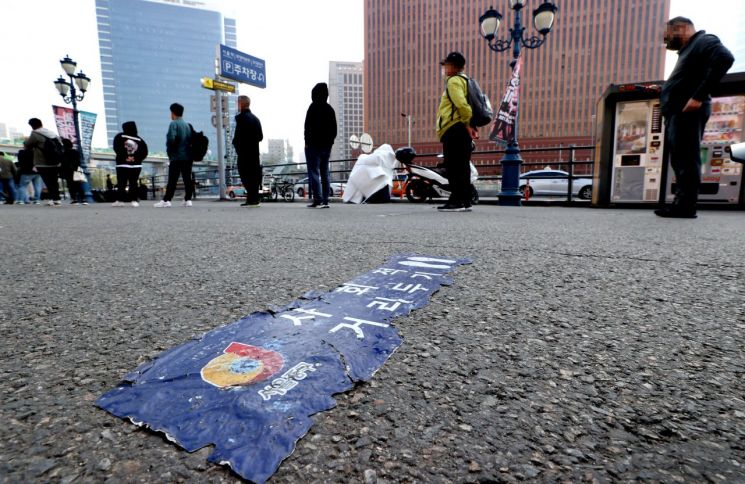
The new restrictions on private gathering numbers and other measures under the social distancing stage reform will be implemented from midnight on the 1st of next month. Although the current distancing system is set to end on the 4th of next month, and it was expected that the new system would start on the 5th, health authorities decided to implement it immediately considering the stable control of the current outbreak and smooth progress of vaccinations.
However, due to concerns about easing tension from sudden changes, local governments may set a two-week transition period from the 1st to the 14th. In the metropolitan area, if the current outbreak scale continues, Stage 2 will apply allowing gatherings of up to 8 people, but considering the large outbreak scale, a transition plan allowing only up to 6 people in private gatherings will be applied for two weeks. Other regions will also decide later whether to have a transition period until the end of this month before switching to the new distancing system based on the evaluation of the outbreak situation.
© The Asia Business Daily(www.asiae.co.kr). All rights reserved.