US Battery Imports, China Share at 51% This Year... Up 8%P from Last Year
Domestic Battery Supply Chain Review Concludes "Caution Against Chinese Dominance"
[Asia Economy Reporter Choi Dae-yeol] It has been revealed that the proportion of Chinese-made secondary batteries imported by the United States has exceeded half. Last year, the share of imports from third countries where Korean battery companies have factories increased, causing China's share to drop to the low 40% range, but it has turned upward again this year.
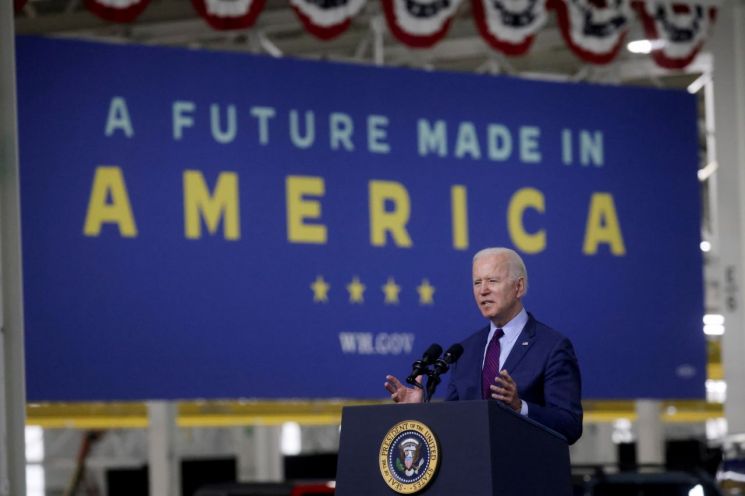
Since the battery supply chain within the United States is still immature, the U.S. continues to rely heavily on imports of batteries used in electric vehicle batteries and others from other countries. After President Joe Biden took office earlier this year, he ordered a review of supply chains for key industries including batteries. After about 100 days of investigation, the recent report concluded that dependence on China must be reduced. Given the potential for trade disputes with China at any time, it is necessary to diversify the supply system with other countries.
According to statistics from the Korea International Trade Association on the 20th, the U.S. imported lithium-ion batteries worth $2.307 billion from January to April this year, a 71% increase compared to the same period last year. By country of import, China accounted for $1.168 billion, or 51%. Previously, the share of Chinese-made batteries among U.S. imports last year was on a downward trend at 43%, but it has turned to an upward trend this year.
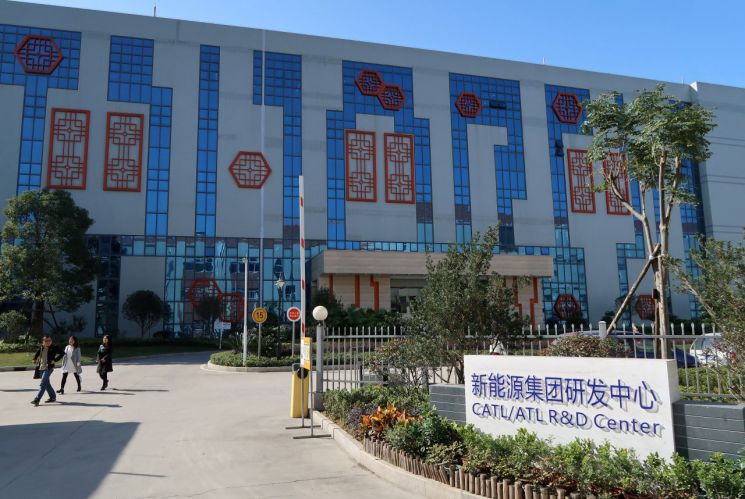 Electric vehicle battery company CATL's research and development center in Ningde, Fujian Province, China
 The reason the Chinese share, which hovered around 50% in recent years, decreased last year was due to increased imports from Hungary, Malaysia, and Poland. These countries each host factories of Korea's top three battery companies: SK Innovation, Samsung SDI, and LG Energy Solution. This is interpreted as a result of increased exports of batteries made at those factories to the U.S. Although some companies like LG and Panasonic have local production systems in the U.S., supply is still far short of demand, so a significant portion of demand is met by imports.
In particular, the president has directly promoted the expansion of electric vehicle adoption as a key policy, but it is expected to take considerable time for battery plants currently under construction in the U.S. to establish a complete supply system. Some parts of SK's Georgia plant were completed this year and are in pilot production, and the joint plant between LG and General Motors (GM) in the U.S. will start operations after next year. As major automakers are launching new electric vehicles one after another, battery demand is surging, so the amount of batteries imported by the U.S. is likely to increase for the time being.
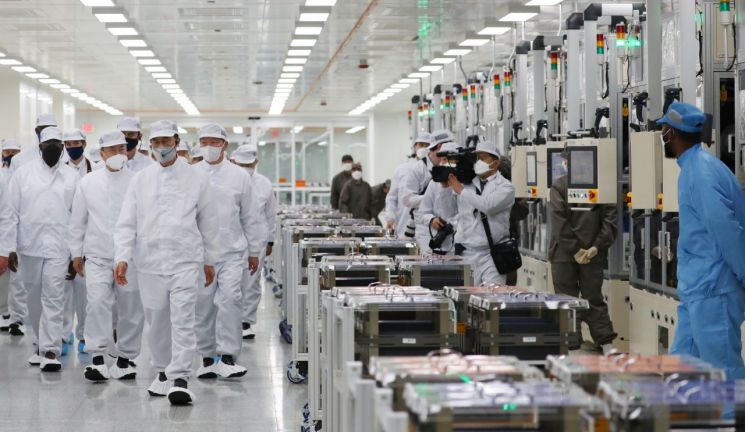 President Moon Jae-in, who visited the United States last month for the Korea-US summit, is inspecting the production line at SK Innovation's electric vehicle battery plant near Atlanta, Georgia. The plant was completed earlier this year and is operating with the goal of mass production within the year.
 Biden's Executive Order to "Review Battery Supply Chains"
100-Day Investigation Concludes "Concerns over China's Market Dominance"
Proposes Diversification of Supply Sources and Expansion of Domestic Production Facilities
After President Biden issued an executive order to review the battery supply chain, the recent investigation report identified China as a risk factor. It concluded that China's control of about 70-80% of midstream processes, such as raw material processing and the production of battery cells?the most basic unit of batteries?raises market dominance concerns that the U.S. should be wary of.
Just as China previously imposed trade retaliation by banning rare earth exports, similar issues could arise with battery materials. The White House pointed out problems such as Chinese government subsidies and Chinese material suppliers providing high-quality products to domestic Chinese battery companies.
The Biden administration has clearly stated its intention to build a series of industrial ecosystems related to electric vehicles as part of its response to climate change and the revival of domestic manufacturing. The report recommended increasing electric vehicle demand, strengthening supply chains for raw materials such as battery materials, and expanding battery cell production facilities domestically. It also suggested focusing on research and development due to rapid technological changes and included content on retraining existing automotive industry workers.
© The Asia Business Daily(www.asiae.co.kr). All rights reserved.
![Clutching a Stolen Dior Bag, Saying "I Hate Being Poor but Real"... The Grotesque Con of a "Human Knockoff" [Slate]](https://cwcontent.asiae.co.kr/asiaresize/183/2026021902243444107_1771435474.jpg)


















