Government Advances Roadmap for Microsatellite Development, Fosters Space Industry Experts, and Supports Small Venture Space Companies
Microsatellites Can Be Produced at 200 Million KRW Each... Delivering Performance Comparable to High-End Expensive Satellites When Operated in Clusters
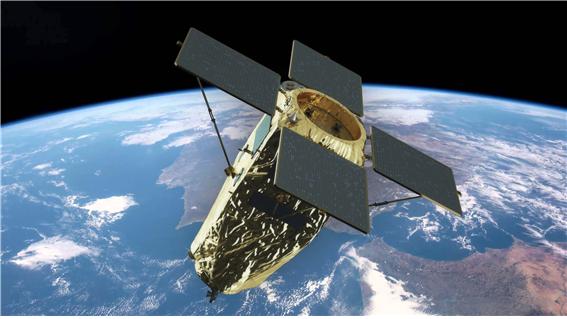
[Asia Economy Reporter Kim Bong-su] The government has begun actively investing as a 'primer' to revitalize the private space industry. By ordering more than 100 public-sector nanosatellites by 2031, it aims to provide a foundation for private space companies to secure 'business opportunities' and acquire technology, thereby opening the full-fledged New Space era and expanding South Korea's economic share in the global space industry.
On the 19th, the Ministry of Science and ICT reported a nanosatellite development roadmap and plans to foster space industry professionals, including these details, at the Emergency Economic Central Countermeasures Headquarters meeting. The government plans to produce and launch about 100 nanosatellites for four purposes: establishing a national security surveillance system, 6G satellite communication, space radio environment, and securing future leading technologies.
Why Nanosatellites?
This public nanosatellite order is expected to directly translate into sales for domestic related companies, becoming a survival foundation. The production cost of high-performance medium and large satellites ranges from 50 to 60 billion KRW at the low end to 100 to 250 billion KRW at the high end, making such projects rare due to their high cost. The production technology is also highly advanced, making development itself difficult. However, nanosatellites can cost as little as $200,000 (about 210 million KRW) and have simpler technology, making it easier for private companies to participate. Their relatively short lifespan also generates continuous production demand.
In particular, the government plans to involve private companies from the first unit (prototype satellite) of each project and have private entities lead mass production from the second unit onward, transferring satellite manufacturing know-how and core technologies. The Ministry of Science and ICT explained, "Because short-term and low-cost development is possible, it lowers the entry barrier for private participation in space development, enhances the economic feasibility of space products and services, and plays a key role in revitalizing the space industry." The U.S. private space company SpaceX is also launching over 12,000 nanosatellites to build space internet and high-speed satellite communication networks.
Although individual performance is lower, forming constellations with multiple satellites yields better effects. It allows more frequent observation of the same point or wider observation at the same time. High-performance satellites can be effectively interconnected and complementarily operated, facilitating global mission execution. Over the past five years, the global nanosatellite industry has grown at an average annual rate of 17%.
Direct Support for Small and Venture Space Companies
The government is also promoting the 'Space Innovation' project to develop pilot models of space business based on nanosatellites, enabling small and venture companies to enter the space industry. Four companies will be selected and supported with about 2 billion KRW over three years, receiving technical advice and schedule management from space specialized institutions. If the business model is successfully validated, additional support for mass production of follow-up satellites, export, and commercialization will be provided for two more years.
The government will also build a database of commercial components needed for nanosatellites and provide it to companies. This is to help reduce development time and costs required to select commercial components applicable to nanosatellites. Nanosatellites use inexpensive commercial components rather than costly space-grade parts. However, finding commercial components that can operate in space environments takes time and money, and this database will save time for both government and private companies.
Training Space Industry Professionals
With the opening of the New Space era, demand for personnel is rapidly increasing. To respond, the government conducts specialized space technology training for about 100 people annually to cultivate practical personnel required in the space industry and prioritizes their employment in space companies. Additionally, about 60 university (graduate) students per year will receive on-site education using facilities and equipment of space specialized institutions.
To cultivate professionals capable of satellite system development, about 10 master's degree holders or higher will be supported to participate directly in satellite development projects for two years and receive apprenticeship-style education from experts. A 'Future Space Education Center' will be established in fields requiring strategic personnel training such as space exploration, space communication, and AI-big data convergence space technology, and experts will be trained through industry-academia-research consortiums. Job training for space company employees will also be supported to strengthen corporate capabilities. More than 200 people annually will receive theoretical, practical, and on-site training by major fields, as well as seminars providing global space technology and market trends.
© The Asia Business Daily(www.asiae.co.kr). All rights reserved.
![Clutching a Stolen Dior Bag, Saying "I Hate Being Poor but Real"... The Grotesque Con of a "Human Knockoff" [Slate]](https://cwcontent.asiae.co.kr/asiaresize/183/2026021902243444107_1771435474.jpg)











