Stock Market Fluctuates on More Hawkish Outcome Than Expected... Volatility Remains Low
Uncertainty Eased Amid Trust in US Federal Reserve
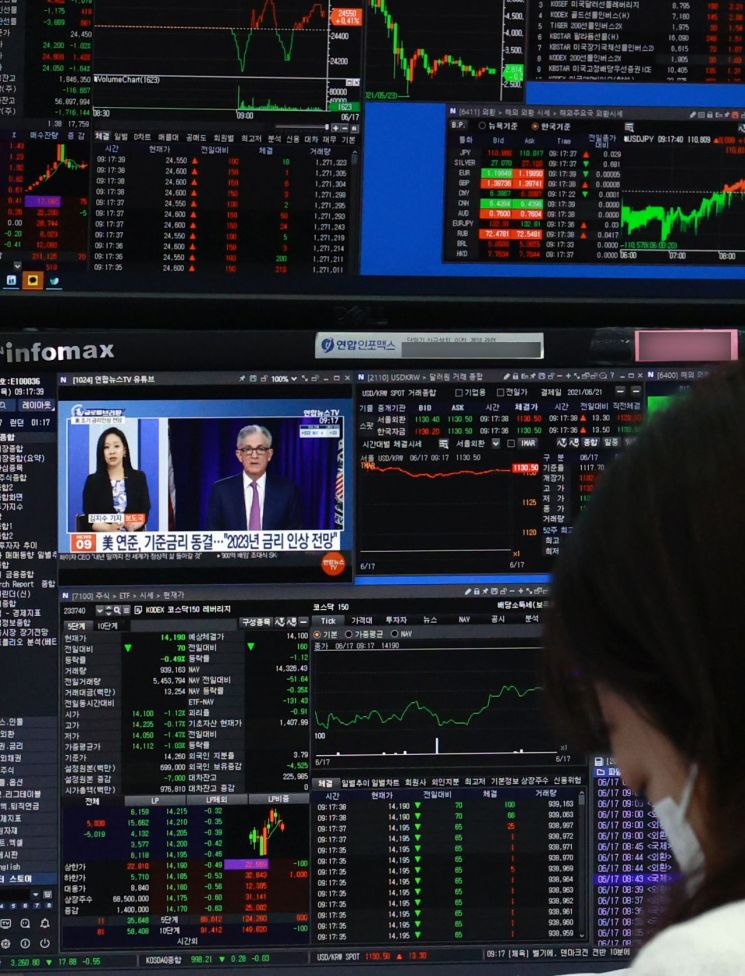 On the morning of the 17th, a foreign exchange dealer is working while monitoring news related to the U.S. Federal Reserve in the dealing room of the Hana Bank headquarters in Euljiro, Jung-gu, Seoul.
 [Image source=Yonhap News]
[Asia Economy Reporter Minwoo Lee] The results of this month's U.S. Federal Open Market Committee (FOMC) meeting came out more hawkish (favoring tightening) than expected, leading to an analysis that the Federal Reserve's (Fed) policy direction has become clearer. The market perceives that the Fed's liquidity reduction is not imminent, suggesting that downward pressure on the stock market will not be significant.
The Fed held the FOMC meeting over two days on the 15th and 16th (local time) and decided to keep the benchmark interest rate at the current 0.00?0.25% level. The asset purchase scale was also maintained at $120 billion (approximately 136 trillion KRW) per month. The number of Fed officials expecting the timing of rate hikes to be earlier than previously forecast increased significantly compared to the March meeting. According to the dot plot showing Fed officials' policy rate expectations, 13 out of 18 participants anticipated rate hikes by 2023. The median forecast predicted a 50 basis point (1bp = 0.01 percentage point) increase during 2023.
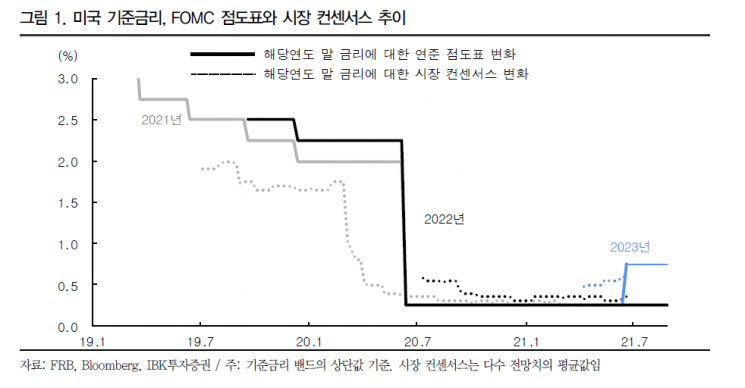
Before the FOMC results were announced, the KOSPI, which had expected a dovish stance, fell upon confirmation of the hawkish position. However, the decline was not large. The closing price on the 17th was 3,264.96, down only 0.42% from the previous day. On the 18th, it closed at 3,267.93, up 0.09%. The U.S. 10-year Treasury yield rose by 8 basis points to 1.57% immediately after the hawkish FOMC results but fell back to 1.52% the next day.
So-eun Ahn, a researcher at IBK Investment & Securities, explained, "While concerns about early rate hikes due to the upward revision in the dot plot were offset by dovish remarks from Fed Chair Jerome Powell, the clearer policy direction of the Fed likely had a positive effect. Until now, the Fed showed differences in views with the market regarding inflation and tapering (reduction of asset purchases), and even internally, consensus was lacking. However, Chair Powell officially acknowledged 'the possibility of prolonged inflation due to bottlenecks' and 'the start of internal discussions on tapering.'
Although the initiation of tapering and rate hike discussions is a burden on the stock market, the likelihood of a sustained decline is considered low. This is because the Fed reiterated its stance that it will provide ample notice before tapering, supported by improving employment indicators. Researcher Ahn stated, "It is necessary to monitor future economic indicators such as employment and inflation, as well as changes in the stance of Fed officials. Unless the Fed's credibility weakens, the risk of immediate liquidity reduction will not intensify."
© The Asia Business Daily(www.asiae.co.kr). All rights reserved.
![Clutching a Stolen Dior Bag, Saying "I Hate Being Poor but Real"... The Grotesque Con of a "Human Knockoff" [Slate]](https://cwcontent.asiae.co.kr/asiaresize/183/2026021902243444107_1771435474.jpg)

















