‘EV·ESS Used Battery Recycling Industrialization Center’ Groundbreaking
Signing of ‘Business Agreement for Establishing Battery Resource Circulation System’
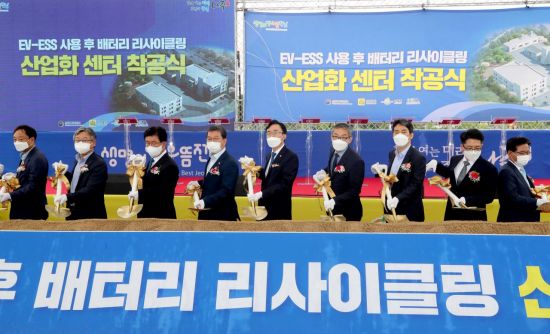
[Muan=Asia Economy Honam Reporting Headquarters, Reporter Yoon Jamin] Jeonnam Province is accelerating efforts to become a hub for the battery reuse industry.
On the 18th, the province announced that it held a groundbreaking ceremony for the ‘EV·ESS Used Battery Recycling Industrialization Center’ at the Naju Innovation Industrial Complex, along with signing a ‘Business Agreement for Establishing a Battery Resource Circulation System.’
The event was attended by political and business figures including Yoon Byung-tae, Jeonnam Province Deputy Governor for Political Affairs; Shin Jung-hoon, Member of the National Assembly; Kang In-gyu, Mayor of Naju; Lee Min-jun, Jeonnam Provincial Assembly member; Kim Wan-gi, Director of Material Convergence Industry Policy at the Ministry of Trade, Industry and Energy; as well as executives from 18 participating companies and institutions such as Sung Hwan-doo, Executive Director of LG Energy Solution; Lee Tae-kyung, Managing Director of Samsung SDI; Park Heon-yong, Vice President of SK Innovation; Oh Jae-hyuk, Managing Director of Hyundai Motor Company; and Lee Jin-guk, Managing Director of Woojin Industrial Systems.
The business agreement to establish a battery resource circulation system involved nine organizations and companies: Jeonnam Province, Naju City, Korea Battery Industry Association, Hyundai Motor Company, the three domestic battery manufacturers Samsung SDI, LG Energy Solution, SK Innovation, Woojin Industrial Systems, and Earth Tech. They pledged to cooperate in fostering the reuse and recycling industry of used batteries.
According to the agreement, the parties will collaborate on ▲ securing and providing used electric vehicle batteries ▲ establishing battery performance and safety testing and evaluation, dismantling and sorting equipment, and developing standards ▲ preparing used battery traceability management systems, transportation and storage guidelines ▲ supporting research and development, application product development, testing and certification ▲ planning joint research projects and promoting pilot projects.
The global electric vehicle market is expected to grow rapidly at an average annual rate of 29% over the next decade, but the disposal of used batteries is emerging as an environmental and industrial issue.
According to the Ministry of Environment, the number of domestic electric vehicle waste batteries is expected to accumulate from 493 units at the end of last year to 420,000 units by 2030.
This is an urgent and important national task from the perspectives of carbon neutrality and circular economy.
Electric vehicle batteries can be reused in various fields depending on their residual value. When battery performance drops to about 70%, they are no longer functional as a power source for electric vehicles but can be used in energy storage systems linked to renewable energy, electric ships, drones, e-mobility, agricultural and fishery electric devices, and camping chargers.
However, current reuse and recycling technologies are insufficient, and there are no methods or standards to evaluate residual value and safety, so used batteries are only being stored.
Accordingly, with a total project cost of 23.1 billion KRW, the Used Battery Recycling Industrialization Center will be established on an 8,602㎡ site in the Naju Innovation Industrial Complex by the end of this year.
The center will consist of an incoming inspection building, storage building, environmental testing building, and safety testing building, and will introduce facilities capable of handling more than 1,000 electric vehicle battery packs annually by 2024.
Once completed, used electric vehicle batteries generated domestically are expected to be reborn as various high value-added application products.
Jeonnam Province has the best technological innovation infrastructure in Korea, including an 8.2GW offshore wind power market, drones, e-mobility, eco-friendly ships, a small and medium-sized research and development special zone, and the Korea Energy Engineering University.
Based on this, the province plans to nurture up to 150 companies utilizing used batteries within the province by 2030.
Deputy Governor Yoon Byung-tae said, “Recently, meaningful achievements have been made with large-scale investments continuing from battery materials to finished products by companies such as POSCO, POSCO Chemical, and LCM Energy Solution,” adding, “The recycling center is expected to serve as a driving force to elevate the domestic secondary battery industry’s capabilities to the next level and to stand tall as the domestic secondary battery industry hub responsible for the entire lifecycle of the secondary battery industry.”
© The Asia Business Daily(www.asiae.co.kr). All rights reserved.
![Clutching a Stolen Dior Bag, Saying "I Hate Being Poor but Real"... The Grotesque Con of a "Human Knockoff" [Slate]](https://cwcontent.asiae.co.kr/asiaresize/183/2026021902243444107_1771435474.jpg)
















