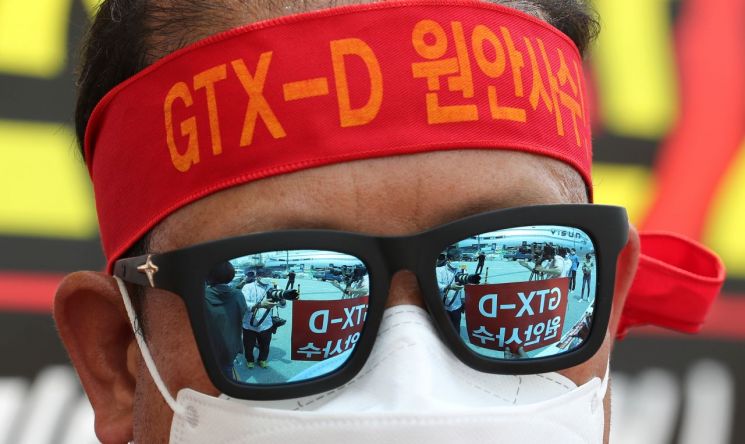
[Asia Economy Reporter Moon Jiwon] Regional conflicts surrounding the metropolitan area’s Great Train Express (GTX) are spreading. As housing prices fluctuate by hundreds of millions of won depending on the GTX routes, not only are emotional disputes arising among residents, but the ‘muddy competition’ among local governments is also intensifying. On top of this, the NIMBY (Not In My Backyard) phenomenon, where residents oppose having the railway pass under or next to their homes or neighborhoods, is causing widespread distress throughout the metropolitan area.
According to industry sources on the 18th, conflicts between regions over the D line have reignited following the Ministry of Land, Infrastructure and Transport’s designation of the Hyundai Construction consortium as the preferred bidder for the GTX-C line the previous day. The Hyundai Construction consortium scored the highest in the private investment project evaluation conducted by the Korea Transport Institute, surpassing the POSCO Construction and GS Construction consortiums. Through their project proposal, the Hyundai Construction consortium suggested adding Wangsimni Station in Seongdong-gu, Seoul, and Indeogwon Station in Anyang-si, Gyeonggi Province as additional stations. Although not yet finalized, the likelihood of these two stations being designated as additional stops beyond the existing 10 stations has significantly increased.
According to Hogangnono, an apartment transaction information company, complexes such as ‘Indeogwon Prugio El Centro’ and ‘Indeogwon Village Samsung,’ which are close to Indeogwon Station, have risen in real-time popular apartment rankings as this news spread, drawing increased attention. The original purpose of GTX was to disperse demand to the outskirts of the metropolitan area to stabilize housing prices, but it is ultimately fueling price increases and exacerbating housing instability.
There is growing opposition among residents of Uiwang Station and Sangnok-su Station areas, where efforts to designate additional stations failed. These areas had already seen significant price increases this year due to GTX expectations. According to statistics from the Korea Real Estate Board, apartment prices in Ansan and Uiwang have risen by 17.85% and 20.52%, respectively, since the beginning of this year?more than double the Gyeonggi Province average of 8.98%. Although there is some possibility that Uiwang Station and others could be included during the design revision process, complexes with diminished chances are expected to inevitably experience price fluctuations.
In areas already designated as GTX-C line stops, there are criticisms that selecting additional stations itself is problematic. A petitioner who posted on the Blue House petition board said, “GTX serves to quickly connect key points in the metropolitan area, but if more stations are added, it will be no different from a regular express train,” adding, “Construction should not be delayed further due to regional selfishness.” As the possibility of Wangsimni Station being selected as an additional station increases, residents near Cheongnyangni Station, which has already been confirmed as a stop, are opposing it with banners, saying, “Wangsimni Station suddenly just jumped on the bandwagon.”
The NIMBY phenomenon surrounding GTX is also intensifying. Residents of Eunma Apartments in Gangnam-gu, Seoul, where the C line passes underground, are protesting daily, demanding route changes. Residents in outer areas such as Dongducheon City, who have announced plans to launch a citywide signature campaign to extend the C line, are also strongly opposing. Additionally, residents near the GTX-D line in Gimpo, Incheon, and Hanam?who sparked the ‘Kim Bu-seon controversy’?are raising their level of opposition ahead of the final plan announcement scheduled for the end of this month, raising concerns that conflicts will continue for the time being.
© The Asia Business Daily(www.asiae.co.kr). All rights reserved.

















