US Interest Rate Hike Signals Combined with Recent Oil Price Rise Burden
Oil Demand and Iranian Election Impact Sustain Mid- to Long-Term Price Increase Outlook
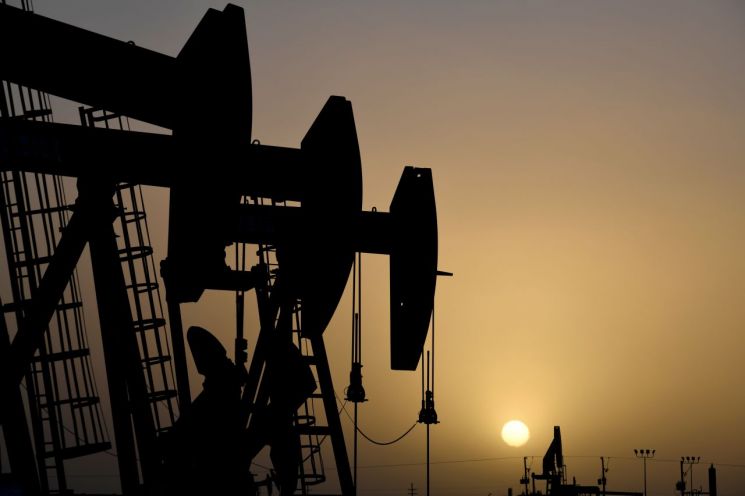
[Asia Economy Reporter Hyunwoo Lee] International oil prices recorded the largest decline this month due to the impact of the strong US dollar. Additionally, concerns grew as the US raised the possibility of increasing crude oil production, leading to short-term price fluctuations.
Experts believe that with the COVID-19 situation calming down, international oil demand continues to rise, and the Iran nuclear deal (JCPOA - Joint Comprehensive Plan of Action) negotiations are unlikely to be concluded before the Iranian presidential election, so the medium- to long-term upward trend is expected to continue.
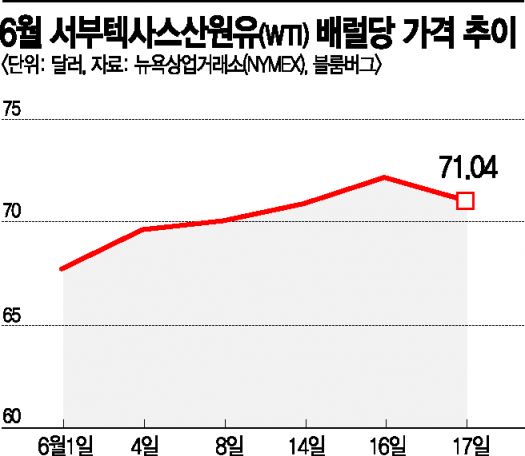
On the 17th (local time) at the New York Mercantile Exchange (NYMEX), West Texas Intermediate (WTI) crude oil closed at $71.04 per barrel, down 1.5% from the previous session. Brent crude traded on the London ICE Futures Exchange also closed at $73.08, down 1.76% from the previous day. This is the first time this month that international oil prices have fallen by more than 1%.
On this day, international oil prices declined due to the combined effects of the strong dollar and price pressure following the recent sharp rise. The Wall Street Journal (WSJ) analyzed, "The dollar surged after news that Federal Reserve officials discussed two interest rate hikes through 2023 at the Federal Open Market Committee (FOMC) meeting the day before, impacting oil prices," adding, "There is also significant pressure on oil prices after an 11% rise over the past month."
The increase in US crude oil production is also seen as contributing to the decline in oil prices. Eugene Weinberg, a commodities analyst at Commerzbank, explained in an interview with MarketWatch, "US daily crude oil production has risen to 11.2 million barrels, the highest since May, and the production rate is increasing rapidly. If US production recovers faster than expected and the US gains control over oil price setting, oil prices could fall even more quickly."
However, since international oil demand is expanding, the dominant view is that the medium- to long-term price increase trend will continue. The US Energy Information Administration (EIA) announced the US weekly crude oil inventory at 466.674 million barrels, a decrease of 7.355 million barrels from the previous week. This decline was more than twice the market expectation of a 2.9 million barrel decrease. Sophie Griffiths, an analyst at the US trading firm OANDA, analyzed in a report that day, "The larger-than-expected drop in crude oil inventories is due to increased US oil exports and shows that global oil demand is still rebounding strongly."
The likelihood of a hardliner victory in the Iranian presidential election scheduled for the 18th is also affecting oil price forecasts. On that day, Iran's state-run Press TV reported that the final poll before the election showed hardline conservative candidate Seyyed Ebrahim Raisi with 68.9% support, making his election highly likely. If the nuclear deal becomes difficult to conclude, the possibility of Iranian crude oil, which is under US sanctions, returning to the market will be low, and the upward trend in oil prices is expected to continue.
© The Asia Business Daily(www.asiae.co.kr). All rights reserved.


















