Transforming into a Customized Smart Office for the Post-Corona Era
Experimenting with Expanded Video Conference Rooms and Flexible Seating System
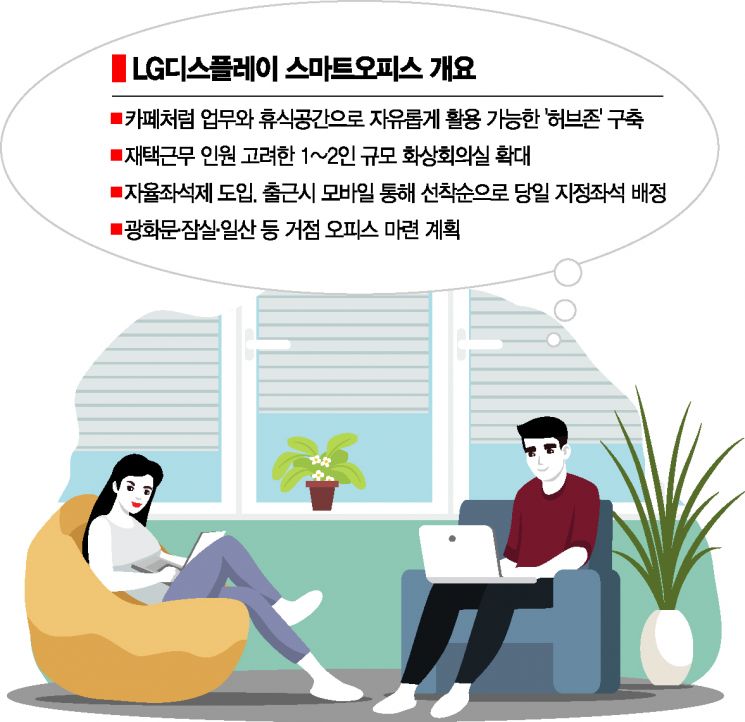
[Asia Economy Reporter Kim Heung-soon] About 100 LG Display employees recently commuted to LG Science Park in Magok, Gangseo-gu, instead of the Twin Towers in Yeouido, Seoul, where the headquarters is located, for about a month. This was due to renovation work to renew the Twin Towers office space. The renewal focused on building a 'smart office' in preparation for the post-COVID-19 era. New spaces were created where employees can combine work and rest to stimulate creativity, transforming the office into a flexible environment that can accommodate video conferencing and flexible working hours.
According to LG Display on the 18th, the biggest change in building the smart office was the introduction of the 'Hub Zone.' The Hub Zone is characterized by remodeling part of the existing workspace like a caf?. Long tables were installed similar to those in franchise coffee shops, and small chairs and tables were placed throughout. Employees can work or relax here during working hours while drinking coffee or beverages provided in the area with their laptops. An LG Display official explained, "Instead of separating rest areas, anyone can work and rest simultaneously in the Hub Zone," adding, "It is a space designed to foster creative ideas in a free and comfortable environment."
The number of small video conference rooms within the office space was also increased. LG Display employees have been implementing up to 50% remote work due to the spread of COVID-19. Considering this, the office was equipped to facilitate remote meetings. Although online meetings via video chat programs were already regular, this time multiple 1-2 person video conference rooms were created to accommodate those participating in meetings from the office.
They also operate a flexible seating system integrated with IT technology. About 300 LG Display employees work at the Twin Towers. With flexible work arrangements such as remote work becoming common, fewer employees come to the office. Therefore, about 30% of the existing seats were reduced during this renovation. Instead, employees coming to the office can check available seats via a mobile application and select their desired seat on a first-come, first-served basis for the day. Once a seat is selected, the small display installed on the desk shows the employee's name like a name tag, completing the seat assignment.
An LG Display official said, "To maintain flexible work arrangements such as remote work in the post-COVID-19 era, we decided to reorganize the office space and operate a flexible seating system," adding, "We plan to review employee satisfaction and effectiveness through a pilot operation before deciding whether to fully launch the smart office."
Separately, LG Display is also considering establishing satellite offices in major areas of Seoul and Gyeonggi where employees can work closer to home. Within LG Group, LG Uplus, LG Innotek, and some business divisions of LG Electronics have previously introduced and implemented flexible seating and satellite office systems.
© The Asia Business Daily(www.asiae.co.kr). All rights reserved.

















