Order to Halt All Sale Procedures Until US CFIUS Decision
Indefinite Postponement of All Sale Procedures Including Shareholders' Meeting
Korean Government Designates MagnaChip Technology as National Core Technology
Korean and US Governments Launch Active Offensive to Block Sale to China
[Asia Economy reporters Su-yeon Woo and Hyun-jin Jung] The U.S. government's pressure to block the sale of MagnaChip Semiconductor, a New York Stock Exchange-listed company, to a Chinese private equity fund is intensifying. U.S. regulatory authorities have issued a direct order to MagnaChip Semiconductor to halt all sale activities until the review process is completed. This demonstrates a strong determination not to transfer any semiconductor technology to China.
According to industry sources and the U.S. Securities Exchange on the 18th, MagnaChip announced on the 15th (local time) that it received an "interim order" from the U.S. Department of the Treasury to suspend all procedures related to the equity sale contract signed with the Chinese private equity fund Wise Road until the U.S. Committee on Foreign Investment in the United States (CFIUS) completes its review and makes a decision.
This is a much stronger message than the action taken last month when the U.S. Treasury Department required the sale process to undergo CFIUS review. The specifics of the interim order prohibit the sale and transfer of MagnaChip shares to Wise Road, prevent Wise Road from acquiring shares or gaining control of MagnaChip subsidiaries, forbid the relocation of the Delaware-incorporated entity, and block any delisting actions on the New York Stock Exchange.
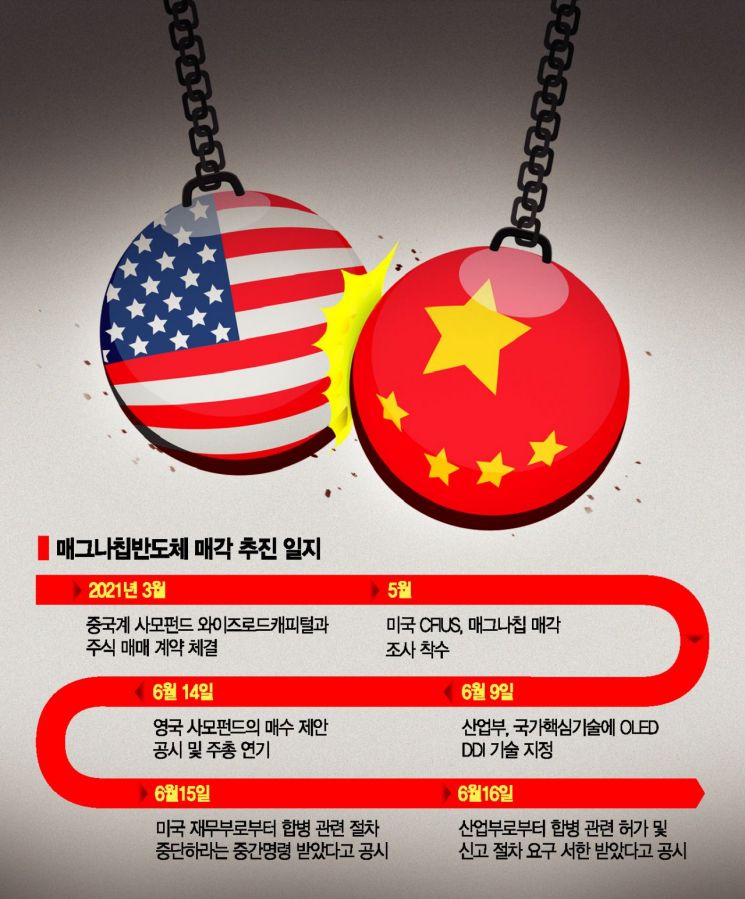
Effectively, U.S. authorities are regulating all direct and indirect actions to finalize Wise Road's acquisition of MagnaChip, raising prospects that the sale attempted by the Chinese private equity fund could be indefinitely postponed. Originally, MagnaChip had signed a $1.4 billion share sale agreement with Wise Road in March and planned to handle the equity sale agenda at a shareholders' meeting on the 15th of this month.
However, after CFIUS began its review and a global private equity firm, Conucopia Investment Partners, emerged as a competing bidder with a higher offer, various variables arose, leading MagnaChip and Wise Road to postpone the shareholders' meeting to the 17th. Ultimately, with the U.S. authorities officially requesting a temporary halt to the sale process, all schedules including the shareholders' meeting were indefinitely delayed.
At the same time, the South Korean government has also launched a campaign to block the sale, designating MagnaChip's OLED display driver IC (DDI) technology as a national core technology on the 9th. MagnaChip announced on the 16th that it received a letter from the Ministry of Trade, Industry and Energy of Korea instructing it to file for merger notification and approval under Article 11, Paragraph 2 of the Industrial Technology Protection Act.
Before the designation of national core technology, the Korean government had no legal grounds to block the sale of MagnaChip, a U.S.-listed company, making direct intervention difficult. However, after the core technology designation, active intervention became possible under the Industrial Technology Protection Act. The Ministry of Trade, Industry and Energy is expected to closely monitor the U.S. situation and begin a full-scale review of the sale.
Industry insiders view this sale as a clear example of how the Korean semiconductor industry is caught in the U.S.-China semiconductor hegemony competition. It reveals the U.S. determination not to transfer semiconductor-related technology to China, even if it is not advanced technology, and China's countermeasures are also a matter of intense interest. Domestically, there is strong opposition to Korean semiconductor companies falling into the hands of Chinese capital.
An industry official said, "Even if it is lower-tier technology, no one can predict what synergies might arise if it falls into Chinese capital hands," adding, "Even if new bidders emerge, private equity funds with unclear ultimate sources of funds will find it difficult to obtain final approval from both countries' reviews."
Meanwhile, following these developments, MagnaChip's stock price has been volatile on the New York Stock Exchange (NYSE). The stock surged 27% on March 25, when the sale news broke, but has gradually declined as difficulties in the sale process emerged. On the 11th of this month, the stock jumped more than 12% after Conucopia's acquisition proposal was announced, but then fell nearly 10% after disclosures that the U.S. Treasury ordered a halt to merger procedures and the Korean Ministry of Trade, Industry and Energy demanded approval and notification procedures. Financial information provider Smarter Analyst reported, "Concerns among investors are growing as MagnaChip's board has not reviewed higher acquisition offers nor finalized the deal with Wise Road."
© The Asia Business Daily(www.asiae.co.kr). All rights reserved.
![Clutching a Stolen Dior Bag, Saying "I Hate Being Poor but Real"... The Grotesque Con of a "Human Knockoff" [Slate]](https://cwcontent.asiae.co.kr/asiaresize/183/2026021902243444107_1771435474.jpg)
















