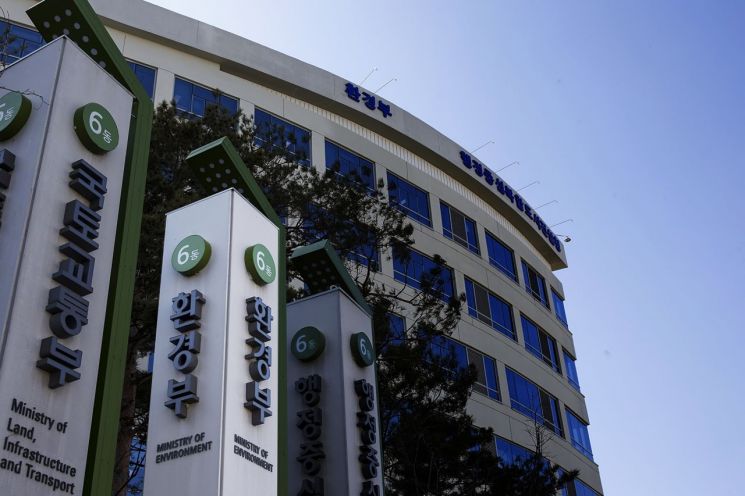
[Sejong=Asia Economy Reporter Joo Sang-don] The Ministry of Environment announced on the 18th that it will actively embark on carbon-neutral smart water management from the second half of this year to achieve carbon neutrality in South Korea by 2050.
This is part of follow-up projects following discussions on 'carbon-neutral smart water management' and calls for international community action by participants at the '2021 Seoul Green Future Summit (P4G)' water basic session* held on the 31st of last month.
The Ministry of Environment will actively promote and expand new renewable energy using water, such as thermal energy and floating solar power, to reduce fossil fuel use and promote carbon neutrality in the water sector.
For thermal energy, the plan is to establish a thermal energy convergence cluster (Chuncheon, Gangwon) and expand eco-friendly thermal energy to the private sector through pilot projects targeting public buildings.
Floating solar power installed on dam surfaces will begin construction of eight projects (147.4 MW) at five dams including Hapcheon Dam and Gunwi Dam by 2023, and based on thorough environmental impact verification and community acceptance, it will be expanded to a scale of 2.1 GW by 2030.
Additionally, to enhance water management efficiency and accuracy and contribute to achieving carbon neutrality, fourth industrial revolution technologies such as information and communication technology (ICT) and big data will be applied to the water management sector.
Dam management will establish a smart dam safety management system using unmanned aerial vehicles (drones), artificial intelligence (AI), and big data analysis systems based on the fourth industrial revolution, strengthening dam safety through proactive maintenance, performance improvement, and asset management. In the water supply and sewage sectors, a smart management system will be established based on AI and ICT to monitor and control the entire national water supply and sewage process in real time, improving operational efficiency and safety.
For digital water management technology development, the site and facilities of the former Daedeok Water Purification Plant (located in Songgang-dong, Yuseong-gu, Daejeon) will be utilized to create research and demonstration facilities for related technologies.
Along with this, to ensure the rapid institutional establishment of carbon-neutral smart water management, related laws and projects will also be reorganized. To shift and promote dam surrounding area support projects into carbon-neutral projects that coexist with local residents, the 'Enforcement Decree of the Dam Construction and Surrounding Area Support Act' will be revised within this year, and the River Act will also be amended to prepare sustainable integrated river management plans that comprehensively consider carbon neutrality, climate crisis response, and ecological restoration.
Kim Dong-jin, Director of the Water Resources Policy Bureau at the Ministry of Environment, said, "As discussed at the 2021 Seoul Green Future Summit (P4G), carbon-neutral water management is an obligation that the international community must all pursue," adding, "We will continuously expand related projects such as utilizing renewable energy and establishing smart systems to realize carbon neutrality in the water sector."
© The Asia Business Daily(www.asiae.co.kr). All rights reserved.
![Clutching a Stolen Dior Bag, Saying "I Hate Being Poor but Real"... The Grotesque Con of a "Human Knockoff" [Slate]](https://cwcontent.asiae.co.kr/asiaresize/183/2026021902243444107_1771435474.jpg)
















