Bank of Korea 'Q1 Corporate Management Analysis'
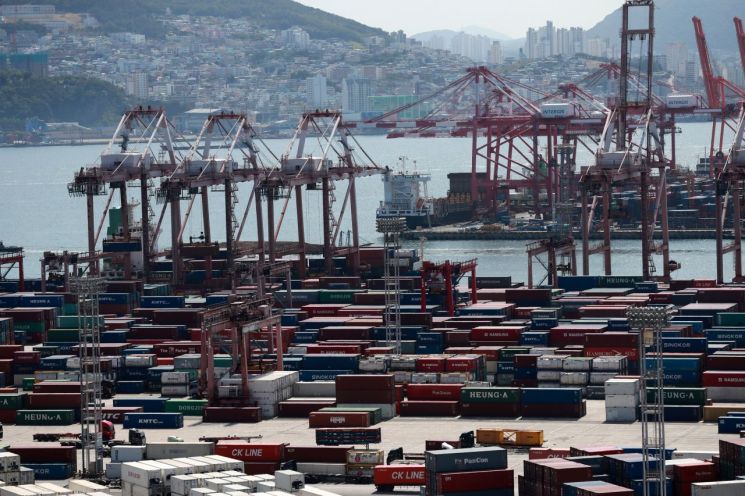
[Asia Economy Reporter Eunbyeol Kim] Thanks to strong exports and domestic demand recovery, the sales of domestic companies turned positive compared to the same period last year for the first time in nine quarters.
According to the '2021 Q1 Corporate Management Analysis' released by the Bank of Korea on the 17th, the sales of 20,914 audited corporations (11,300 manufacturing companies and 9,614 non-manufacturing companies) in the first quarter increased by 7.4% compared to Q1 of last year. This result is based on the disclosure data of 3,862 sample companies (2,358 manufacturing and 1,504 non-manufacturing) and estimates the performance of all 20,914 companies.
This is the first time in nine quarters since Q4 2018 (6.0%) that corporate sales have increased compared to the same period last year.
Kim Daejin, head of the Corporate Statistics Team at the Bank of Korea's Economic Statistics Bureau, explained, "Corporate sales decreased for two consecutive years due to the US-China trade conflict in 2019 and the COVID-19 pandemic last year, but this year, exports are doing well and consumption centered on online channels has increased, leading to a growth trend."
Compared to the previous quarter, Q4 of last year, the sales growth rate of manufacturing increased significantly (from 1.3% to 10.4%), and non-manufacturing recovered from a decline (-4.1% to 3.3%). When broken down by company size, both large enterprises (-1.3% to 7.1%) and small and medium enterprises (0.1% to 8.5%) showed clear sales growth.
By detailed industry, automobile and transportation equipment (3.1% to 14.6%), electrical, electronics, and machinery (10.3% to 12.8%), and information and communication industries (3.8% to 5.6%) showed favorable performance. The Bank of Korea analyzed this as being due to increased exports of automobiles and semiconductors and the expansion of 5G subscribers. Another growth indicator, the total asset growth rate (quarter-on-quarter, 3.3%), also rose compared to Q1 last year (1.5%) and Q4 last year (-0.2%).
Profitability indicators such as operating profit margin (6.4%) and pre-tax net profit margin (7.9%) also surpassed those of the same period last year (4.2% and 4.4%, respectively). These levels were also higher than the previous quarter (3.3% and 0.4%). In particular, the profit margin increase was significant in petroleum, chemical, pharmaceutical, and rubber industries (from -0.5% in Q1 last year to 9.6% this year) and transportation industry (2.7% to 9.4%). This was influenced by rising oil prices, improved refining margins, and increased container freight rates.
Financial stability also improved overall. The debt dependency ratio (24.4%) decreased compared to the previous quarter (24.6%), and the interest coverage ratio (operating profit/interest expense) rose from 542.7% to 823.5% within one quarter.
However, the debt ratio increased by 3.3 percentage points to 89.4% compared to Q4 last year (86.1%). Kim explained, "The increase in the debt ratio is due to seasonal factors, as temporary liabilities without accompanying financial costs, such as unpaid dividends related to dividend resolutions in March, increased."
© The Asia Business Daily(www.asiae.co.kr). All rights reserved.
![Clutching a Stolen Dior Bag, Saying "I Hate Being Poor but Real"... The Grotesque Con of a "Human Knockoff" [Slate]](https://cwcontent.asiae.co.kr/asiaresize/183/2026021902243444107_1771435474.jpg)
















