Presidential Candidate Relay Interview ④ Ahn Cheol-soo, Leader of the People Party
The People Party Has a Strong Conservative Image
Moderate Pragmatism Should Be Included in the Unified Party's Charter and Platform
Focus on the Unified Opposition Candidate Now Rather Than "Who Will Be the Candidate"
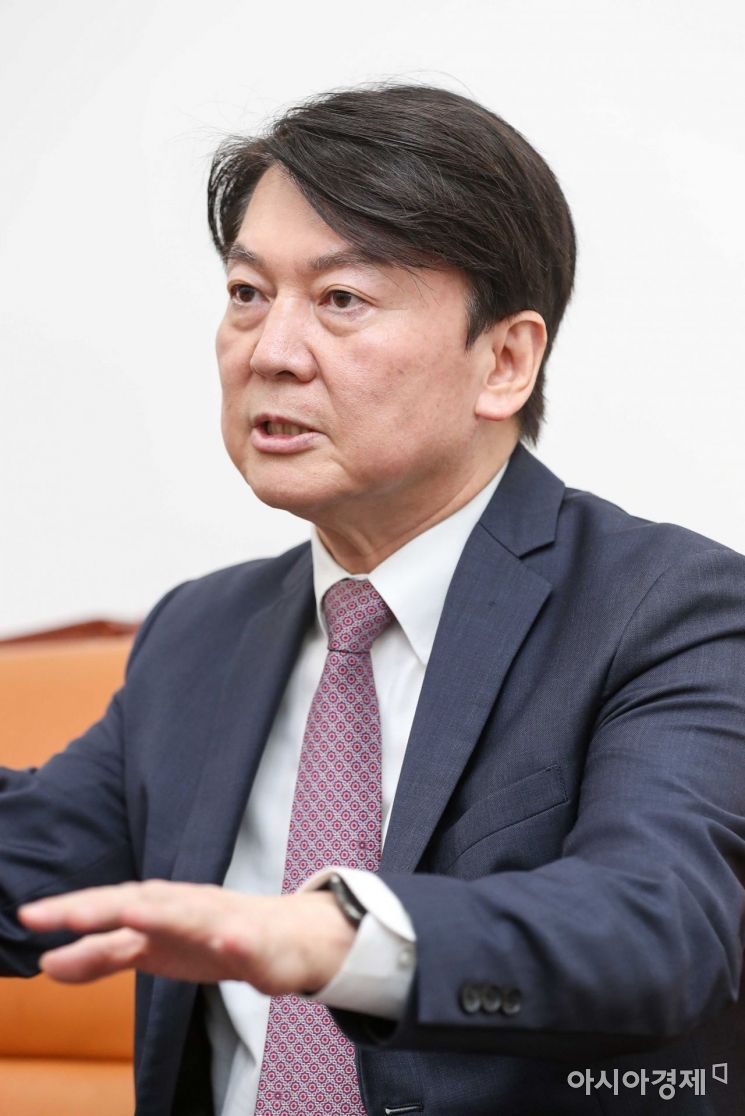 Ahn Cheol-soo, leader of the People Party, is being interviewed at the National Assembly in Yeouido, Seoul on the 17th. Photo by Kang Jin-hyung aymsdream@
[Asia Economy Reporter Naju-seok] "I have always followed a centrist pragmatic path. I left the Democratic Party to uphold this path. If this orientation is not reflected in the merger discussions with the People Power Party, there is no need to unify."
Ahn Cheol-soo, leader of the People Party, is currently discussing the merger issue with Lee Jun-seok, who was recently elected as the new leader of the People Power Party. Recently, there has been controversy over what the name of the unified party should be. Ahn repeatedly emphasized the 'fundamental purpose of the merger.' Although the People Power Party currently has a strong conservative image, after the merger, the party should reflect Ahn’s color and advocate a 'centrist pragmatic path.' He made it clear that this principle is non-negotiable.
The interview with Ahn was conducted in the party leader’s office at the National Assembly. After the interview, the People Power Party held its leadership election. On the 16th, Ahn and Lee met at the National Assembly to discuss the merger issue. Subsequently, both sides agreed to form a working-level consultative group to proceed with merger discussions.
Ahn is specifically demanding that the unified party’s constitution and platform reflect the 'advocacy of a centrist pragmatic path.' Only then can the party stand as an agent of change, innovation, and reform. Regarding this, Lee also said in a radio interview on the 17th, "I think he hopes that the values Ahn has maintained will live on in the unified party as well. Naturally, I intend to understand that."
Ahn recalled, "When I was part of the Democratic Party for a year, former co-leader Kim Han-gil suggested, 'How about changing this party to a centrist pragmatic one?' and we tried, but later I realized it was impossible." He added, "Rather than changing the path and settling, I left the Democratic Party to uphold my own path." He clearly drew the line by saying, "This merger also does not need to happen unless it is a principled merger."
When asked if he would run for president in the future, he tried to shift the topic but still circled around the merger. Ahn said, "I am not concerned about what role I will play in the presidential election. Right now, I am focusing solely on creating a unified opposition candidate." He emphasized, "More important than who becomes the candidate is the unification of the opposition."
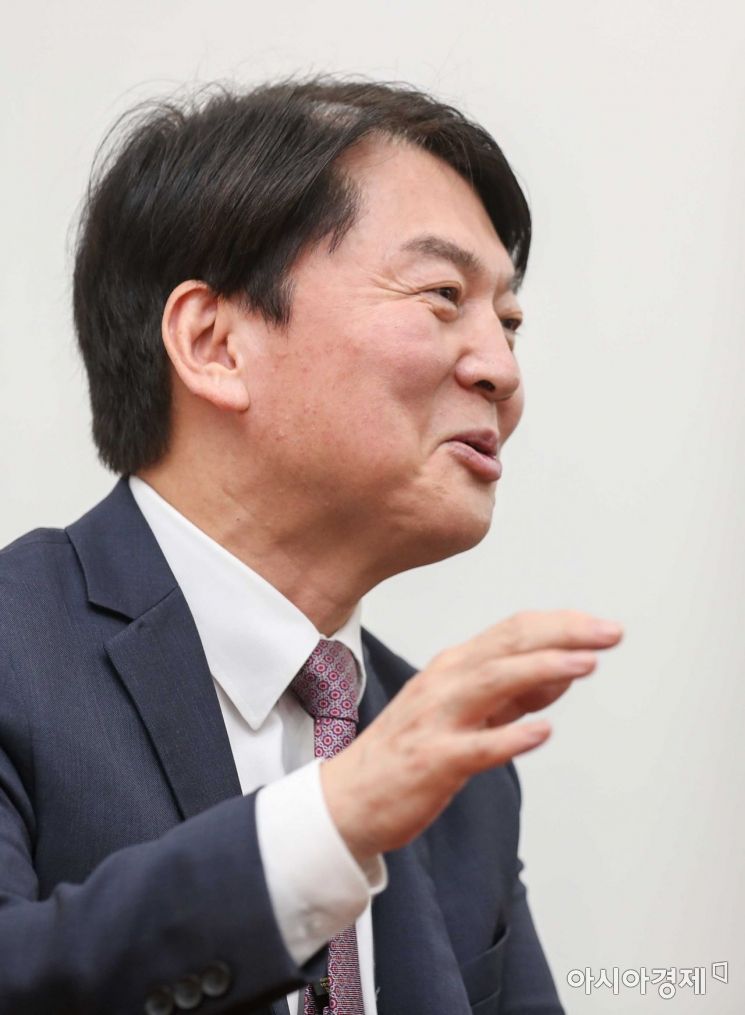 Ahn Cheol-soo, leader of the People Party, is being interviewed at the National Assembly in Yeouido, Seoul on the 17th. Photo by Kang Jin-hyung aymsdream@
Thanks to those who still believe in me,
I gain the strength to continue in politics.
The wisdom of going together with people
who think differently is the core of democracy.
The current government’s problem is turning people into enemies.
The political standing of Ahn Cheol-soo has, in fact, declined or remained flat over the past decade since his political debut in 2011. However, he recently surged as a leading presidential candidate within the opposition after a meaningful support base was confirmed during the Seoul mayoral by-election. When the topic of supporters’ encouragement came up, Ahn showed a reflective expression and said, "There are many who have supported me for a very long time. Thanks to those who still believe in me, I am still in politics and gain the strength to continue." He added, "Among those who have made great achievements for the country outside politics and then entered politics, I heard that no one has lasted as long as I have. Some leave politics in as short as 20 days, others in 2-3 years, but I was able to endure because of a sense of mission."
We did not ask separately what that sense of mission was, as Ahn’s explanation already contained both specific and general aspects. To summarize: horizontal leadership, democracy, and regime change. "When Osama bin Laden was killed by the U.S. military, the general who led the operation sat at the central table. Meanwhile, President Obama, the commander-in-chief, sat crouched beside, watching. You may remember this as a representative scene of horizontal leadership that entrusts full authority to experts." Ahn continued, "The era when leaders gave every single order is over. Leaders should respect experts’ opinions and help make decisions. Of course, leaders must also know the overall direction. That is why decision-makers are important."
The topic shifted to criticism of the current government. Ahn said, "The core of democracy is the wisdom of people with different thoughts living together," and pointed out, "The current government turns those who think differently into enemies." He emphasized, "We must have the mindset that everyone is an unstable being who can make mistakes, and I am no exception. Only then can democracy firmly take root." He also expressed concern about ruling party presidential candidates’ successive cash support pledges. "It’s not their own money, is it? Welfare is not about that. Welfare is about creating jobs. Considering that jobs are the best form of welfare, regime change is essential."
© The Asia Business Daily(www.asiae.co.kr). All rights reserved.


















