Korea Research Foundation Professors Bang Changhyun and Cho Seungwoo's Team
Mimicking Water Beetle Adhesive Organ for Strong Attachment Without Chemical Adhesives
Enables Skin Monitoring Including Body Fluid Acidity
[Asia Economy Reporter Kim Bong-su] A skin-adhesive patch that can determine whether wounds such as acne have healed has been developed. Inspired by the structure of the backswimmer's forelegs, it adheres well to the skin without chemical adhesives and changes color according to skin conditions such as acidity and moisture, allowing the timing of wound healing to be identified.
The National Research Foundation of Korea announced on the 17th that a research team led by Professor Bang Chang-hyun (Sungkyunkwan University) and Professor Cho Seung-woo (Yonsei University) developed a skin-adhesive patch that can monitor skin acidity (pH) and oil-moisture levels by mimicking the adhesive organs of the backswimmer.
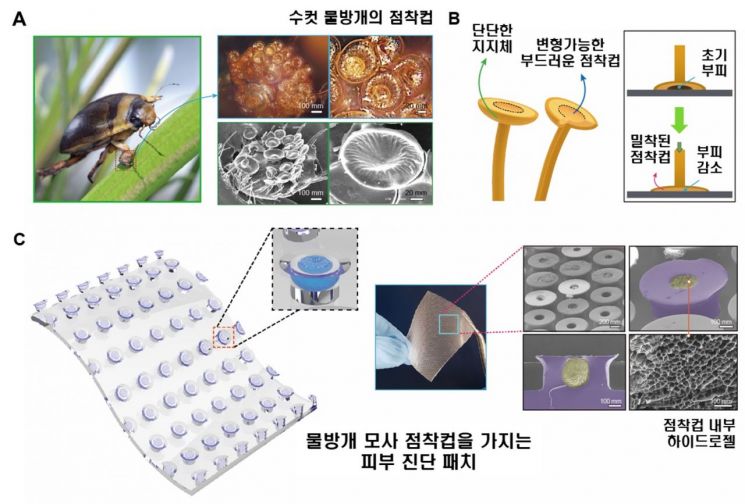
The research team revealed the structure and principle of the adhesive cups on the forelegs of male backswimmers and developed a power-free, rapid body fluid collection skin monitoring patch modeled after them.
The aquatic insect backswimmer has a unique feature that distinguishes males from females: the round adhesive cups on its forelegs. These adhesive cups stick well to the female's round and rough dorsal surface during underwater mating and detect necessary chemicals during the mating process.
The research team fabricated micro-sized artificial adhesive cups inspired by the backswimmer's adhesive cups, which adhere to the skin using internal suction force while simultaneously collecting and monitoring body fluids. Additionally, they incorporated a hydrogel inside the adhesive cups that has high fluid absorption capacity and changes color according to acidity changes, enabling analysis of the collected fluid's acidity without a separate power source.
Through the development of a machine learning-based analysis application, the adhesive cups can track skin acidity with high accuracy by machine learning the color image data (RGB) of the hydrogel captured by a mobile device. In fact, the research team confirmed that when applied to acne conditions accompanied by acidity changes, faster skin normalization was possible compared to cases where drug treatment timing was judged based on visual observation.
Although skin-adhesive wearable patches that collect body fluids (tears, sweat, etc.) for monitoring skin conditions (acidity, oil-moisture levels, etc.) have been developed, this patch overcomes the limitation of requiring a separate power source to increase fluid collection speed and monitoring accuracy. Furthermore, the patch does not require harmful chemical adhesives and has strong adhesion, so it is highly likely to remain attached even when sweating, on curved skin surfaces, or during physical activity, according to the research team.
The research results were published on the 17th (Korean time) in the international journal Science Advances.
© The Asia Business Daily(www.asiae.co.kr). All rights reserved.
![Clutching a Stolen Dior Bag, Saying "I Hate Being Poor but Real"... The Grotesque Con of a "Human Knockoff" [Slate]](https://cwcontent.asiae.co.kr/asiaresize/183/2026021902243444107_1771435474.jpg)
















