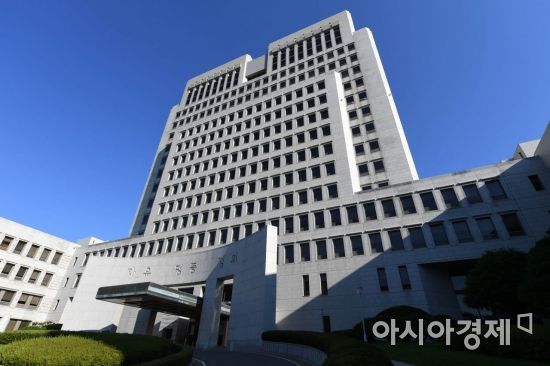
[Asia Economy Reporter Baek Kyunghwan] A public hearing was held at the Supreme Court regarding whether a man who secretly entered a married woman’s house without her husband’s knowledge can be punished for trespassing.
On the 16th, the Supreme Court’s full bench held a public hearing on the case of Mr. A, who was prosecuted for trespassing, sentenced to six months in prison with a two-year probation in the first trial, and acquitted in the second trial.
At the hearing, the prosecution argued that even if there is approval from a co-resident, if there was a criminal purpose, criminal act, or civil illegal act in the house entered, it should be regarded as trespassing. Kim Jaehyun, a professor in the Department of Police Administration at Osan University who appeared as a prosecution witness, explained, “The crime of trespassing is intended to protect the resident’s right to housing, and it is against social norms to ignore the housing rights of other absent residents just because one co-resident consents.”
On the other hand, the defense attorney argued that punishing this case would prioritize the will of the absent resident and would be no different from indirectly punishing the already abolished crime of adultery.
In particular, if trespassing is established due to opposition from a co-resident, it would mean that in the reality of various housing types such as share houses, one would have to confirm the consent of all residents every time they visit someone else’s home. Kim Sungkyu, a professor at Hankuk University of Foreign Studies Law School, also explained, “Considering it trespassing if even one co-resident does not consent emphasizes the unity of community opinion through criminal law.”
Questions from the Supreme Court justices followed. Justice Ahn Cheolsang asked the prosecution, “If trespassing is applied only in cases of wrongful purpose or acts, why not just punish or hold accountable for those purposes or acts instead of applying trespassing as well?”
To the defense, Justice Lee Gitaek pointed out, “If the husband was at home and opposed Mr. A’s coming but he still entered, shouldn’t that be considered trespassing? Can the husband’s will be ignored just because he was absent when it is clear that the husband opposed it?”
Meanwhile, the Supreme Court is expected to make a final decision based on the hearing. However, since this is a full bench case involving Chief Justice Kim Myeongsoo and 12 other justices, it is expected to take some time before the verdict is announced.
© The Asia Business Daily(www.asiae.co.kr). All rights reserved.

















