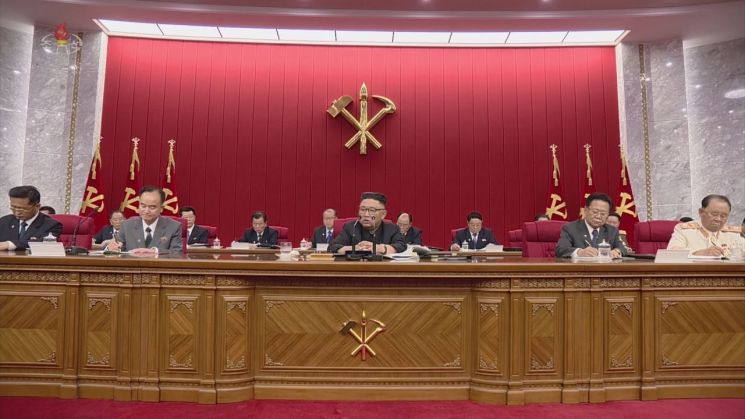
[Asia Economy Reporter Lee Ji-eun] Regarding the interpretation that the revision of the Workers' Party of Korea (WPK) charter at the 8th Party Congress signifies a "renunciation of unification," an argument has been raised that it is difficult to view it as giving up on unification.
At the "2021 North Korean Party Charter Forum" hosted by Assemblymen An Min-seok, Lee Jae-jung, and Lee Yong-seon, held on the afternoon of the 16th at the Press Center in Jung-gu, Seoul, Jeong Seong-jang, head of the North Korea Research Center at the Sejong Institute, stated, "North Korea is showing a stance to realize not only stability in the Korean Peninsula situation but also national reunification through superior national defense based on nuclear weapons and missiles. Therefore, it is a hasty judgment to say that North Korea has abandoned the will for unification and is aiming for 'two separate states.'"
In January, North Korea revised its party charter by removing the mention of the "national liberation democratic revolution" from the immediate objectives of the Workers' Party and changing it to "realizing autonomous and democratic development of society." This led some to interpret that North Korea had abandoned the "South Korean revolutionary unification theory." Former Minister of Unification Lee Jong-seok also interpreted that North Korea had given up on unification and the "South Korean revolution."
However, Director Jeong analyzed, "The strategy of supporting the struggle of South Korean people to succeed in the 'South Korean revolution' and unify North and South Korea has been revised to a strategy of advancing peaceful unification by suppressing military threats with North Korea's 'strong national defense.'" He meant that it was only a partial revision and not a renunciation of unification.
Professor Kim Dong-yeop of the University of North Korean Studies also argued, "The softened expression from the nationwide 'national liberation democratic revolution' to 'autonomous and democratic development' appears to realistically recognize and reflect changes in inter-Korean relations," adding, "The theory of renouncing unification is an excessive interpretation."
Professor Kim explained, "(The party charter) still clearly states that 'the Workers' Party of Korea fights to protect the safety and peaceful environment of the Korean Peninsula... to advance peaceful reunification of the fatherland and achieve the common prosperity of the nation,'" and "North Korea itself aims to create a favorable environment for peace and unification on the Korean Peninsula based on its national defense strength."
Researcher Hong Min of the Korea Institute for National Unification also commented on the deletion of the phrase "national liberation democratic revolution," saying, "It reflects a realistic recognition that a revolution allied with the South Korean masses is difficult, and terms like liberation and revolution do not align with the universal aspirations of the current international community," adding, "I find it hard to agree with the interpretation that this means giving up on unification."
Researcher Hong said, "The primary goal has been set as strengthening national defense to establish safety and a peaceful environment," and "The change in terminology and the realization of goals in line with the times have been made, so reading this as a declaration of giving up on unification is premature."
© The Asia Business Daily(www.asiae.co.kr). All rights reserved.
![Clutching a Stolen Dior Bag, Saying "I Hate Being Poor but Real"... The Grotesque Con of a "Human Knockoff" [Slate]](https://cwcontent.asiae.co.kr/asiaresize/183/2026021902243444107_1771435474.jpg)
















