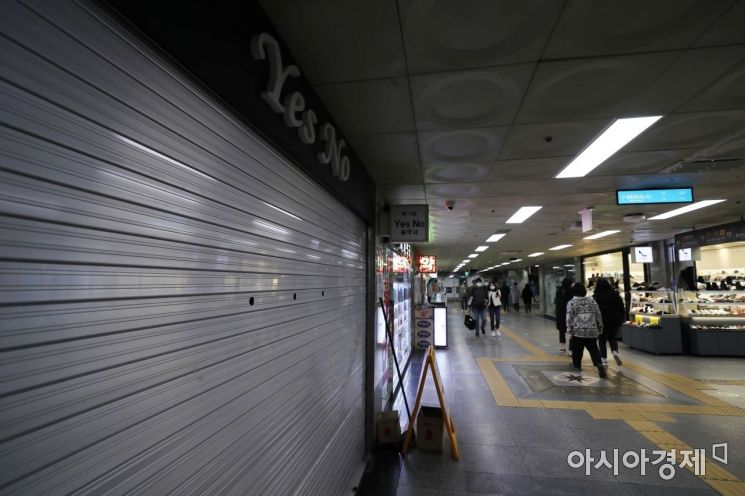
 Seoul Jung-gu Myeongdong Underground Shopping Center, quiet due to the impact of COVID-19. / Photo by Moon Honam munonam@
[Asia Economy Reporter Kwangho Lee] As incomes have decreased due to COVID-19, there is a growing trend of early cancellations of savings deposits and insurance policies. Typically, savings deposits and insurance are the last to be canceled among financial products because the refund amount is smaller than the principal paid. The increase in cases where people give up midway despite losses is interpreted as meaning that the income situation of ordinary households is more severe than expected.
According to the Life Insurance Association on the 16th, the number of life insurance policy cancellations in the first quarter of this year was 1,537,728, an increase of 53,347 (3.6%) compared to the same period last year (1,484,381). During the same period, the refund amount for cancellations was 7.4817 trillion KRW, a decrease of 256.572 billion KRW (3.3%) from the same period last year (7.7382 trillion KRW). The industry analysis attributes the increase in the number of cancellations but decrease in refund amounts to many cases of automatic contract cancellations due to long-term non-payment of premiums caused by COVID-19, or 'livelihood cancellations' where policyholders themselves break contracts to repay credit card debts or secure living expenses.
An insurance company official explained, "Policyholders with large contract amounts are relatively less likely to face difficulties requiring refund amounts, whereas many small-amount contract holders do."
Cases of early termination of regular savings deposits, one of the means for ordinary people to accumulate lump sums, are also increasing. Despite incomes decreasing or remaining the same, households are canceling savings deposits as debts increase.
As of the first quarter of this year, the total amount of time deposits and savings deposits held by the five major commercial banks?KB Kookmin, Shinhan, Woori, Hana, and NH Nonghyup?was 663.3976 trillion KRW, down 10.331 trillion KRW from the end of last year (673.7286 trillion KRW).
By bank, Kookmin Bank's deposit and savings balance was 139.2515 trillion KRW, a decrease of 4.9059 trillion KRW compared to the same period. Nonghyup Bank also decreased by 2.0542 trillion KRW to 138.9456 trillion KRW, and Hana Bank (133.6972 trillion KRW) and Shinhan Bank (125.8874 trillion KRW) decreased by 2.8013 trillion KRW and 844.5 billion KRW, respectively.
A financial industry official said, "Considering that the refund amount is significantly less than the amount paid when insurance is canceled early, the increase in insurance cancellations means that household income conditions are deteriorating to the worst level," adding, "As household incomes decrease and debts increase, it has become difficult to maintain insurance or savings deposits."
© The Asia Business Daily(www.asiae.co.kr). All rights reserved.
![Clutching a Stolen Dior Bag, Saying "I Hate Being Poor but Real"... The Grotesque Con of a "Human Knockoff" [Slate]](https://cwcontent.asiae.co.kr/asiaresize/183/2026021902243444107_1771435474.jpg)











