[Asking About South Korea's Economy] Interview with Kwon Tae-shin, President of Korea Economic Research Institute
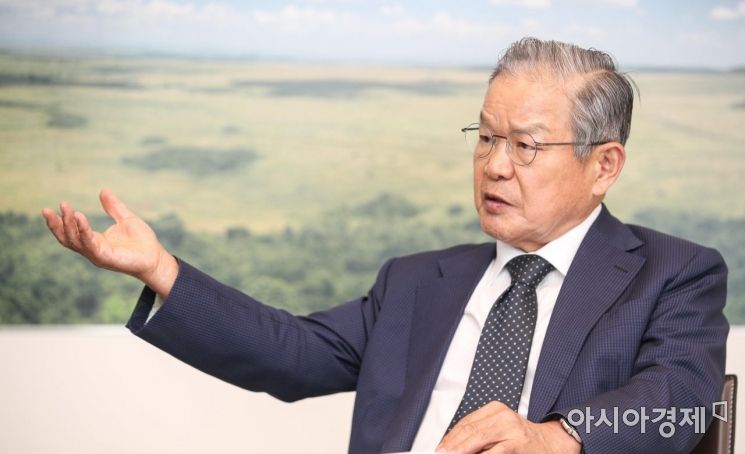 Kwon Tae-shin, President of the Korea Economic Research Institute, is emphasizing the need for regulatory reform and labor reform in an interview held at the Federation of Korean Industries building in Yeouido, Seoul. Photo by Kang Jin-hyung aymsdream@
[Asia Economy Reporters Heungsun Kim and Hyunjin Jung] "There are now over 200 discriminatory regulations targeting companies with assets exceeding 100 billion KRW. As regulations continue to increase, mid-sized companies are reluctant to grow. The bigger they get, the fewer benefits they receive and the more restrictions they face. The more corporate regulations increase, the more quality jobs disappear, and the burden will ultimately fall on the younger generation."
Recently, at the Federation of Korean Industries building in Yeouido, Seoul, Kwon Tae-shin, President of the Korea Economic Research Institute (72), spoke candidly. Having served as Chief of Staff to the Prime Minister, Kwon is a veteran economist with experience in major economic ministries, the Blue House secretariat, and as an ambassador to international economic organizations, now leading a private economic research institute. Throughout the interview, Kwon did not hide his sharp criticism, citing personal experience and statistics to provide insight into various current issues, consistent with his deep understanding of Korea’s economic development and domestic and international economic conditions.
He especially raised his voice against anti-business policies that strangle companies. Kwon said, "Regulations should align with international standards, but they are still based on criteria from 30 to 40 years ago." He added, "During the industrialization era, the government praised businesspeople as patriots, boosting morale, so companies worked desperately and contributed to economic growth. But now, with unfavorable regulations continuing, small businesses avoid becoming mid-sized companies, and mid-sized companies avoid becoming large corporations." He warned that Korean companies are seriously suffering from a 'Peter Pan syndrome' and that this will severely impact the future of our economy and, ultimately, the younger generation."
- There are criticisms that despite opposition from economic organizations and the business community, regulations that burden companies continue to increase. What is your view?
△ Two years ago, the Korea Economic Research Institute investigated discriminatory regulations targeting companies with assets over 100 billion KRW and found 47 laws and 188 regulations. Recently, the number of regulations has exceeded 200 and is estimated to be approaching 300, showing a rapid increase.
It is understood that small businesses face nine stages of regulatory barriers as they grow into large conglomerates subject to cross-shareholding restrictions. First, companies with total assets exceeding 100 billion KRW face five regulations. When a company reaches 250 billion KRW in assets and has more than 300 employees, 20 additional regulations apply. The next stage is companies with 450 billion KRW in assets and over 500 employees, adding five more regulations. When total assets reach 500 billion KRW, the number of applicable regulations increases by 81 to a total of 111. Further regulations are added at 3.9 trillion KRW in assets with over 1,000 employees and at 4.79 trillion KRW in assets with capital exceeding 100 billion KRW, adding two and four regulations respectively.
At the final stage, designated as a large-scale corporate group, regulations become very restrictive. For example, a publicly disclosed corporate group with assets of 5 trillion KRW faces 11 additional regulations, and a cross-shareholding restricted corporate group with assets of 10 trillion KRW faces 47 additional regulations. These nine stages of regulatory barriers ultimately block small businesses from growing into large corporations and reduce the global competitiveness of large companies. This is holding back our economy. As a result, the number of large company jobs desired by young people inevitably decreases.
Small and Medium Enterprises Face 9-Stage Regulatory Barriers to Become Large Corporations
Only 10% of 28 Million Workers Are Union Members
- In a past interview, you mentioned job creation as one of the conditions for a successful government. How do you evaluate the current administration’s employment performance?
△ It is a complete failure. In a market economy, companies ultimately create jobs, but with policies focused on pro-labor measures such as minimum wage increases, reduced working hours, and converting irregular workers to regular status, companies are reducing domestic investment and moving overseas. This is not just a problem for large corporations. From 2017 to 2019, the minimum wage rose by 32.8%, and small self-employed businesses that could not cope reduced jobs. Nearly 1,300 self-service gas stations, which do not require employees, have increased nationwide, and fast-food chains have expanded unmanned ordering machines that cost about 10% of the monthly minimum wage, reducing over 1,200 part-time jobs. Meanwhile, Korea’s overseas direct investment (ODI) reached $54.9 billion last year, the second highest since statistics began in 1980.
What about job quality? While government-led job creation increased jobs for seniors aged 60 and over from 3.26 million in January 2016 to 5.41 million as of April this year, jobs for youth aged 15 to 29 actually decreased from 3.87 million to 3.83 million. By industry, public sector jobs in health and social welfare increased from 1.73 million to 2.49 million, while manufacturing jobs decreased from 4.67 million to 4.39 million. We must note that all government-led policies to address economic problems such as unemployment have ended in failure. If the government could raise incomes and grow the economy through laws or orders, there would be no poor countries on earth.
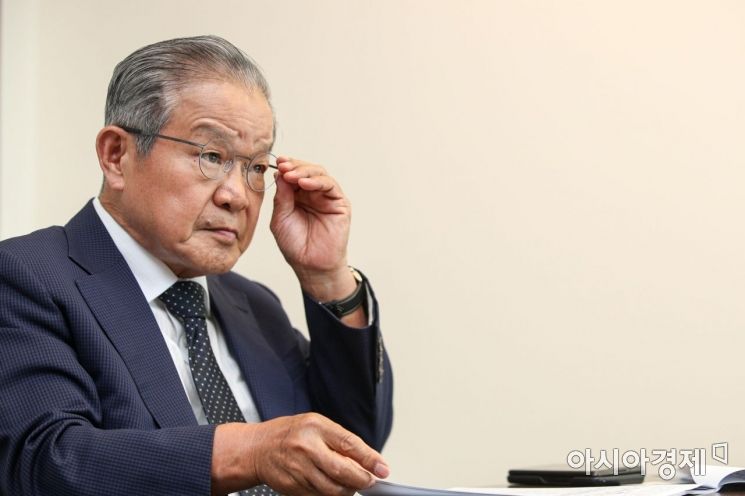 Kwon Tae-shin, President of the Korea Economic Research Institute, is being interviewed at the Federation of Korean Industries building in Yeouido, Seoul. Photo by Jin-hyung Kang aymsdream@
- The business community has consistently pointed out that the 'tilted playing field' toward labor unions discourages corporate investment. What is your opinion?
△ Among Korea’s 28 million workers, less than 10% are union members (2.531 million nationwide in 2019 according to the Ministry of Employment and Labor). Among them, some unions, considered vested interests, rigidify labor conditions under the pretext of protecting their rights. Politicians have enacted policies supporting their voices. Productivity declines, but companies cannot dismiss older workers whose wages are several times higher than new hires, so companies either move overseas or avoid hiring new employees. Ultimately, this structure harms the youth.
Some Unions Rigidify Labor Conditions
To Minimize Damage to Semiconductor Industry, Vice Chairman Lee Jae-yong Should Be Given a Chance
- If corporate regulations are eased and the labor market made more flexible, there will likely be significant backlash. How do you see this?
△ Growing pains are inevitable. But society overlooks one fact: the majority who are not organized suffer because of the interests of a small group. This is true in cases like ride-sharing services and large discount stores. Although 30 to 40 million people benefit from cheaper rides and goods compared to taxis and traditional markets, regulations protecting a few thousand suppliers prevent these benefits. No one points out this problem. For the younger generation and more consumers, reforms accompanied by pain are necessary. Regulatory reform and labor reform are part of this.
- How should we prepare for the social and economic changes after COVID-19?
△ Non-face-to-face and digitalization will spread throughout the economy. To prepare for the post-COVID era, we need to strategically nurture new industries centered on online distribution and service sectors, which have high employment creation effects. For example, as of September last year, Coupang employed 43,000 people, ranking third in Korea after Samsung Electronics and Hyundai Motor Company. We need to move beyond the outdated paradigm of conflict between large supermarkets and traditional markets and improve regulations that ban not only supermarket operations but also online delivery on mandatory holidays. Korea has many regulations in the service sector, making innovation and new industries difficult. We must boldly reform these and promote competition in the private sector.
- Since the business community appealed for the pardon of Vice Chairman Lee Jae-yong, political sentiment has shifted considerably. What is your view?
△ The success of the semiconductor industry depends on when, where, and how much to invest. The judgment and will of the top decision-maker are decisive. About 30 years ago, when Samsung Chairman Lee Byung-chul decided to invest 1 trillion KRW in a single semiconductor production line, all employees opposed it, fearing the entire group might collapse. Despite this, the investment was made, resulting in today’s Samsung Electronics. This shows how important the owner’s decision is.
Vice Chairman Lee has played an important role in Korea’s economy and diplomatic security through his global network with influential political and business figures overseas. When Japan declared export restrictions on key materials, he consulted with senior Japanese corporate officials to diversify import sources and proposed solutions such as indirect exports. He has led the most important industry that creates jobs without tax support and contributes to the national economy through exports. Amid intensifying US-China disputes and fierce economic hegemony battles, we must minimize damage to domestic industries and provide opportunities to expand jobs for future generations.
◆ About Kwon Tae-shin
- Seoul National University, Economics / Vanderbilt University, Economics Master’s / University of Cambridge Judge Business School MBA
- Passed 19th Administrative Examination
- Director-General of International Finance Bureau, Ministry of Finance and Economy; 2nd Vice Minister, etc.
- Secretary for Industry and Communications, Secretary for Economic Policy, Presidential Secretariat
- Ambassador to OECD Delegation
- Minister at the Prime Minister’s Office
- Vice Chairman of the National Competitiveness Enhancement Committee
- Current President of Korea Economic Research Institute and Vice Chairman of the Federation of Korean Industries
© The Asia Business Daily(www.asiae.co.kr). All rights reserved.


















