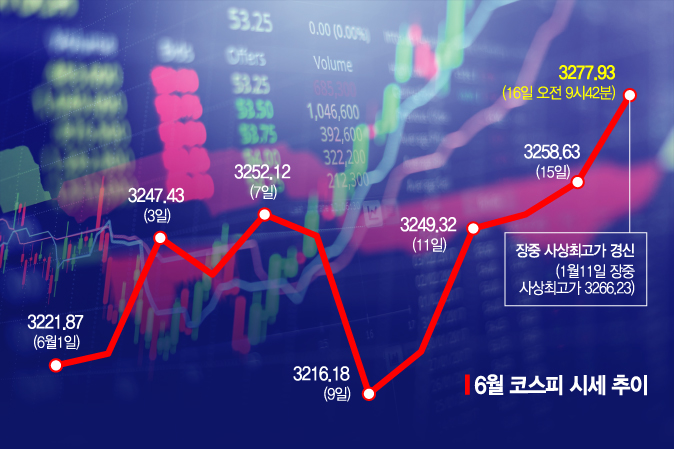
[Asia Economy Reporter Lee Seon-ae] The KOSPI set a new all-time high for the second consecutive day based on closing prices, and on the 16th, it made history by surpassing the 3280 mark intraday for the first time. Expectations for breaking the 3260 level based on closing prices are also growing. While there are optimistic forecasts that the KOSPI could rise as high as 3700 this year, there are many negative factors that could pull the index down or trap it within a range in the short term, leading to heightened market caution.
The record high of the KOSPI was driven by net buying from foreign investors. As of 10:30 a.m. that day, foreigners had net purchased 179 billion KRW worth of KOSPI stocks, supporting the rise. Individual investors, who had contributed with net buying right after the market opened, switched to net selling after the KOSPI hit the all-time high, realizing profits. Previously, individual investors were the main contributors to the KOSPI’s record closing highs for two consecutive days, having purchased about 550 billion KRW worth of stocks over those two days.
Han Ji-young, a researcher at Kiwoom Securities, said, "The overall market level burden following the new high is not as significant as during previous record highs, so the supply pressure from sell-offs is relatively low."
Experts expect the KOSPI to continue setting new record highs while moving sideways for the time being. The upper range of the KOSPI forecast bands from securities firms for the second half of the year is between 3300 and 3700. Samsung Securities, Korea Investment & Securities, and Kyobo Securities forecast 3300; IBK Investment & Securities 3400; Meritz Securities 3500; NH Investment & Securities and Hanwha Investment & Securities 3500; Daishin Securities 3630; Hana Financial Investment 3650; and Shinhan Financial Investment gave the highest forecast at 3700.
The driving force behind the market’s optimism is corporate earnings. According to financial information provider FnGuide, the estimated annual operating profit (consolidated basis) for 176 KOSPI-listed companies this year is 199 trillion KRW. This is more than a 14% increase compared to the 173 trillion KRW operating profit estimate for these companies at the end of last year. If the total annual operating profit for the entire KOSPI reaches 200 trillion KRW, the year-over-year growth rate would be 63%. The sales forecast for the same period is 1980 trillion KRW. The KOSPI’s annual operating profit was recorded at 197 trillion KRW in 2018. It was 137 trillion KRW in 2019 and 143 trillion KRW last year, but it has never surpassed 200 trillion KRW. In fact, this year marks the beginning of the '200 trillion operating profit' era.
However, there are negative factors. Inflation resulting from economic recovery and tapering?the reduction of asset purchases?are major variables. The mainstream view is that concerns about early tightening by the U.S. Federal Reserve (Fed) are realistically unlikely before 2023. Accordingly, experts expect these variables to be short-term negative factors. Therefore, the KOSPI is likely to continue moving sideways in the short term. Jung Yong-taek, head of research at IBK Investment & Securities, predicted, "After the June Federal Open Market Committee (FOMC) regular meeting results are released, the KOSPI is expected to fluctuate around the current level."
In the mid to long term, the likelihood of rising U.S. long-term interest rates is another factor suggesting a sideways rotation market for the KOSPI. One researcher said, "As a rotation market unfolds, stock price movements will diverge among sectors depending on intraday changes in the U.S. futures market and 10-year bond yields, as well as China’s May retail sales and industrial production data."
© The Asia Business Daily(www.asiae.co.kr). All rights reserved.

















