[Asia Economy Reporter Choi Seok-jin] Should a man who entered a house with the wife's consent to commit adultery with another man's wife be recognized as committing the crime of trespassing against the husband?
This issue is related to whether the protected legal interest of the crime of trespassing under criminal law should be regarded as the right of residence or the actual peace of the residence, and it has been a subject of various conflicting views in academia for decades. Even in the courts, lower court rulings have been divided.
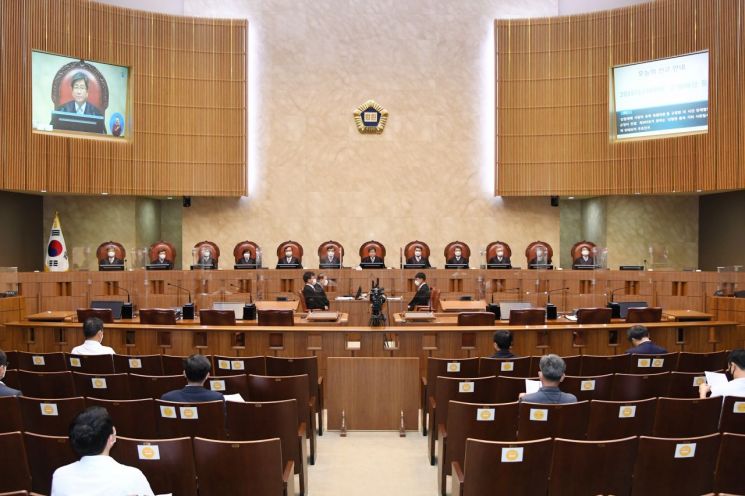
To hear expert opinions on this highly contested topic, the Supreme Court's full bench will hold a public hearing from 2 p.m. on the 16th.
There are two cases subject to the appeal hearing on that day.
First, one case involves Mr. A, who entered the house of Ms. B, with whom he had an extramarital relationship, and committed an illicit act, and was prosecuted for trespassing by Ms. B's husband. The first trial recognized Mr. A's trespassing charge and sentenced him to six months in prison with a two-year probation, while the second trial acquitted him.
The other case involves Mr. C, who, after a marital quarrel, left the house and tried to return with his parents after a month, but when his spouse did not open the door, he broke the entrance door and entered, and was prosecuted for joint trespassing under the Act on the Punishment of Violent Acts. Mr. C was fined in the first trial but acquitted in the second trial.
So far, the Supreme Court has regarded the protected legal interest of trespassing as the actual peace of the residence, maintaining the position that "even if the husband is temporarily absent, the husband's control over the residence still exists, and entering the residence for the purpose of adultery is considered against the husband's will, so even if the wife consents, the actual peace of the husband's residence is disturbed, and in such cases, trespassing is established."
However, regarding this, the majority opinion in academia holds that if the protected legal interest of trespassing is regarded as the actual peace of the residence, and there is genuine consent from the current resident, the actual peace cannot be considered disturbed, so trespassing should not be established.
From the perspective that the protected legal interest of trespassing is the right of residence, in the case of shared residence, consent from all residents is required for entry to recognize trespassing, whereas the view that consent from the current resident alone is sufficient denies the establishment of trespassing.
Earlier, the Supreme Court stated regarding the public hearing, "The discussion on whether trespassing can be established when consent is obtained from one of the co-residents but against the will of other residents, and whether co-residents can be punished for trespassing, is a matter of how to harmonize and reasonably adjust the conflict of the protected legal interest of 'actual peace' within the shared residence among co-residents." It added, "This is closely related to the daily life relationships of the people, and whether to change the long-standing existing precedent doctrine may affect the overall doctrine of trespassing."
Chief Justice Kim Myung-soo, considering that this issue is closely related to the daily life relationships of the people and its social impact, requested various organizations, including the Korean Women Lawyers Association, to submit opinions ahead of the public hearing to gather broad views from various sectors.
At this public hearing, Professor Kim Jae-hyun of Osan University’s Department of Police Administration will present opinions as an expert witness for the prosecution, and Professor Kim Sung-kyu of Hankuk University of Foreign Studies Law School will present opinions as an expert witness for the defendant.
The Supreme Court plans to disclose the entire public hearing process, including questions and answers between the panel, prosecutors, defense attorneys, and expert witnesses, to enhance the fairness and transparency of the trial.
The final verdict will be delivered after the conclusion of the hearing and the final discussion among the Chief Justice and the Supreme Court justices.
© The Asia Business Daily(www.asiae.co.kr). All rights reserved.
![Clutching a Stolen Dior Bag, Saying "I Hate Being Poor but Real"... The Grotesque Con of a "Human Knockoff" [Slate]](https://cwcontent.asiae.co.kr/asiaresize/183/2026021902243444107_1771435474.jpg)
















