The Last Stronghold for Small Business Owners and Self-Employed: 'Noran Usan'
Cancellation Floods Increase by 10.7%... 98% Due to Business Closure
Sharp Rise in Insurance Mid-Term Cancellations for Livelihood Reasons
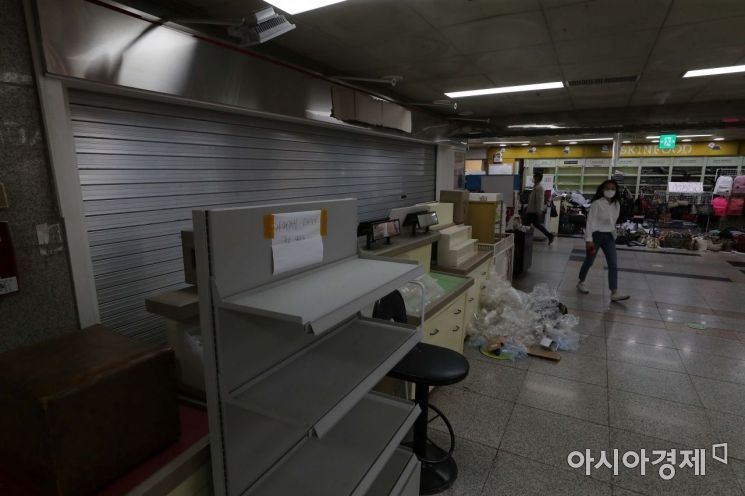 A cosmetics store in Hoehyeon Underground Shopping Center, Jung-gu, Seoul, is closed due to the impact of COVID-19. Photo by Mun Honam munonam@
[Asia Economy Reporters Kim Jong-hwa and Lee Kwang-ho] COVID-19 has changed not only our daily lives. The "nasty virus," which has been spreading for 1 year and 6 months, is showing signs of subsiding as vaccination rates increase, but it has pushed the livelihoods of ordinary people to the brink.
There is an increasing number of cases where small business owners and self-employed individuals are breaking into their insurance (mutual aid) ? considered their last line of defense ? and taking out loans to survive. Typically, mutual aid products have lower refund amounts compared to the principal paid, so they are usually the last to be canceled. The rise in cases of surrendering these policies despite losses indicates that household income situations are more severe than expected.
According to the Korea Federation of SMEs on the 16th, the number of cancellations of the "Noranwoosang" (Yellow Umbrella, a mutual aid product brand for SMEs and small business owners) from January to May this year was 39,995, a 10.7% increase compared to 36,122 during the same period last year. Cancellations occur when mutual aid funds are received due to reasons such as business closure, death, retirement, or old age, with 98% of cancellations attributed to business closures.
The number of early cancellations was 10,982 from January to May, a 10.1% decrease compared to 12,218 during the same period last year, but it began to rise again in May. This trend is expected to continue into June.
While early cancellations decreased, mutual aid loans (a type of policy loan) increased sharply. From January to May, mutual aid loans reached 111,737 cases totaling 1.3245 trillion KRW. This is a 48.4% increase compared to the 892.5 billion KRW loan volume during the same period last year and has already surpassed half of last year's annual loan volume (207,444 cases, 2.3438 trillion KRW) in just five months. Since early cancellations have low refund rates and require returning various benefits received, people tend to choose loans over cancellations unless they face bankruptcy or similar situations.
The trend of increasing early cancellations is also seen in insurance products from financial institutions. According to the Life Insurance Association, the number of life insurance cancellations in the first quarter of this year was 1,537,728, an increase of 53,347 cases (3.6%) compared to 1,484,381 in the same period last year. However, the refund amount for cancellations during the same period was 7.4817 trillion KRW, a decrease of 256.572 billion KRW (3.3%) compared to 7.7382 trillion KRW last year. The industry analysis attributes the increase in cancellation cases but decrease in refund amounts to many "living expense cancellations," where contracts were automatically canceled due to long-term non-payment of premiums caused by COVID-19 or were voluntarily surrendered by policyholders to repay credit card debt or cover living expenses.
A financial industry official said, "The increase in cancellations of insurance or mutual aid policies, where refunds are significantly lower than the premiums paid, indicates that household income situations are deteriorating to the worst level," adding, "As household income decreases and debt increases, it has become difficult to maintain insurance or savings plans."
What is Noranwoosang?
The Noranwoosang mutual aid was introduced in 2007 as a retirement fund concept for small businesses and small business owners. Similar to employees' severance pay, when a mutual aid event such as business closure or death occurs, the accumulated amount is paid out with an average compound interest rate of 2.5%. Contributions can be made monthly from a minimum of 10,000 KRW to a maximum of 2 million KRW. It offers an annual income tax deduction benefit of up to 5 million KRW, and contributions are protected from seizure, transfer, or collateral, ensuring funds for minimum living stability and business recovery in case of closure. However, early cancellation refunds are classified as "other income" and subject to a 16.5% withholding income tax. Additionally, subscribers with less than 10 years of participation are subject to retirement income tax, so short-term subscribers may receive less than the principal paid upon early cancellation. As of the end of May, Noranwoosang manages about 15 trillion KRW in assets, investing in bonds (58%), alternative investments (20%), and stocks (15%). As of the end of last month, 1,475,209 people were enrolled in the mutual aid.
© The Asia Business Daily(www.asiae.co.kr). All rights reserved.

















