Minimum Wage Commission Holds 3rd Plenary Meeting
Democratic Labor Union Attends After Boycotting 2nd May Plenary Meeting
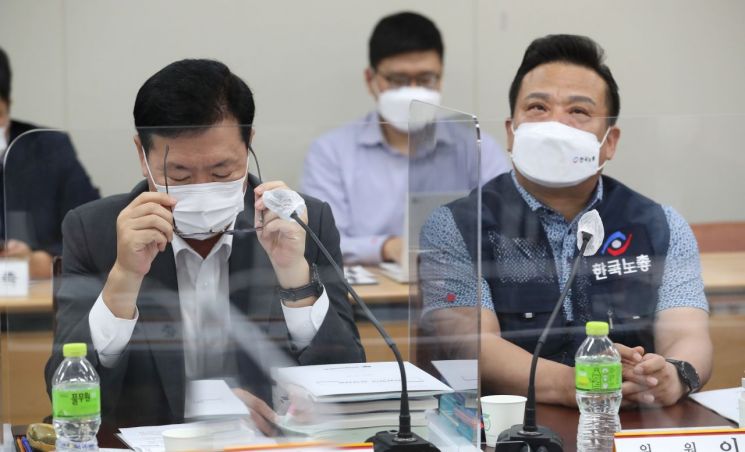 On the afternoon of the 15th, Ryu Ki-jung, Executive Director of the Korea Employers Federation, a user committee member, and Lee Dong-ho, Secretary General of the Korean Confederation of Trade Unions, a labor committee member, attended the 3rd plenary meeting held in the Minimum Wage Commission meeting room at the Government Complex Sejong in Sejong City, listening to Chairman Park Jun-sik's remarks. (Photo by Yonhap News)
[Sejong=Asia Economy Reporter Moon Chaeseok] The Minimum Wage Commission, a social dialogue body that deliberates and decides on the minimum wage, held its third plenary meeting on the 15th and officially began deliberations on next year's minimum wage. On this day as well, labor and management showed clear differences of opinion regarding whether to raise the wage and by how much. The labor sector repeatedly emphasized the need for a significant increase in the minimum wage, while the management side strongly opposed, stating that small business owners are at their limit. The labor side is likely to propose a first demand of more than 10,000 won, while the management side is expected to propose freezing this year's minimum wage at 8,720 won, with deliberations proceeding by narrowing the gap.
The Minimum Wage Commission held its third plenary meeting in the afternoon at the Government Complex Sejong. This was the first plenary meeting held by the commission in a month since the last one on the 18th of last month. Four worker members from the Korean Confederation of Trade Unions (KCTU), who had not attended the second meeting, participated this time. The KCTU members had cited the dismissal of their demand for a complete replacement of the public interest members and the fact that only 4 out of 9 worker members were recommended by the KCTU as reasons for their previous absence. On this day, the KCTU returned to the meeting as some of their demands for correction of worker members were accepted. The Minimum Wage Commission consists of 27 members: 9 worker members, 9 employer members, and 9 public interest members. For the worker members, the two major trade unions, the Federation of Korean Trade Unions (FKTU) and the KCTU, recommend 5 and 4 members respectively.
Chairman Park Junsik mentioned in his opening remarks that the legal deadline for deliberating next year's minimum wage is the end of this month, stating, "It is now time to swiftly proceed with specific discussions on the minimum wage decision unit, sector-specific differentiated application, and the level." The minimum wage deliberation proceeds by first deciding on the hourly wage amount, whether to indicate the monthly converted amount, and whether to apply sectoral differentiation, followed by discussions on the minimum wage level.
Lee Dongho, Secretary General of the Federation of Korean Trade Unions and a worker member, pointed out, "The living expenses for a single unmarried worker, which is the basic data for next year's minimum wage deliberation, is about 2.09 million won, approximately 270,000 won higher than this year's monthly converted minimum wage amount of 1.82 million won," emphasizing that "the current minimum wage is unacceptably low." He also mentioned that the government's expected economic growth rate this year is 4.2% and the consumer price inflation rate as of May is 3.3%, stressing the need to 'realize the minimum wage' to alleviate income inequality and polarization.
Park Hee-eun, Vice Chairperson of the KCTU, argued that the significant minimum wage increases in 2018 and 2019 helped reduce wage and income inequality and positively influenced economic recovery through increased household consumption, stating, "For the minimum wage system to achieve its purpose, a substantial increase in the minimum wage is necessary." She criticized the management side, saying that Korea's minimum wage is the lowest among OECD member countries and that "management claiming the minimum wage is too high in this situation has no conscience."
In response, Ryu Kijeong, Executive Director of the Korea Employers Federation (KEF), countered, "The minimum wage increases in 2018 and 2019 increased market burdens, and the shock from this has not been resolved at all. Amid the COVID-19 pandemic, the capacity of small business owners and small and micro enterprises, who are the wage payers, has reached its limit." Ryu cited a recent survey result stating that 4 out of 10 small business owners are considering closing their businesses and mentioned a self-employed person at a recent public forum in Gwangju who strongly criticized the minimum wage increase.
Labor and management are internally coordinating their initial minimum wage demands to be submitted to the Minimum Wage Commission ahead of discussions on next year's minimum wage level. Although the legal deadline for next year's minimum wage deliberation is the end of this month, the commission has rarely met the deadline. Considering that the official announcement deadline for the minimum wage is August 5, the deliberation on next year's minimum wage must be concluded by mid-next month at the latest.
© The Asia Business Daily(www.asiae.co.kr). All rights reserved.

















