Korea Institute of Machinery and Materials, Eye-Catching Unveiling of Various Robot Technologies on the 15th
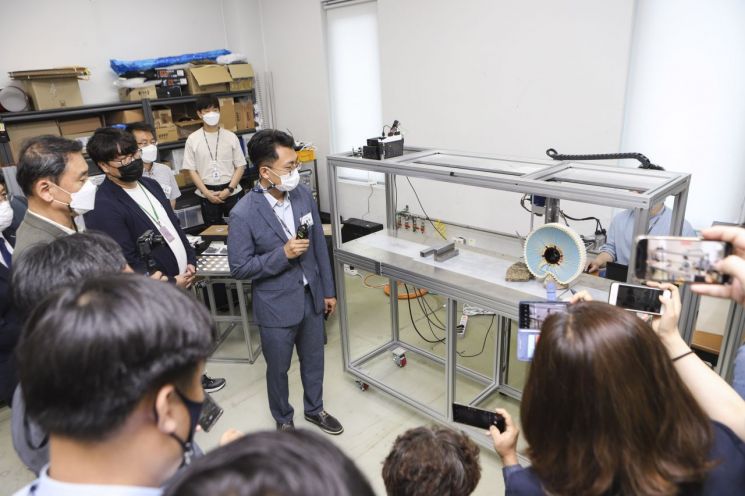 Robotic wheelchair under development by the Korea Institute of Machinery and Materials. Photo by Korea Institute of Machinery and Materials
[Asia Economy Reporter Kim Bong-su] On the morning of the 15th, at an experimental building of the Korea Institute of Machinery and Materials (KIMM) in Daejeon, a wheel with thick, round spokes suddenly changed shape upon encountering stairs, climbing up by crushing the steps without disturbing its center of gravity. Sensors checked the angle of the obstacle ahead and adjusted the wheel spokes, allowing it to change shape like a water droplet to overcome the obstacle.
Although still in the basic stage, this was a demonstration of a robotic wheelchair being developed by KIMM. This wheelchair is designed to allow disabled users to safely pass over rocks or stairs without any mechanical or human assistance. A KIMM official said, "By using the principle of surface tension to change the shape of the wheel, the center of gravity does not shift, enabling safe boarding for the disabled. After passing obstacles, the wheel tightens again to maintain its original shape," adding, "We expect commercialization within 3 to 4 years to distribute it to disabled individuals."
On this day, KIMM attracted attention by unveiling a large number of robot technologies aimed at 'realizing social value' and contactless services. The first to be revealed was the ankle-type and knee-type robotic prosthetic leg systems. Last year, KIMM developed an ankle-type prosthetic leg that considers the user's body weight and joint and muscle movements to enable free walking and motion, which has been distributed to national veterans and others. The newly unveiled knee-type robotic prosthetic leg is scheduled for distribution starting next year after clinical trials in the second half of this year. Unlike existing products that only support body weight, it is designed to naturally support weight when the user intends to walk forward or backward or sit down. Notably, its price is about 20 million KRW, much cheaper compared to overseas products costing between 70 million and 100 million KRW. KIMM is working with the Ministry of Patriots and Veterans Affairs to provide institutional support so that these products can be purchased and used by disabled veterans without financial burden through national subsidies.
The robotic prosthetic hand, capable of various hand movements and priced lower than foreign counterparts, also drew interest. The fingers flex freely depending on the object being grasped, and the user's muscle signals are measured to perform desired movements. The number of motors has been reduced and the device has been lightweighted to minimize cost. The research team also developed an analysis system that measures muscle signals to predict user movements with over 90% accuracy. The robotic prosthetic hand is expected to be commercialized by 2025.
A wearable muscle device capable of lifting 1.5 kg, or 1500 times its own weight of about 1 gram, made from lightweight fabric was also unveiled. When electric signals were applied to short artificial fibers like stockings, they contracted with elasticity, lifting the heavy weight attached. The wearable muscle fitted on a mannequin appeared suitable for assisting elderly or disabled individuals with weak muscles in lifting heavy objects or performing movements. A KIMM official explained, "Adding technology to recognize the user's intent could create a more convenient wearable muscle system."
The robot system for remote collection of COVID-19 test samples is already near commercialization. When a test subject places their face in front of the robot installed on site, a remote doctor monitors the face via camera and uses a remote control device to insert a swab into the nose to collect the sample, which is then retrieved. KIMM explained that this system is suitable for rapid testing in places difficult for medical staff to access, such as deep-sea fishing vessels, remote areas, islands, or severely contaminated zones.
An autonomous tractor using an affordable satellite navigation system costing one-fifth of existing prices is being developed to reduce labor in aging rural areas by autonomously plowing fields and harvesting crops. It can drive with a straight-line error of only 10 cm, making it suitable for crop management and farming. A versatile gripper robot capable of naturally grasping any object?from tofu and eggs to chickens?adding water to a pot and turning on a gas stove to cook was also introduced. Additionally, a hand robot that mimics an elephant's trunk to grasp objects with unusual surface shapes like screwdrivers and can perform precise scissor-like cutting just like a human hand was unveiled, attracting attention.
Park Sang-jin, director of KIMM, said, "We are committed to developing warm robot technologies for a future where humans and robots coexist," adding, "In April, we established the Innovation Robot Center to consolidate research and development capabilities for securing future core robot technologies at the national level and to establish systematic technology development strategies and roadmaps."
© The Asia Business Daily(www.asiae.co.kr). All rights reserved.

















