Number of Doctorate Degree Holders Increased by 5.4%p Year-on-Year
Proportion of Doctorate Degree Holders Under 34 Years Old at 41.7%
Female Doctorate Degree Holders Also Increased to 38.4%
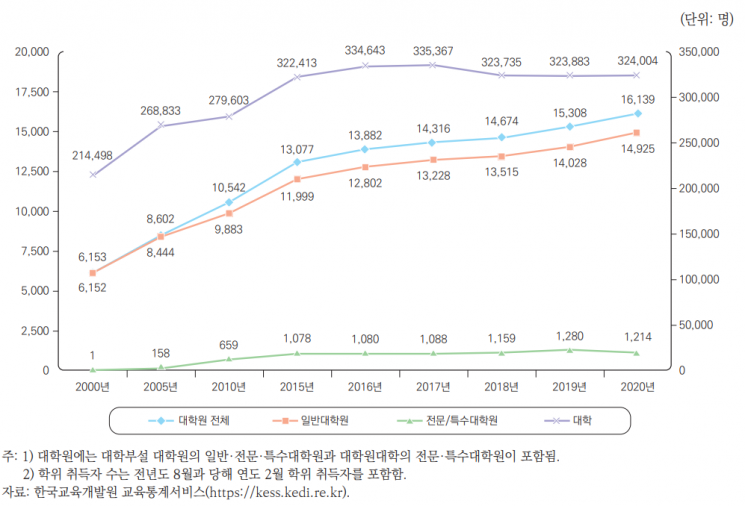
[Asia Economy Reporter Han Jinju] As demand for high-level talent expands, the number of new domestic doctoral degree recipients is steadily increasing. By age group, those under 34 and those over 50 have significantly increased.
On the 15th, the Korea Research Institute for Vocational Education and Training analyzed the characteristics and employment status changes of new domestic doctoral degree recipients and found that the total number of doctoral degree recipients last year was 16,139, a 5.4% increase compared to the previous year.
While the number of university graduates has decreased, the demand for high-level R&D personnel has increased, leading to a steady rise in the number of doctoral degree recipients. In particular, the proportion of engineering degree recipients has steadily increased since 2017 (25.6%), reaching 28.0% last year.
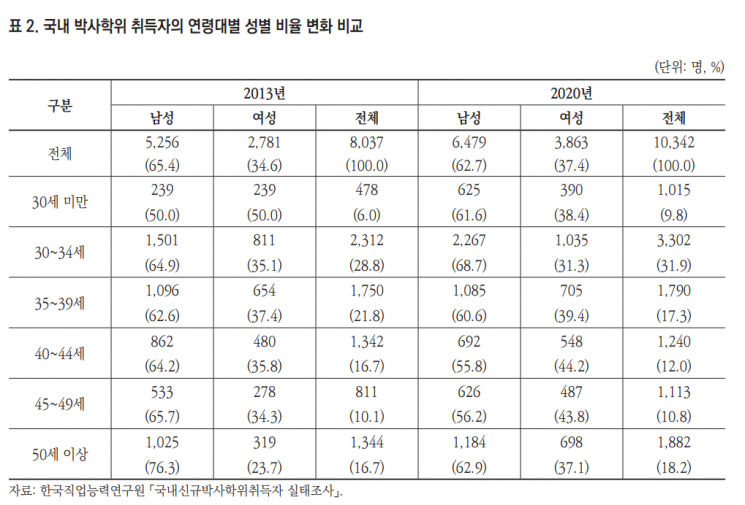
By age group, the increase in the proportions of those under 34 and those over 50 is notable. Last year, the proportion of those under 34 was 41.7%, up 6.9 percentage points compared to 2013. The proportion of those over 50 also increased by 1.5 percentage points compared to seven years ago (16.7%).
The proportion of female doctoral degree recipients also rose from 32.8% in 2012 to 38.4% last year. By major, the education field had the highest proportion at 75.4%, while engineering accounted for only 12.8%.
Among doctoral degree recipients in the humanities, social sciences, engineering, and natural sciences, the number of people obtaining their doctorates while working has steadily increased. As of last year, the proportion of those working while studying was ▲social sciences 74.9% ▲humanities 65.7% ▲engineering 42.1% ▲natural sciences 39.7%, in that order.
The proportion of those who secured employment or decided on a career path as part-time lecturers or postdoctoral researchers after obtaining their doctorate was 69.5%, showing a decreasing trend. Among those whose career paths were decided at the time of degree completion, the proportion of those fully devoted to study was 26.7% across all fields. The humanities and social sciences were significantly lower at 14.5% and 10.1%, respectively, compared to engineering (40.1%) and natural sciences (42.3%).
Since 2018, the proportion of regular employees among doctoral degree recipients has increased, while the proportion of temporary and daily workers has decreased. However, in the humanities and social sciences, the proportion of regular employees increased, whereas in engineering and natural sciences, the proportion of temporary workers increased.
Baek Won-young, Associate Research Fellow at the Korea Research Institute for Vocational Education and Training, said, "For the quantitative increase of high-level talent in Korea to lead to enhanced university research capabilities and national competitiveness, measures for the cultivation and utilization of high-level human resources are needed from the perspectives of education, industry, and the labor market." He added, "It is necessary to first grasp the current status of high-level talent cultivation and conduct surveys and diagnoses on the quantity and quality of personnel needed in the labor market."
© The Asia Business Daily(www.asiae.co.kr). All rights reserved.
![Clutching a Stolen Dior Bag, Saying "I Hate Being Poor but Real"... The Grotesque Con of a "Human Knockoff" [Slate]](https://cwcontent.asiae.co.kr/asiaresize/183/2026021902243444107_1771435474.jpg)

















